<?xml version="1.0" encoding="UTF-8"?>
<feed xmlns="http://www.w3.org/2005/Atom">
  <title type="text">Intermountain Histories</title>
  <updated>2026-04-17T19:32:15+00:00</updated>
  <generator uri="http://framework.zend.com" version="1.12.20">Zend_Feed_Writer</generator>
  <link rel="alternate" type="text/html" href="https://www.intermountainhistories.org/"/>
  <link rel="self" type="application/atom+xml" href="https://www.intermountainhistories.org/items/browse?output=rss2"/>
  <id>https://www.intermountainhistories.org/</id>
  <author>
    <name>Intermountain Histories</name>
    <uri>https://www.intermountainhistories.org</uri>
  </author>
  <link rel="hub" href="https://pubsubhubbub.appspot.com/"/>
  <entry>
    <title type="html"><![CDATA[Abbey of Our Lady of the Holy Trinity: Trappist Cistercian Monastery]]></title>
    <summary type="html"><![CDATA[<p><strong><em>The Our Lady of the Holy Trinity Abbey was a monastery in Huntsville was one of the oldest monasteries in the Western United  States. At its peak, the monastery produced honey, bread, and grandfather clocks. Due to the decreasing number of monks, the monastery closed in 2017.  </em></strong></p><img src="https://www.intermountainhistories.org/files/fullsize/ca47ab2d2a54662a1f03fa4e327b3caa.jpg" alt="Abbey of Our Lady of the Holy Trinity" /><br/><p><span style="font-weight:400;">The Our Lady of the Holy Trinity of Abbey was a Trappist Monastery in Huntsville, Utah. The abbey was founded in 1947, just two years after the end of the Second World War. After the war, monasteries around the country were filling up. The Monastery of the Gethsemani Abbey in Kentucky opened five monasteries around the country, one of which was in Huntsville. </span>
<span style="font-weight:400;">When the Monastery of Huntsville was first founded in 1947, it had 32 monks living in military Quonset huts until the abbey could be built. However, the grand abbey was never built and the monks continued to live on the land for the next six decades in a smaller building. By 1956, over 80 monks had been added to the monastery's ranks.  The Monastery in Huntsville was one of the biggest properties in the Weber County area, totaling up to 1,860 acres of land. Father Patrick Boyle said of his time at the abbey, “We had 84 monks and we would pick up fifty-thousand bales of hay by hand … we had more energy than sense.” </span>
<span style="font-weight:400;">Until the mid-1990s, the monks built a life and a business, selling the farm’s beef, hay, honey, peanut butter, cereal, bread, and crafted items including clocks that were hand built by Brother Nicholas. While farming the land, the monks established a tradition of leaving one alfalfa field to bloom in order for the bees to have a plentiful food source. They credited the alfalfa with making particularly delicious honey.</span>
<span style="font-weight:400;">However, decreasing price of goods affected their bottom line. The two tons of milk and 450 dozen eggs they sold daily was not enough to sustain the community. Even the sale of calves, steer, bales of alfalfa and barley, wheat and pastuage was insufficient to reach their needed profit margin. Soon, monks began to leave the monastery. The bakery, known for its wheat and raisin bread, shut down in 1996 because there were no longer enough monks to run it. The heavy work of running the farm was outsourced and performed by college students.</span>
<span style="font-weight:400;">The lack of new recruits meant that only a handful of aging monks were present for their daily prayer in the near empty chapel. As Father Brendan Freeman explained, “You’re supposed to have elderly Monks, then the middle age monks, and then juniors, but if no one comes then it’s just all elderly monks.” </span>
<span style="font-weight:400;">In the 2000s, the monastery had only 10 monks. In 2013, Father Brendan Freeman came to the monastery with an assignment of trying to sell and conserve the property. The monks voted “yes” to the sale. On August 27, 2017 the final mass was celebrated and ended the 70 years of the monastery’s service. Reverend Patrick Boyle left the Abbey of Our Lady of the Holy Trinity in Huntsville to join his brethren at St. Joseph Villa Catholic nursing home in Salt Lake City. Boyle, 89, who had served in the abbey for 67 years, was the last of the remaining monks to leave the compound.</span>
<span style="font-weight:400;">The land was purchased by Huntsville local, Bill White, to save the land as open space. </span><span style="font-weight:400;">The current owners, Bill White and Wynstonn Wangsgard, continue agricultural production, particularly alfalfa, barley, and cattle grazing. Honeybees are also still kept on the property. </span><span style="font-weight:400;">The Summit Land Conservancy, Park City’s local accredited land trust, and Ogden Valley Land Trust came together to help protect the property.</span> <span style="font-weight:400;">The farm serves as a wildlife corridor and provides potential habitat for two endangered species, the Canada lynx and yellow-billed cuckoo, and ten migratory avian species. The property is also used as rangeland and wintering ground for elk and deer. Owls, hawks, and wild turkeys thrive in the wooded areas at the edge of the farm’s pastures. </span></p><p><em><strong><a href="https://www.intermountainhistories.org/items/show/694">For more (including 5 images) view the original article</a></strong></em></p>]]></summary>
    <published>2022-11-04T02:59:12+00:00</published>
    <updated>2026-04-17T19:32:15+00:00</updated>
    <link rel="alternate" type="text/html" href="https://www.intermountainhistories.org/items/show/694"/>
    <id>https://www.intermountainhistories.org/items/show/694</id>
    <author>
      <name>Stephen Sokol and Caeser Mayren, Weber State University</name>
    </author>
  </entry>
  <entry>
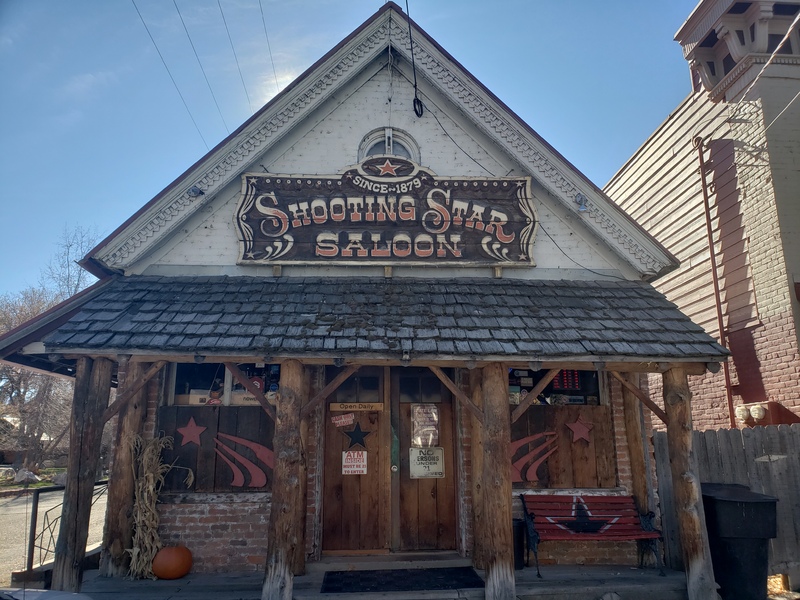
    <title type="html"><![CDATA[The Shooting Star Saloon]]></title>
    <summary type="html"><![CDATA[<p><strong><em><span style="font-weight:400;">The Shooting Star Saloon is one of the oldest operating businesses in the state of Utah. Its unique interior and local folklore have made it a staple in Huntsville.</span></em></strong></p><img src="https://www.intermountainhistories.org/files/fullsize/19b659e1fc460dfe79186664309c32a2.jpg" alt="The Shooting Star Saloon" /><br/><p><span style="font-weight:400;">The building from which the Shooting Star Saloon currently operates was erected around 1850 as a mercantile shop for Native Americans, fur trappers, fur traders, herders, and the small number of settlers of the town. The mercantile switched to a saloon in 1879, originally named Hoken’s Hole for its owner Hoken Olsen. Hoken (1862-1945) was the son of Norwegian immigrants who had converted to Mormonism and moved to Utah in 1876 as part of the “gathering.” He became a citizen of the US in 1902. Hunstville’s early newspapers are filled with accounts of how “Slippery Hoken'' had once more been fined for selling liquor without a license, or sent to jail for the same. His wife Maria Bingham operated the saloon when Hoken was in jail. </span>
<span style="font-weight:400;">During the Prohbition Era in the 1920s, alcoholic drinks and card games were enjoyed in secret and a confectionery shop for children was displayed on the top floor of the saloon. However, Hoken continued to be arrested for selling liquor without a license. In 1929, Hoken sold his property to Ben Wood. In 1940, Huntsville’s Carl Stokes moved the saloon upstairs from the basement and named it the Shooting Star. </span>
<span style="font-weight:400;">The Saloon has had several owners these past years. It is known for its menu, consisting of burgers and hotdogs. There is even a combination of hot dog and burger called the Star Burger. And, of course, there is a full bar of alcoholic beverages. The Saloon’s decor is also of note. Inside, the ceiling is completely covered in dollar bills and has a St. Bernard’s head stuffed and displayed on the wall, belonging to the deceased Buck, a previous Guinness World Record holder for St. Bernards because of its size and weight. “Buck” is a gift from Ernie Schultz who ran a bar in West Yellowstone, Montana. The tables were once used by monks at the nearby Trappist monastery. Antique items such as registers can also be found in the Saloon. </span>
<span style="font-weight:400;">The origins of the dollar bill ceiling are unclear. Some say that Whiskey Joe, a patron from decades orevious, began the trend of tacking dollar bills on the ceiling. Whiskey Joe was notorious for never having enough money to pay for his beer. He'd give the bartender a dollar toward his tab, and it would be tacked up on the ceiling. Whiskey Joe would show up the next day with an additional dollar, and so it continued. A few have claimed that Whiskey Joe continues to haunt the saloon. </span><span style="font-weight:400;">However, Whiskey Joe's legacy is debated. Huntsville librarian Carol Stoker claims that her uncle Charlie left the first dollar bill on the ceiling on his way to fight in World War II, declaring he would use it when he came back. Whatever the real story, today hundreds of dollar bills blanket the ceiling. Names of patrons penned on each one are a sign that they'll be back for another round. </span></p><p><em><strong><a href="https://www.intermountainhistories.org/items/show/683">For more (including 4 images) view the original article</a></strong></em></p>]]></summary>
    <published>2022-10-26T19:17:54+00:00</published>
    <updated>2026-04-17T19:32:15+00:00</updated>
    <link rel="alternate" type="text/html" href="https://www.intermountainhistories.org/items/show/683"/>
    <id>https://www.intermountainhistories.org/items/show/683</id>
    <author>
      <name>Julia Johnson, Weber State University</name>
    </author>
  </entry>
</feed>