<?xml version="1.0" encoding="UTF-8"?>
<feed xmlns="http://www.w3.org/2005/Atom">
  <title type="text">Intermountain Histories</title>
  <updated>2026-04-17T19:32:14+00:00</updated>
  <generator uri="http://framework.zend.com" version="1.12.20">Zend_Feed_Writer</generator>
  <link rel="alternate" type="text/html" href="https://www.intermountainhistories.org/"/>
  <link rel="self" type="application/atom+xml" href="https://www.intermountainhistories.org/items/browse?output=rss2"/>
  <id>https://www.intermountainhistories.org/</id>
  <author>
    <name>Intermountain Histories</name>
    <uri>https://www.intermountainhistories.org</uri>
  </author>
  <link rel="hub" href="https://pubsubhubbub.appspot.com/"/>
  <entry>
    <title type="html"><![CDATA[Latina Legacies in Carbon County: Latinas in Carbon County]]></title>
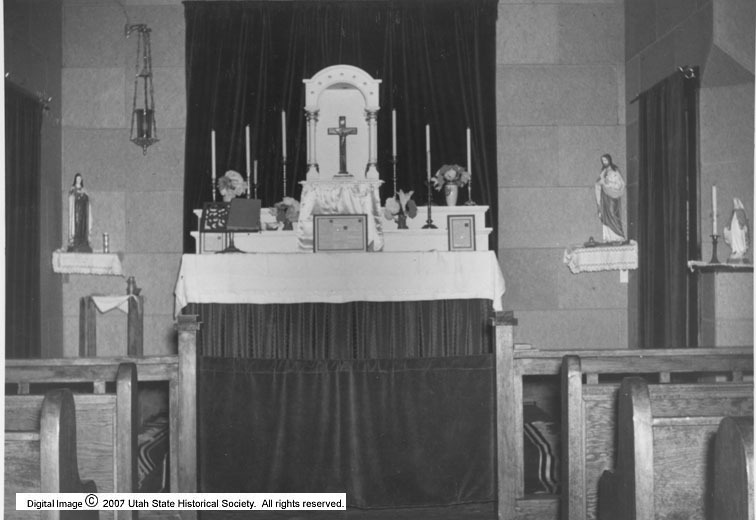
    <summary type="html"><![CDATA[<p><strong><em>Despite the difficulties Latinas faced as they settled in coal mining camps, their sacrifices, efforts, and love for their families helped them create culturally welcoming spaces that transformed Carbon County and Notre Dame De Lourdes Church.</em></strong></p><img src="https://www.intermountainhistories.org/files/fullsize/39750120fdd4c704d1a40815308e4861.jpg" alt="Notre Dame de Lourdes Catholic Church" /><br/><p><span style="font-weight:400;">Although Carbon County is known for its cultural diversity, Latinas who resided there often faced discrimination from other groups of immigrants. Angelina Gutierrez recalled “there was so much prejudice against the Spanish people. We could not go anywhere. There [were] about six couples of us [who] went to a bar over here. And they threw us out ‘no Mexicans allowed.’” Rosa Sandoval also remembers the discrimination she faced as a fifth grader by an Italian girl. In addition to facing discrimination, Latinas faced the constant threat of becoming widows and single mothers due to the hazardous working conditions in the mines. When Leticia Ramos’ husband died, she had to assume new responsibilities for the care of her family. She remembers, “[It was] scary because…I didn’t know how to do nothing…I didn’t do nothing but have kids and take care of them.” In situations where their husbands were laid off or passed away because of mine conditions, Latinas became not only caretakers, but breadwinners. They worked in “local hospitals, salons, as secretaries, house cleaners, and cooks.” Even though they were extremely busy, Latinas found refuge in the Catholic Church. </span>
<span style="font-weight:400;">However, Latinas faced challenges even within the refuge of the church. Irish and Italians dominated the Catholic church and as a result Latinas often faced “discrimination and exclusion” there. Latinas did not seclude themselves, but instead claimed their dignity. Patricia Sanchez stated, “we are going to show them that we are people, that we are human. We’re not a little rodent that just goes and hides.” Latinas’ strong stance brought changes to Notre Dame Catholic church. For example, mass started to be held in Spanish. Latinas also formed a church choir where they sang “Alabanzas” in important ceremonies like weddings. Even more revolutionary was the ethnic celebrations incorporated into the church, such as quinceaneras and the Virgin of Guadalupe day. Passing on such traditions was important to Latinas. One of the ways they preserved their culture was by creating fond memories with their children. For instance, Rose remembered spoiling her grandkids with tortillas. In addition, Latinas carved out spaces for their children to learn about their traditions; the Notre Dame Catholic School was such a space. It wasn’t easy paying tuition, but Latinas valued education and they wanted to reinforce their traditional religious values in their kids. As a result of their parents’ sacrifices, Latin children in private school did not face the same type of discrimination they would have faced in public schools. Like the Notre Dame Catholic church, the Notre Dame Catholic school became a place of inclusion and safety for all nationalities thanks to the efforts of Latinas.</span></p><p><em><strong><a href="https://www.intermountainhistories.org/items/show/659">For more (including 3 images) view the original article</a></strong></em></p>]]></summary>
    <published>2022-09-19T20:42:53+00:00</published>
    <updated>2026-04-17T19:32:14+00:00</updated>
    <link rel="alternate" type="text/html" href="https://www.intermountainhistories.org/items/show/659"/>
    <id>https://www.intermountainhistories.org/items/show/659</id>
    <author>
      <name>Sarai Silva, Brigham Young University</name>
    </author>
  </entry>
  <entry>
    <title type="html"><![CDATA[Spanish Speaking Saints and La Rama Mexicana]]></title>
    <summary type="html"><![CDATA[<p><strong><em>When immigrants from Mexico and other Latin American countries began settling in Utah in the early 20th century, many of them converted to the Church of Jesus Christ of Latter-Day Saints. Eventually, La Rama Mexicana—The Mexican Branch—was formed in the early 1920’s.</em></strong></p><img src="https://www.intermountainhistories.org/files/fullsize/931d18be56d3a7b42375f62d3021becb.jpg" alt="&quot;Mexicans Await New Church&quot;" /><br/><p><span style="font-weight:400;">At the end of the 19</span><span style="font-weight:400;">th</span><span style="font-weight:400;"> century, Utah was in an economic boom that would change the course of its history. With the completion of the transcontinental railroad in 1869, thousands of immigrants flooded the state to work in mines that sprung up across Utah. Although initially very few of these immigrants were from Mexico, the start of the Mexican Revolution in 1910 resulted in Mexicans fleeing north to escape conflict. Although the Immigration Acts of 1917 and 1924 had placed quotas on the number of people that could immigrate from each country, the need for laborers allowed a large number of Mexicans to obtain a permit to temporarily enter the country. The number of Spanish-speaking immigrants in Utah continued to grow throughout the following decades as they sought work on railroads, on farms, and in mines. While the 1890 census only recorded 19</span> <span style="font-weight:400;">Mexican people living in Utah, by 1920 there were 1,083. These immigrants created a thriving hub of Hispanic culture in Salt Lake City’s west side. </span>
<span style="font-weight:400;">After their arrival in Salt Lake City, many of these immigrants were converted and baptized as members of The Church of Jesus Christ of Latter-Day Saints. However, very few of them spoke English, the predominant language of the Church in Utah. Noticing a problem, Juan Ramon Martinez, Margarito Buatista, and Francisco Solano sought permission from church leadership to hold meetings in Spanish. In April of 1921, the first Spanish meeting was held in a rented restaurant. The meeting was attended by 19 Latter-Day Saints and 33 non-members being taught by missionaries. On May 15, 1923, the members of this congregation were made into an official branch called La Rama Mexicana. </span>
<span style="font-weight:400;">Two years later the branch began meeting in available rooms in the 6th Stake meetinghouse. In 1950, La Rama Mexicana received their own meetinghouse after three years of construction. Just a decade later, the brach became the Lucero Ward. The population of Spanish-speakers continued to grow and, as of 2019, there were 58 Spanish-speaking wards and branches in Utah.</span></p><p><em><strong><a href="https://www.intermountainhistories.org/items/show/643">For more (including 3 images) view the original article</a></strong></em></p>]]></summary>
    <published>2022-09-09T18:27:12+00:00</published>
    <updated>2026-04-17T19:32:14+00:00</updated>
    <link rel="alternate" type="text/html" href="https://www.intermountainhistories.org/items/show/643"/>
    <id>https://www.intermountainhistories.org/items/show/643</id>
    <author>
      <name>Maggie Allen, Brigham Young University</name>
    </author>
  </entry>
  <entry>
    <title type="html"><![CDATA[The Guadalupe Center: A Haven for Hispanics]]></title>
    <summary type="html"><![CDATA[<p><strong><em>In 1966, on 346 West 100 South in Salt Lake City, UT, the Guadalupe Center opened its doors to the public. Started by Father Jerald H. Merrill, this center was a haven for the Hispanic population of Salt Lake.</em></strong></p><img src="https://www.intermountainhistories.org/files/fullsize/2c2175e6d7758e3defd53960ca070a96.jpg" alt="The Guadalupe Center" /><br/><p><span style="font-weight:400;">In 1961, Father Jerald Merrill, a Catholic priest, was assigned to the “Our Lady of Guadalupe” Mission on the West side of Salt Lake City, Utah. With the mission having recently received a new building, all adults of the parish were invited to monthly meetings of the Guadalupana Society—a group which met to discuss problems pertaining to their mission. A few months after his arrival, Father Merrill created a branch of the Guadalupana Society that focused on social programs meant to solve the Hispanic community’s problems. In a rented room underneath the Rio Grande Hotel, Merrill and other members founded the precursor to the Guadalupe Center. Later, in 1966 and under the direction of Manuel G. Martinez and Oliver Ulibarri, volunteers helped to open a larger version of the center on 346 West 100 South with faith that the center would become a focal point for local Hispanics. </span>
<span style="font-weight:400;">After its opening, the center focused on projects for the economic and professional development and well-being of the Hispanic community. The Westside Catholic Credit Union focused on helping local members of the community to build capital. The Voluntary Improvement Program taught English and other valuable skills. A cooperative store was opened to serve poorer families in the area. Additionally, the Utah Nonprofit Housing Corporation collaborated with multiple churches and cooperative associations in the area to rehabilitate houses in the inner city region. The Guadalupe Center served as a clearinghouse for information on these and other services and coordinated support for the city’s Hispanic population. The center was also the birthplace for Hispanic activist group SOCIO, which helped pave the way for Latino civil rights throughout Utah. </span>
<span style="font-weight:400;">To create capital that could be reinvested into these programs, leaders decided to open La Morena Café as part of the center. Started just six months after the opening of the Guadalupe Center, La Morena proved immensely valuable. In addition to the profit it eventually generated, enough to support many of the Center’s programs, it also unified a diverse set of people—both hispanic and non-hispanic—in the community through its warm atmosphere and authentic Mexican cuisine. La Morena became a welcoming place for all and encapsulated the vision of  Father Merrill through its ability to unify the community. </span>
<span style="font-weight:400;">In 1986, after their rented lot was bought to build the Triad center, the original Guadalupe Center closed its doors. However, the center’s aims extended into the Guadalupe School which continues to operate today. The school provides personalized education for children with a focus on those in the Latinx community. For Latinx adults the center provides English classes, citizenship classes, and career planning. Since its inception, the spirit of the Guadalupe Center and those who founded it continue to better the lives and welfare of members of the Utah Latinx community. </span></p><p><em><strong><a href="https://www.intermountainhistories.org/items/show/642">For more (including 2 images) view the original article</a></strong></em></p>]]></summary>
    <published>2022-09-09T16:01:16+00:00</published>
    <updated>2026-04-17T19:32:14+00:00</updated>
    <link rel="alternate" type="text/html" href="https://www.intermountainhistories.org/items/show/642"/>
    <id>https://www.intermountainhistories.org/items/show/642</id>
    <author>
      <name>Lindsey Meza, Brigham Young University </name>
    </author>
  </entry>
  <entry>
    <title type="html"><![CDATA[The &quot;Most Important Event on Campus&quot;: 1974 Chicano Conference at BYU]]></title>
    <summary type="html"><![CDATA[<p><strong><em>In 1974, Brigham Young University hosted a symposium on Chicanos. From coast to coast, law enforcement, social and government workers, educators, healthcare workers, and others interested in the Spanish-American population attended in order to understand and address the problems facing Spanish-speaking Americans. </em></strong></p><img src="https://www.intermountainhistories.org/files/fullsize/01fd33b1d3bd410bfc117f5ed59fa188.jpg" alt="Armando Morales at the Chicano Conference" /><br/><p>In 1974, the United States was home to over 11 million Spanish-speaking people. The Chicano Conference was organized in order to “understand and confront the challenges facing Spanish-speaking people in their struggle for education and for finding their proper place in American society.” These problems varied, but included an unemployment rate that was two to three times the national level, disease, and cultural barriers. </p><p>The basis of the conference included workshops, speakers, and lessons. Leaders of this conference included a wide array of professors and leaders of the Chicano movement, as well as leaders in The Church of Jesus Christ of Latter-day Saints. Organizers highlighted non-stereotypical problems and people of the Spanish-speaking community in order to bring awareness to the disservice that such stereotypes were causing Spanish-speaking people. </p><p>One of these “non-stereotypical” scenarios was originally told by Dr. Clark Knowlton and was included in the opening statement. In a neighborhood in El Paso, Texas, gang members rallied together to raise enough money to give a college scholarship to one of their own. When that member failed his first quarter, fellow gang members woke him up at four in the morning to study, escorted him to and from class, and made sure that he completed his homework. That member passed his second quarter and went on to complete a law degree. Such a story emphasized one of the overarching messages of the conference: Spanish-speaking Americans were fighting battles that were important to the whole country and were not exclusively their own. </p><p>The symposium’s keynote speaker, Utah Governor Calvin Rampton, ended the conference by expressing his desire for greater action and initiative on behalf of Spanish-speakers within the state. He mentioned the involvement of the Spanish Speaking Organization for Community, Integrity, and Opportunity in creating government councils, as well as a 20-hour training on the culture of Spanish-speakers for law enforcement.</p><p>The Chicano Conference of 1974 was a part of the larger Chicano Movement which began in the 1960s. The movement itself was multifaceted and evolved overtime, but it originated in Mexican Americans rejecting previous efforts to assimilate into white American identity and instead embracing their heritage. The Chicano Conference—the “most important event on campus” at the time—followed previous conferences in Utah, such as the Chicano Conference in 1971 sponsored by Chicanas Unidas and the Chicano Conference in 1973 sponsored by La Raza; both groups were coalitions of Chicanos in the state. The Conference of 1974 joined previous efforts to alleviate pressure of assimilation as well as increase understanding of the needs of Hispanics in Utah.</p><p><em><strong><a href="https://www.intermountainhistories.org/items/show/641">For more (including 2 images) view the original article</a></strong></em></p>]]></summary>
    <published>2022-09-09T00:37:20+00:00</published>
    <updated>2026-04-17T19:32:14+00:00</updated>
    <link rel="alternate" type="text/html" href="https://www.intermountainhistories.org/items/show/641"/>
    <id>https://www.intermountainhistories.org/items/show/641</id>
    <author>
      <name>Lindsey Meza, Brigham Young University </name>
    </author>
  </entry>
  <entry>
    <title type="html"><![CDATA[Sugar Beets and Sheep: Hispanic Migrant Labor in Utah]]></title>
    <summary type="html"><![CDATA[<p><strong><em>The migrant labor of Hispanics has been vital to the economy of Utah since the 20th century, but these workers remain one of the most vulnerable populations within the state, at one point making less than those on welfare. Their history here in Utah provides further context for current discussions on migrant labor and immigration. </em></strong></p><img src="https://www.intermountainhistories.org/files/fullsize/75781beb5df04b5715e2f94497e033ce.jpg" alt="In the Field till Sundown" /><br/><p>In the beginning of the 20th century, Utah became one of the largest domestic American producers of sugar through sugar beet farming. The industry extended into neighboring states as well. The workers who planted and harvested those beets were mainly migrant Mexican and Mexican-American laborers. Migrant Hispanic laborers were also heavily involved with sheep herding and harvesting onions, potatoes, tomatoes, apples, cherries, pears, raspberries, and apricots. They made the backbone of the agricultural and meat industries in the state then and today, Latino workers (mainly of Mexican descent) continue to be vital to these industries. The history of Hispanic migrant labor in Utah demonstrates both their importance and their vulnerability that has persisted since the start of the 1900s. </p><p>Mexican migrant workers became integral to the economy of Utah starting in the early 20th century with the sugar industry, where many of the workers were concentrated in Garland, Utah. In 1918, reports from the Salt Lake Tribune detailed conditions of workers such as lack of running water, stoves, and toilets. Hispanic families nonetheless invested in the community by assisting in the construction of schools in Garland. Additionally, the wives of Hispanic families often worked for families nearby, further contributing to the economy’s function. Many of these migrant workers eventually left due to the lack of economic mobility and low wages, although others at the time incorrectly surmised that the workers’ departure was due to an inability to assimilate their Mexican-Catholic culture into the anglo-Mormon communities. </p><p>Poor conditions and treatment was a trend for migrant workers throughout the state. Accordingly, workers did not highly regard Utah. In the 1950s, Utah began an intense effort to attract more migrant workers. At the same time, the state created strict systems that would require those migrant workers to return to their country when the harvest was over. Despite these efforts to draw more workers to the state, many migrant workers did not return to Utah for a second harvest in response to continually poor conditions including lack of education opportunities for their children, poor housing situations, and no health care services. During that same decade, the Mexican Consulate in Salt Lake City officially reported that violations of the housing codes, unfair wages, and labor abuses were being experienced by migrant workers throughout Utah. In 1957 the state created the “Annual Worker Plan” to oversee migrant labor in Utah and prevent bad treatment. New regulations by the state also lessened the number of children being employed in the fields, a practice that had been prevalent since the 1920s. Hispanic groups formed other programs on behalf of migrant laborers. In 1969, due to internal lobbying by Hispanics in Utah and nationwide labor movements, the Utah government started an official program called the Utah Migrant Council on behalf of migrant laborers of all races and ethnicities. </p><p>Despite these efforts, Utah continues to struggle with attracting enough migrant workers. In 1986 a research team found that disease and illness were most prevalent among migrant workers in Utah. They face low birth weight, high rates of infant mortality, tuberculosis, and measles. In 2010, the Utah Migrant and Seasonal Farm Worker Coalition estimated that workers entering the state earned an annual income of $7,500 per year. Migrant workers constitute the most vulnerable population within the state—the middle men between economic prosperity and economic disparity for Utah and who have little opportunity for educational, economic, or social advancements in the state.</p><p><em><strong><a href="https://www.intermountainhistories.org/items/show/640">For more (including 3 images) view the original article</a></strong></em></p>]]></summary>
    <published>2022-09-08T22:51:01+00:00</published>
    <updated>2026-04-17T19:32:14+00:00</updated>
    <link rel="alternate" type="text/html" href="https://www.intermountainhistories.org/items/show/640"/>
    <id>https://www.intermountainhistories.org/items/show/640</id>
    <author>
      <name>Lindsey Meza, Brigham Young University</name>
    </author>
  </entry>
  <entry>
    <title type="html"><![CDATA[SOCIO: Reforming Utah’s Approach to Hispanic Education]]></title>
    <summary type="html"><![CDATA[<p><strong><em>As the Hispanic population in Utah continued to develop during the course of the 20th century, so did the growing community’s efforts to secure equal opportunities for education. The Spanish-speaking Organization for Community, Integrity, and Opportunity (SOCIO) was a grassroots organization which—for over 20 years—helped develop reforms aimed at improving educational opportunities and experiences for the Hispanic population of Utah. </em></strong></p><img src="https://www.intermountainhistories.org/files/fullsize/87f3fb6aa0429ff6c17bcf3b73d0b8ae.jpg" alt="SOCIO Float Shows Cultural Heritage" /><br/><p>At a December 1967 meeting held in the Guadalupe Center, over 150 people—including Father Jerald H. Merrill from the “Our Lady of Guadalupe” Mission and Bishop Orlando Rivera from the Lucero Spanish Ward of the Church of Jesus Christ of Latter-day Saints (LDS, or Mormon)—came together to discuss the possibility of forming a grassroots organization aimed at advocating for the welfare of Hispanics in Utah. The name of this operation would be the Spanish-speaking Organization for Community, Integrity, and Opportunity (SOCIO). On March 21, 1968 SOCIO formally began operations on behalf of the over 50,000 Hispanics residing in Utah. </p><p>SOCIO initial activities centered on improving conditions for Spanish-speaking children in Utah schools. From the start of the organization, members of SOCIO recognized the disparity between Hispanic children and their classmates, with over half of Spanish-speaking students dropping out of school in 1969. SOCIO helped increase the number of children attending school through proposals to implement bilingual programs, hire bilingual teachers, and address the specific needs of minority children. This raised the ratio of minority teachers by 263 percent in a span of just 5 years. They also succeeded in creating leadership opportunities for Hispanics and increased the number of Spanish-speaking persons on the Salt Lake School District Board of Education. SOCIO continued into the 1970s with such success. However, due to the high school dropout rate of Hispanic students still being above 50 percent, SOCIO created the Committee on Education in order to lobby for more representation in administrators, as well as Chicano student scholarships. </p><p>When SOCIO started, there were about five Chicano students attending the University of Utah, making up approximately .02 percent of the total student body. The notable lack of minorities in the student body of the university led to a bill that would use leftover funds in Utah as scholarship money for underrepresented populations. When the bill was proposed on a Thursday to the Utah legislature, it was rejected. On Friday, SOCIO decided to get involved and convinced different churches in the area to have their members appeal to their legislators on behalf of the bill. That weekend, legislators across Utah were inundated with so many calls that on Sunday at midnight, the president of the Utah Senate called the president of SOCIO, Ricardo Barbero, to have a meeting the next day regarding the bill. By Tuesday the bill had been passed. SOCIO’s lobbying power as a grassroots organization had varying levels of success, but indelible progress such as this bill was being made. </p><p>By 1981, funding became a growing problem for SOCIO with no plausible solution. Previous efforts to rally funding from church organizations, businesses, and the government—along with a membership fee—proved insufficient. By 1990, SOCIO stopped operations. SOCIO’s contributions to the education of Hispanic children persists in the form of Latino scholarships and continued programs aimed at serving the needs of Spanish-speaking children.</p><p><em><strong><a href="https://www.intermountainhistories.org/items/show/639">For more (including 3 images) view the original article</a></strong></em></p>]]></summary>
    <published>2022-09-08T17:42:28+00:00</published>
    <updated>2026-04-17T19:32:14+00:00</updated>
    <link rel="alternate" type="text/html" href="https://www.intermountainhistories.org/items/show/639"/>
    <id>https://www.intermountainhistories.org/items/show/639</id>
    <author>
      <name>Lindsey Meza, Brigham Young University </name>
    </author>
  </entry>
  <entry>
    <title type="html"><![CDATA[SOCIO: Advocating for Hispanics in Utah ]]></title>
    <summary type="html"><![CDATA[<p><strong><em>As the Hispanic population in Utah continued to develop during the course of the 20th century, so did the growing community’s efforts to secure equal opportunities for education, representation, and economic welfare. The Spanish-speaking Organization for Community, Integrity, and Opportunity (SOCIO) was a grassroots organization which for over 20 years helped develop reforms aimed at improving educational, economic, social, and political circumstances for the Hispanic population of Utah. </em></strong></p><img src="https://www.intermountainhistories.org/files/fullsize/e9b161375213b85f06121b5fc9b4c60c.jpg" alt="Float for SOCIO in Utah Parade" /><br/><p>At a December 1967 meeting held in the Guadalupe Center, over 150 people—including Father Jerald H. Merrill from the “Our Lady of Guadalupe” Mission and Bishop Orlando Rivera from the Lucero Spanish Ward of the Church of Jesus Christ of Latter-day Saints (LDS, or Mormon)—came together to discuss the possibility of forming a grassroots organization aimed at advocating for the welfare of Hispanics in Utah. The name of this operation would be the Spanish-speaking Organization for Community, Integrity, and Opportunity (SOCIO). On March 21, 1968 SOCIO formally began operations on behalf of the over 50,000 Hispanics residing in Utah. </p><p>SOCIO started as a grassroots organization seeking to ensure the civil rights of Hispanics in Utah. For decades, Hispanics had faced varying levels of racism and discrimination. In the mid-1960s, many struggled to thrive in Utah’s growing economy. Discrimination was persistent in new private-sector job markets, and many lacked the skills and training for the new jobs and industries. These issues were at the forefront of SOCIO concerns. </p><p>Several other organizations shared SOCIO’s goals and concerns and focused on helping Hispanics, mainly Mexicans, navigate financial and social problems in Utah. However, SOCIO differed from other Chicano Civil Rights efforts in the Southwest in its approach to protecting and edifying the Spanish-speaking population. They made it a point to avoid confrontational methods of protest and activism and instead worked with the systems already in place in order to include Hispanics in leadership and fix the rules and regulations that were negatively affecting them. In this sense, they focused on rectifying the causes of challenges rather than alleviating negative outcomes as previous Hispanic rights organizations in Utah had. </p><p>SOCIO focused its attention on creating representation in both governmental and professional markets. They created several skill training programs aimed at increasing Hispanic self-sufficiency and included clerical skills, math and grammar skills, construction training, and even the Minority Women Employment Program which worked to train Hispanic women for occupations such as plumbing. Furthermore, SOCIO helped implement permanent offices in the Utah government such as the Governor's Advisory Council on Hispanic Affairs whose specific aim was to serve as the voice of Utah’s Spanish-speaking population at a bureaucratic level. They also proposed the formation of a Utah Migrant Council, whose task would be to care for migrants who came each year for agricultural labor. Efforts such as these helped to create an expectation within the Hispanic community of representation on the bureaucratic level. </p><p>However, by 1981, funding became a growing problem for SOCIO with no plausible solution. Previous efforts to rally funding from church organizations, businesses, and the government—along with a membership fee—proved insufficient. By 1990, SOCIO stopped operating, but not without making a lasting impact on both the educational, social, and economic systems in Utah as seen through the continuation of changes such as the Office of Hispanic Affairs.</p><p><em><strong><a href="https://www.intermountainhistories.org/items/show/638">For more (including 3 images) view the original article</a></strong></em></p>]]></summary>
    <published>2022-09-07T18:31:34+00:00</published>
    <updated>2026-04-17T19:32:14+00:00</updated>
    <link rel="alternate" type="text/html" href="https://www.intermountainhistories.org/items/show/638"/>
    <id>https://www.intermountainhistories.org/items/show/638</id>
    <author>
      <name>Lindsey Meza, Brigham Young University</name>
    </author>
  </entry>
  <entry>
    <title type="html"><![CDATA[Our Lady of Guadalupe Mission: Catholicism and Hispanics in Utah]]></title>
    <summary type="html"><![CDATA[<p><strong><em>As the Spanish-speaking population of Salt Lake exploded in the beginning of the twentieth century, the need for a Catholic mission to better minister to members and protect them from other missionary efforts resulted in the Our Lady of Guadalupe mission. </em></strong></p><img src="https://www.intermountainhistories.org/files/fullsize/7496cac3a9eb22aee98d622cb4485883.jpg" alt="Sisters of Perpetual Adoration" /><br/><p>In the first half of the twentieth century, religious diversity within Salt Lake was growing along with ethnic diversity. Saint Patrick’s Catholic Parish dedicated itself to ministering to Italian Catholics. However, Father Francis Alva noticed a distinctive lack of accommodation for Spanish-speaking patrons, many of whom hailed from New Mexico. Beginning in 1920, Father Alva held mass in Spanish. Concurrently, he wrote to the Catholic Diocese asking for a separate school and church to be formed in the “mission style” to adjust to the city’s demographics. He recommended that this mission be called Our Lady of Guadalupe—a clear reference to Mexico’s patron saint. </p><p>The need for Spanish-speaking priests was not fulfilled until 1927, when Father Perfecto Arrellano joined Saint Patrick’s parish. For the next three years, the mission experienced a quick turnover of four Spanish-speaking priests until 1930. While the mission went through a revolving door of priests, Mexican nuns—refugees from tension between the Catholic church and the Mexican government—kept the mission afloat. Called Las Madres (The Mothers), were sent to Salt Lake to start and maintain school programs for the mission’s children. They became so busy with these new duties that their superiors reprimanded them for not keeping a twenty-four-hour vigil of the Holy Eucharist, as was required by their order. </p><p>In 1930, Father Collins came to Guadalupe. Despite not knowing Spanish, Father Collins immediately began his ministry over the predominantly Spanish-speaking congregation. His commitment to learning Spanish and the congregants’ culture endeared him to those in the mission. As the Great Depression continued, the mission’s budget was extremely limited, but the mission still provided space to hold activities and celebrations, as well as sponsor a Boy Scout troop. It was also in meetings held by the mission that members of the mission envisaged community outreach programs such as Spanish Speaking Organization for Community, Integrity, and Opportunity—an organization that advocated for the welfare of Hispanics in Utah during the latter half of the twentieth century. In 1944, as the mission grew to accumulate more than 1800 members, the Church officially raised the mission to become Our Lady of Guadalupe parish from West Temple and 500 West to 100 and 600 South.</p><p><em><strong><a href="https://www.intermountainhistories.org/items/show/637">For more (including 3 images) view the original article</a></strong></em></p>]]></summary>
    <published>2022-09-07T16:44:21+00:00</published>
    <updated>2026-04-17T19:32:14+00:00</updated>
    <link rel="alternate" type="text/html" href="https://www.intermountainhistories.org/items/show/637"/>
    <id>https://www.intermountainhistories.org/items/show/637</id>
    <author>
      <name>Lindsey Meza, Brigham Young University</name>
    </author>
  </entry>
  <entry>
    <title type="html"><![CDATA[“This Gathering”: Hispanics in Monticello 1900-1950 ]]></title>
    <summary type="html"><![CDATA[<p><strong><em>Due to external pressures and free land, several Hispanic families moved to Monticello and the surrounding San Juan County. The rural landscape allowed Hispanic families to keep more of their culture than those in more urban spaces which manifested in the construction of the first Hispanic Catholic Church in the state. </em></strong></p><img src="https://www.intermountainhistories.org/files/fullsize/548a81439a5af7bab727f49d8255c5d3.jpg" alt="St. Joseph&#039;s Cathedral Altar" /><br/><p>Compared to the rest of the American Southwest, Utah did not have as strong a Hispanic population until the twentieth century. Previously, Hispanic men had often moved to southern Utah to herd sheep and cattle for three quarters of the year before moving back home to their families. Beginning in the early 1900s, men started to bring their families to Monticello,​​ Utah. Many of the Hispanic families who moved to Monticello were citizens from small New Mexican villages or Colorado. Governments and policies in these states took away Hispanics’ land, water, and right to be involved in the government. This, along with the promise of “free” land in Monticello, spurred Hispanics to move. Groups of families began homesteading in the community with men being employed as sheep herders, ranch hands, and cowboys. </p><p>William Herman Gonzalez’s father was of the first family to move to the community in the early twentieth century. Born and raised in Monticello, Gonzalez remembers that “there was always deer meat and potatoes and plenty of tortillas.” Their small group of Hispanics attracted others to move to the community, “this gathering.” In times of need, the families of Hispanics would rally around one another, although they were mostly independent due to the layout of Monticello. As a consequence of the rural landscape, the Hispanics who moved to Monticello were able to keep more of their traditional culture in comparison to Hispanics who moved to urban landscapes. Many were strongly Catholic and raised money to build the first Hispanic Catholic church in Utah, St. Joseph’s. </p><p>The relations between Hispanics and Anglos in the community were complex because of the cultural barriers between Catholic and Mormon and Anglo and Hispanic. The two communities did not intermarry until the late 1940s. When World War II began, about 125 Hispanic men enlisted in the war. Upon their return, some were able to advance economically. One of them was Robert Nieves who opened the Highland Café in 1947. However, World War II and the Korean War created new dynamics in this southern part of the state and led many Hispanics in and around Monticello to move north for better paying jobs, bringing with them their strong sense of culture.</p><p><em><strong><a href="https://www.intermountainhistories.org/items/show/636">For more (including 4 images) view the original article</a></strong></em></p>]]></summary>
    <published>2022-09-07T16:29:42+00:00</published>
    <updated>2026-04-17T19:32:14+00:00</updated>
    <link rel="alternate" type="text/html" href="https://www.intermountainhistories.org/items/show/636"/>
    <id>https://www.intermountainhistories.org/items/show/636</id>
    <author>
      <name>Lindsey Meza, Brigham Young University</name>
    </author>
  </entry>
  <entry>
    <title type="html"><![CDATA[Railroads and Miners: Hispanic Migrant Labor in Utah]]></title>
    <summary type="html"><![CDATA[<p><strong><em>As both the mining and railroad industries began to develop in Utah, they depended upon the migrant labor of Hispanics. Despite this dependence, Hispanic migrant workers were often underpaid and living in conditions with no running water and little opportunity for education.</em></strong></p><img src="https://www.intermountainhistories.org/files/fullsize/08f4eeb0a222f4e2f824f1f0e6e898f8.jpg" alt="Jesus Arinaz: A Utah Copper Co. miner, Jesus Arinaz. " /><br/><p>Mining, railroads, and agriculture were the primary industries which attracted migrant Hispanic laborers (mostly Mexicans and Mexican-Americans) to Utah during the early-twentieth century to Utah. Beginning in 1910, the Mexican Revolution caused a large influx of Mexicans to flee to Utah to avoid violence and economic strain. In the ten years between the 1910 census to the 1920 census, the population of Hispanics in Utah grew from 166 to 1,666. This developing sector of the population was integral to the development of Utah as a whole by mining the state’s resources and building its railways. </p><p>Despite how much employers relied on their labor, Mexicans faced serious dicrimination. Often mining labor leaders held deep prejudices against Spanish-speakers, despite being fellow laborers. Anglos considered migrant miners a threat to labor strikes, and when Mexicans were hired to break a massive strike in Bingham Canyon, mining leaders blamed the migrant workers instead of the employers who underpaid them both. This prejudice, along with dismal living conditions, led many Hispanic workers to leave the state or work at the railroad during the Great Depression. However, after World War II some previous workers returned to the mines with their families and a desire to stay in Utah. The majority of Hispanic miners who worked in Bingham Canyon lived in Dinkeyville, a subsection of nearby Copperton. Mexican miners and their families were barred from living in the main city of Copperton and instead had to deal with the scarcity of water in Dinkeyville. However, Hispanic miners who had accumulated more experience in Bingham Canyon were eventually able to buy real estate in Copperton, which they often rented out to other Hispanic workers. </p><p>The railroad industry also relied on the labor of Mexican workers, in addition to other migrant workers. Mexicans were among the many immigrant laborers of various ethnicities who built the first transcontinental railroad in 1869. For most of the first half of the twentieth century, railroad workers consisted mainly of young, single men. While Bingham Canyon's Anglo American miners had been hostile to Mexicans, Vincent Mayer Sr., a migrant from Mexico, recalled living alongside Greek immigrants simply as fellow railroad workers out a life amid their shared poverty. His Greek neighbors, he remembered even 45 years later, had figured out how to make even weeds taste good. In regards to living conditions for railroad workers, Mayer remembered always being seated in the back of the theater and not being able to eat in many of the nicer restaurants due to his race. As more railroad workers brought their families to live with them, some utilized discarded railroad cars as their homes. These railroad cars had no running water and were often covered in soot from the railroad. </p><p>As early as 1910, Hispanics created different organizations to alleviate some of the issues facing migrant Hispanic workers. The Mexican Cruz Azul (Mexican Blue Cross) in Bingham City provided monetary support to individuals and families. In addition, they sponsored cultural and social events for the Hispanic community. This led to a unification among Hispanics of different countries, although many migrant workers originated from Mexico. The Mexican Consulate, created in 1912 and centered in Salt Lake City, also worked to solve unfair treatment for Mexicans, and it often worked on behalf of all Hispanics.</p><p><em><strong><a href="https://www.intermountainhistories.org/items/show/635">For more (including 5 images) view the original article</a></strong></em></p>]]></summary>
    <published>2022-09-07T16:03:14+00:00</published>
    <updated>2026-04-17T19:32:14+00:00</updated>
    <link rel="alternate" type="text/html" href="https://www.intermountainhistories.org/items/show/635"/>
    <id>https://www.intermountainhistories.org/items/show/635</id>
    <author>
      <name>Lindsey Meza, Brigham Young University</name>
    </author>
  </entry>
</feed>