<?xml version="1.0" encoding="UTF-8"?>
<feed xmlns="http://www.w3.org/2005/Atom">
  <title type="text">Intermountain Histories</title>
  <updated>2026-04-17T19:32:12+00:00</updated>
  <generator uri="http://framework.zend.com" version="1.12.20">Zend_Feed_Writer</generator>
  <link rel="alternate" type="text/html" href="https://www.intermountainhistories.org/"/>
  <link rel="self" type="application/atom+xml" href="https://www.intermountainhistories.org/items/browse?output=rss2"/>
  <id>https://www.intermountainhistories.org/</id>
  <author>
    <name>Intermountain Histories</name>
    <uri>https://www.intermountainhistories.org</uri>
  </author>
  <link rel="hub" href="https://pubsubhubbub.appspot.com/"/>
  <entry>
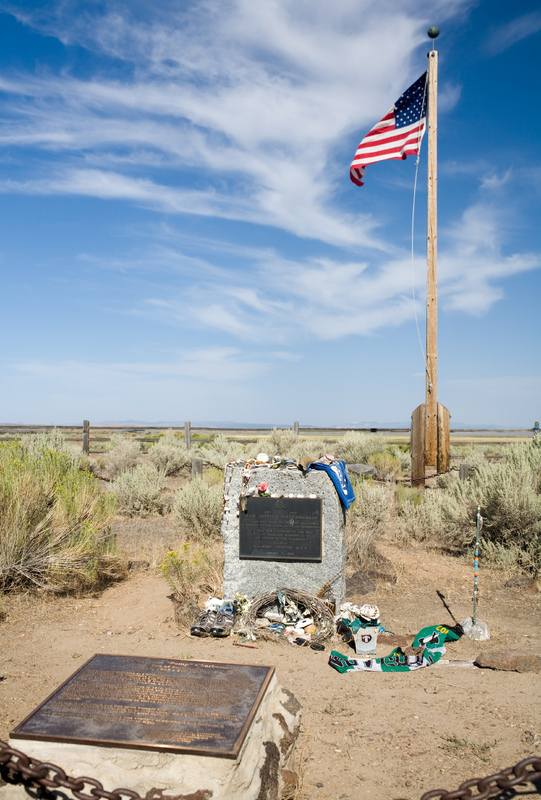
    <title type="html"><![CDATA[Jean-Baptiste Charbonneau’s Grave]]></title>
    <summary type="html"><![CDATA[<p><strong><em>Born in February 1805, Jean-Baptiste Charbonneau accompanied the Lewis and Clark Expedition as an infant before becoming a fur trader, guide, alcalde, and then a hotel manager in California.</em></strong></p><img src="https://www.intermountainhistories.org/files/fullsize/01db17a0c012fd0f8a8d4751a3066439.jpg" alt="Charbonneau gravesite" /><br/><p>Jean-Baptiste Charbonneau, son of Sacagawea and Toussaint Charbonneau, accompanied his parents on Meriwether Lewis and William Clark’s expedition for the Corps of Discovery. Although a small infant, he made the entire trek from North Dakota to the Pacific Coast and back to the Mandan Villages on the Knife River. After Sacagawea’s death in December 1812, William Clark legally adopted Jean-Baptiste and his little sister Lisette. Clark provided an education for the two children at a Catholic boarding school in St. Louis. This education opened up numerous opportunities for Jean-Baptiste throughout his life.
As an adult, Jean-Baptiste spent a substantial amount of time in Europe where he learned additional languages and skills. Returning to America, he joined the fur trade, working as a trapper with the Rocky Mountain Fur Company. His extensive knowledge of the terrain enabled him to serve as a guide for explorers, as well as for the Mormon Battalion on their route from Leavenworth to San Diego in 1846 during the Mexican–American War.
While in California, Charbonneau worked as an alcalde (mayor), panned for gold, provided interpretation services, and operated a hotel in Auburn, California. After the American Civil War and toward the end of his life, Charbonneau worked odd jobs until he learned about gold and silver strikes in Idaho and Montana. On his way to the mining rushes he traveled through Danner, Oregon, but shortly after crossing the Jordan Creek and the Owyhee River, he fell ill (likely of pneumonia) and died at sixty-one years old. Oregonians memorialized Charbonneau by erecting and dedicating a plaque to him in Danner. His place of death is located just over the border of Oregon and is close to the Lemhi Shoshone Nation of Idaho, the likely birthplace of his mother, Sacagawea.</p><p><em><strong><a href="https://www.intermountainhistories.org/items/show/585">For more (including 3 images) view the original article</a></strong></em></p>]]></summary>
    <published>2022-04-09T07:02:41+00:00</published>
    <updated>2026-04-17T19:32:12+00:00</updated>
    <link rel="alternate" type="text/html" href="https://www.intermountainhistories.org/items/show/585"/>
    <id>https://www.intermountainhistories.org/items/show/585</id>
    <author>
      <name>Taylor Mansfield, Brigham Young University</name>
    </author>
  </entry>
  <entry>
    <title type="html"><![CDATA[Sacagawea Birthplace]]></title>
    <summary type="html"><![CDATA[<img src="https://www.intermountainhistories.org/files/fullsize/da84f7bf86bc77b6104e4c22670e6f59.jpg" alt="Lemhi" /><br/><p>More than two centuries have passed since the Lewis and Clark Expedition traveled to the Pacific and back, and the expedition and its members continue to generate interest. Aside from the leaders, Meriweather Lewis and William Clark, Sacagawea may be the best-known member of the expedition. When she was around sixteen years old, she gave birth to her first child, Jean Baptiste Charbonneau. Two months later she departed on the expedition with her husband and child in tow. She made it the entire journey while carrying and tending to her child and simultaneously helping the efforts of the expedition.
Her main role in the expedition was as an interpreter between the party and Shoshones. She was likely born into the Lemhi Shoshone tribe around 1788, and her birthplace may have been somewhere between Kenney Creek and Agency Creek in Tendoy, Idaho.  Since the Lemhi Shoshone lived along the river, they fished for salmon as a dietary staple. From a young age, Sacagawea contributed to her family by gathering and preparing food. Recently, oral histories have made claims Sacagawea was Hidatsa, not Shoshone. While there is currently some controversy surrounding precisely what tribe Sacagawea came from, history does not dispute that Sacagawea lived part of her life with the Hidatsas. She did tell Lewis and Clark that she was captured while traveling across the Rocky Mountains and adopted into the Hidatsa Nation as a child and her new name was Sacagawea, meaning Bird Woman or Eagle Woman. It is likely that she learned additional agricultural skills from the Hidatsas, where she resided until her marriage as a plural wife to Toussaint Charbonneau, a French-Canadian explorer.
Although forced to leave her childhood homeland in Idaho, Sacagawea returned to the Lemhi Valley with Lewis and Clark, reuniting with the Shoshones. She then reunited with her tribal family in the place she was born and celebrated her reunion with her brother Cameahwait before continuing her journey to the Pacific.</p><p><em><strong><a href="https://www.intermountainhistories.org/items/show/584">For more (including 3 images) view the original article</a></strong></em></p>]]></summary>
    <published>2022-04-08T04:34:55+00:00</published>
    <updated>2026-04-17T19:32:12+00:00</updated>
    <link rel="alternate" type="text/html" href="https://www.intermountainhistories.org/items/show/584"/>
    <id>https://www.intermountainhistories.org/items/show/584</id>
    <author>
      <name>Taylor Mansfield, Brigham Young University</name>
    </author>
  </entry>
  <entry>
    <title type="html"><![CDATA[Sacagawea’s Alleged Gravesite]]></title>
    <summary type="html"><![CDATA[<p><strong><em>American icon Sacagawea was instrumental in the Lewis and Clark expedition. However, the circumstances surrounding her death and even when and where she died are murky and hotly contested.</em></strong></p><img src="https://www.intermountainhistories.org/files/fullsize/0deae90765f5318925358d115eade6c9.jpg" alt="Mountains at Wind River" /><br/><p>Sacagawea has inspired countless girls to have greater strength and courage in their lives. Around age 16, this Lemhi Shoshone young woman joined Lewis and Clark on their journey across the American West, acting as an interpreter and occasional guide. She did this while carrying her baby Jean Baptiste upon her back. What the Lewis and Clark Expedition achieved was impressive, but what Sacagawea achieved seems heroic and unimaginable.
Despite the important place Sacagawea holds in American history, the stories regarding her death remain contested. Some insist she died in December 1812 in South Dakota at the age of 24. Others contend she lived to age 96 and died on the Wind River Indian Reservation in Wyoming Territory in 1884, reunited with her Shoshone kinsmen. The Hidatsa use Sacagawea (meaning Bird Woman or Eagle Woman). Shoshones used Sacajawea (meaning boat-pusher).
Between 1825 and 1828, William Clark created a list of the expedition members of the Corps of Discovery and identified where each of them were. Next to Sacagawea’s name he wrote, “dead.” This matches other primary accounts that record one of Toussaint Charbonneau’s wives died at Fort Manuel in December 1812. Additional primary sources indicate that Clark adopted her two children, Jean Baptiste and Lisette, the following year in 1813, offering additional credence to the notion that she likely died in December 1812.
Clark’s record conflicts with Shoshone oral histories about Bird Woman’s life and death recorded by University of Wyoming historian Grace Hebard in the early twentieth century. She interviewed several Shoshones and recorded their traditions. They described Sacagawea having left her abusive husband Charbonneau and traveled to Colorado territory to live with her cousins, the Comanches. She purportedly married a warrior named Jerk Meat, raised a family, and eventually returned home to live out her twilight years with the Eastern Shoshone on the Wind River Reservation. There she lived out her last days with her son Jean Baptiste and eventually died in peace. Her son is also reported by some to have died there and to be buried in an unmarked grave somewhere in the Wind River Mountain range. Other accounts clearly identify Jean Baptiste Charbonneau as dying in Danner, Oregon in 1866.
It is conceivable that these oral accounts attributed to the Bird Woman may also refer to another Shoshone woman who had life experiences similar to Sacagawea. No matter where her final resting place is, the grave in the Ethete cemetery marked with Sacajawea’s name stands as an important historical landmark because of how it honors this great Shoshone woman, pays tribute to her memory, and recognizes her contributions to history. While the spot marked here at the Sacajawea Cemetery near Fort Washakie, Wyoming may not be her actual resting place, it is still a remarkable place to visit for any American who wants to celebrate the life of this great explorer, or for any woman who wants to connect with a true heroine.</p><p><em><strong><a href="https://www.intermountainhistories.org/items/show/579">For more (including 3 images) view the original article</a></strong></em></p>]]></summary>
    <published>2022-03-12T09:50:55+00:00</published>
    <updated>2026-04-17T19:32:12+00:00</updated>
    <link rel="alternate" type="text/html" href="https://www.intermountainhistories.org/items/show/579"/>
    <id>https://www.intermountainhistories.org/items/show/579</id>
    <author>
      <name>Sara Grundvig, Brigham Young University</name>
    </author>
  </entry>
</feed>
