<?xml version="1.0" encoding="UTF-8"?>
<feed xmlns="http://www.w3.org/2005/Atom">
  <title type="text">Intermountain Histories</title>
  <updated>2026-04-17T19:32:17+00:00</updated>
  <generator uri="http://framework.zend.com" version="1.12.20">Zend_Feed_Writer</generator>
  <link rel="alternate" type="text/html" href="https://www.intermountainhistories.org/"/>
  <link rel="self" type="application/atom+xml" href="https://www.intermountainhistories.org/items/browse?output=rss2"/>
  <id>https://www.intermountainhistories.org/</id>
  <author>
    <name>Intermountain Histories</name>
    <uri>https://www.intermountainhistories.org</uri>
  </author>
  <link rel="hub" href="https://pubsubhubbub.appspot.com/"/>
  <entry>
    <title type="html"><![CDATA[Heart of Polyurethane: Barney Clark and the Artificial Heart]]></title>
    <summary type="html"><![CDATA[<p><strong><em>In December 1982, Dr. Barney B. Clark received the first permanent total artificial heart implant in a human. The implant was his last resort and his last chance of survival after being diagnosed with congestive heart failure in 1979. He lived with the Jarvik-7 artificial heart for 112 days. Today a memorial in Provo honors his courage.</p></strong></p><img src="https://www.intermountainhistories.org/files/fullsize/1687587c565e27f65f087d15a77083a3.jpg" alt="Marker Close Up" /><br/><p><span style="font-weight:400;">In December 1982, Dr. Barney Clark pioneered medical research by receiving the first artificial heart implant. Clark had suffered from congestive heart failure for several years and his condition was worsening. Despite the experimental nature of the implant and the potential for significant personal suffering, Clark wanted to receive the artificial heart. It represented his last remaining option for survival, and he aimed to contribute to the medical community’s knowledge in the field of heart disease. Before the surgery, Clark had been treated by several doctors. He tried many treatments including experimental medications. Because of the limited number of heart donors, he was too old and too sick to be eligible for an organic heart transplant. The Jarvik-7 artificial heart was his last resort. </span>
<span style="font-weight:400;">The artificial heart was heavily researched before Clark received it. Dr. William C. DeVries had been researching it since 1967. DeVries had implanted the Jarvik-7 heart in cadavers and in many live animals, including calves. Every detail of the preparation and the surgery were outlined almost two years before Clark was selected to receive the implant. </span>
<span style="font-weight:400;">The implant surgery was initially successful. On Thursday, December 2, 1982 the Provo Daily Herald reported that after seven hours of surgery the artificial heart was working well and that it had given Clark “the blood pressure of an 18-year-old.” Despite the successful surgery, Clark soon started facing complications. He experienced an air leak in his lung, seizures, a broken valve on the artificial heart, and frequent nose bleeds. The doctors fixed these problems as they arose, although they were never able to figure out the cause of the seizures. In March 1983 Clark suffered from aspiration pneumonia, which sent him back into the intensive care unit. He never recovered. On March 23, 1983 Clark “suffered from multiple organ system failure that caused a circulatory collapse” and passed away at 10:02 that night. Researchers concluded that the artificial heart itself had not killed him, but complications associated with the surgery and prior conditions had. </span>
<span style="font-weight:400;">Clark survived with the Jarvik-7 total artificial heart for 112 days, though experiencing great suffering. Many regard Barney Clark as a pioneer and a hero. A memorial in Provo honors his legacy. Today the artificial heart is used as a temporary placement while heart failure patients wait for a heart donor.</span></p><p><em><strong><a href="https://www.intermountainhistories.org/items/show/768">For more (including 2 images) view the original article</a></strong></em></p>]]></summary>
    <published>2024-01-20T07:16:05+00:00</published>
    <updated>2026-04-17T19:32:17+00:00</updated>
    <link rel="alternate" type="text/html" href="https://www.intermountainhistories.org/items/show/768"/>
    <id>https://www.intermountainhistories.org/items/show/768</id>
    <author>
      <name>Caitlin Zollinger, Brigham Young University</name>
    </author>
  </entry>
  <entry>
    <title type="html"><![CDATA[St. Benedict&#039;s Hospital<br />
]]></title>
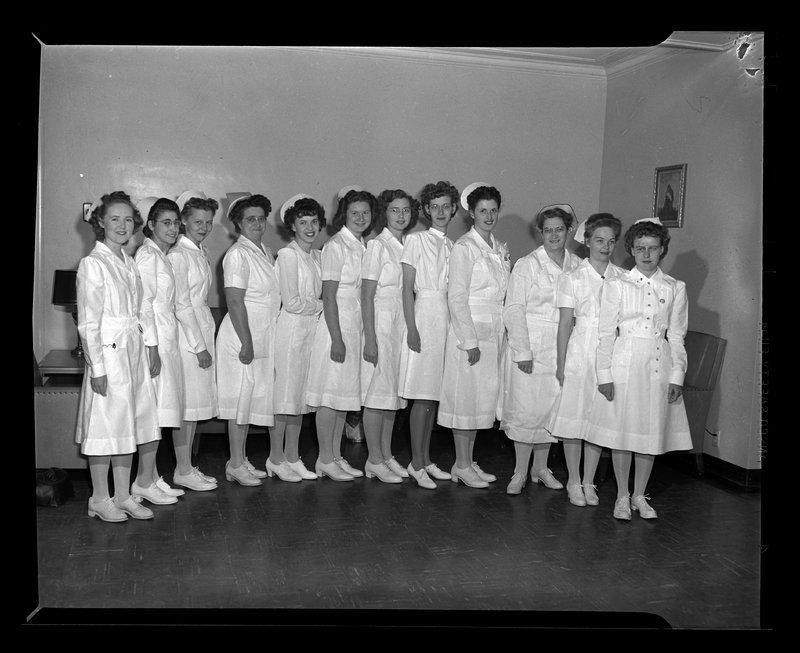
    <summary type="html"><![CDATA[<p><strong><em>St. Benedict’s Hospital was the second built in Ogden to serve a growing population. </p></strong></p><img src="https://www.intermountainhistories.org/files/fullsize/99dda60824788bf8f6efc951093e4aab.jpg" alt="Nurses graduating from the school at St. Benedict’s Hospital" /><br/><p>In 1940, the people of Weber County became aware that the hospitals they already had in the area could not accommodate the growing population brought in by the new Hill Air Force Base. Despite the need, however, there was no public money for a new hospital, and so they were left with two options, a government hospital or a Catholic hospital. Monsignor Giroux of St. Joseph’s Catholic Church was asked to find a group willing to bring a new hospital to the Ogden area, and he found a convent in St. Joseph, Minnesota that had over 1,200 sisters. The Mother Superior was initially hesitant until Monsignor Giroux showed up on their doorstep a week later stating, “I came to get my sisters.”  Shortly after that, the Sisters of St. Benedict of St. Joseph, Minnesota came to Ogden with the intention of funding, building, and staffing the hospital themselves.</p><p>In August of 1944, they broke ground and construction was completed in May of 1946. From May to September the Sisters spent every day getting the hospital ready for its opening, doing tasks ranging from scrubbing new tile to making linens for the operating room. Upon the hospital's opening in September of 1946, the Sisters moved into both clinical and administrative roles within the hospital, lending their extensive expertise to delivering the level of care sorely needed in the Ogden community.</p><p>In the spring of 1947, the Sisters opened a nursing school based out of the hospital.  In 1966, the school moved to Weber State University and became the foundation for their Practical Nursing Program.  The last class graduated from the school at St. Benedict's Hospital in 1968; over 19 years it had put out 357 new nurses. In 1977, the hospital's success demanded an expansion and a new location, ending its 31 year home on top of the hill. After the sisters sold the building, it became St. Benedict’s Manor, a senior care facility, now a HUD Apartment.</p><p>A new hospital was built in South Ogden. That hospital was eventually sold by the sisters to become Ogden Regional. While no longer in the same place or run by the Sisters who built it, care is still given with same original mission: to care for the sick "as if they were Christ in person."</p><p><em><strong><a href="https://www.intermountainhistories.org/items/show/275">For more (including 5 images) view the original article</a></strong></em></p>]]></summary>
    <published>2019-02-07T02:42:59+00:00</published>
    <updated>2026-04-17T19:32:04+00:00</updated>
    <link rel="alternate" type="text/html" href="https://www.intermountainhistories.org/items/show/275"/>
    <id>https://www.intermountainhistories.org/items/show/275</id>
    <author>
      <name>Annika Shinn, Weber State University</name>
    </author>
  </entry>
</feed>