<?xml version="1.0" encoding="UTF-8"?>
<feed xmlns="http://www.w3.org/2005/Atom">
  <title type="text">Intermountain Histories</title>
  <updated>2026-08-18T15:52:34+00:00</updated>
  <generator uri="http://framework.zend.com" version="1.12.20">Zend_Feed_Writer</generator>
  <link rel="alternate" type="text/html" href="https://www.intermountainhistories.org/"/>
  <link rel="self" type="application/atom+xml" href="https://www.intermountainhistories.org/items/browse?output=rss2"/>
  <id>https://www.intermountainhistories.org/</id>
  <author>
    <name>Intermountain Histories</name>
    <uri>https://www.intermountainhistories.org</uri>
  </author>
  <link rel="hub" href="https://pubsubhubbub.appspot.com/"/>
  <entry>
    <title type="html"><![CDATA[Theodore Roosevelt and the Havasupai in the Grand Canyon: Story 2 of 8 of the President Theodore Roosevelt in the West Tour]]></title>
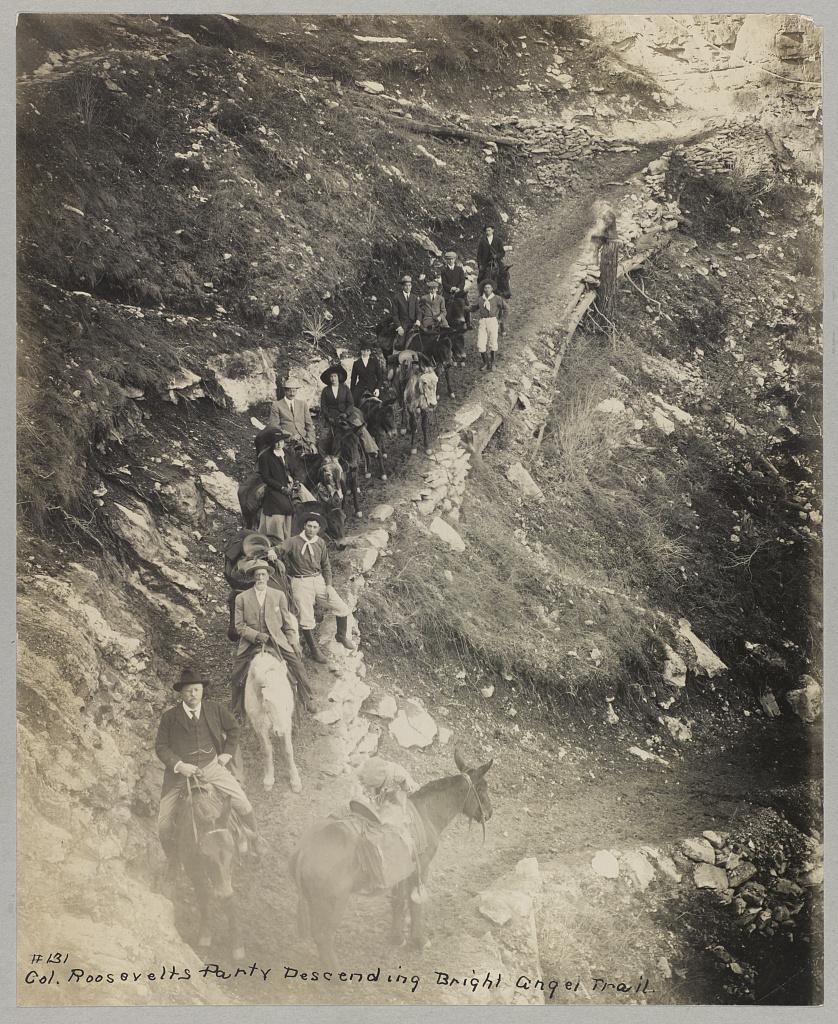
    <summary type="html"><![CDATA[<p><strong><em>President Theodore Roosevelt visits the Grand Canyon meeting the Havasupai Tribe. His efforts are making this landmark a National Park.</em></strong></p><img src="https://www.intermountainhistories.org/files/fullsize/81adde6a6a5c04daf97ec29b93d422ee.jpg" alt="Down a winding pathway, Theodore Roosevelt and others ride mules down Bright Angel Trail in the Grand Canyon" /><br/><p>Theodore Roosevelt traveled over 14,000 miles, visiting over 25 states, in the span of nine weeks in the early summer of 1903. His western tour was filled with speeches, commemorations, and his favorite thing to do: exploring the outdoors. His tours of Yosemite and Yellowstone are widely known, but in between them, he visited the Grand Canyon on May 6, 1903. He said, giving a speech, “In the Grand Canyon, Arizona has a natural wonder which, so far as I know, is absolutely unparalleled throughout the rest of the world.” Astounded, he said, “I shall not attempt to describe it, because I cannot. I could not choose words that would convey or that could convey to any outsider what that canyon is.” The majesty of Earth’s beauty there led him to explore more.
Riding a mule down Bright Angel Trail, he met two natives from the Havasupai tribe who lived in the Indian Garden with their families. For 1,000 years, the tribe lived in this region without outside contact, until Spanish priest Francisco Garces explored the area in 1776. As a result of the Santa Fe Railroad in the early 18th century, the Havasupai had increasingly more contact with other explorers and settlers. When Roosevelt and his regiment visited, he asked them to leave to make the canyon a National Park. To gain the status of a national park, all private development on the land would be illegal according to Congress. This resulted in the Havasupi’s relocation to a 518-acre reservation in Havasu Canyon instead.
Roosevelt was also concerned about the commercialization and exploitation of the land due to encroaching mining and timber interests. On June 8th, 1906, he signed the Antiquities Act, which authorized the president to “declare by public proclamation historic landmarks, historic and prehistoric structures, and other objects of historic or scientific interest that are situated upon the lands owned or controlled by the Government of the United States to be national monuments.” Subsequently, this act was used to establish the Grand Canyon National Monument on January 11th, 1908. It was made a National Park in 1919. Roosevelt Point and Trail were named in the President’s honor for the efforts he provided. A placard at Roosevelt Point reads another part from his speech advocating one request, “Leave it as it is. You can not improve on it. The ages have been at work on it, and man can only mar it. What you can do is to keep it for your children, your children's children, and for all who come after you, as one of the great sights which every American, if he can travel at all, should see.” Poetically, he wrote a letter to John Hay, former Secretary of State, summing up his experience on his Western tour and paying special attention to the Grand Canyon, “To me the most impressive piece of scenery I have ever looked at. I don’t exactly know what words to use in describing it. It is beautiful and terrible and unearthly. It made me feel as if I were gazing at a sunset of strange and awful splendor.” Today, almost 5 million tourists continue to explore this canyon that Roosevelt cared so profoundly to preserve.</p><p><em><strong><a href="https://www.intermountainhistories.org/items/show/924">For more (including 4 images) view the original article</a></strong></em></p>]]></summary>
    <published>2025-10-24T15:03:19+00:00</published>
    <updated>2026-08-18T15:52:34+00:00</updated>
    <link rel="alternate" type="text/html" href="https://www.intermountainhistories.org/items/show/924"/>
    <id>https://www.intermountainhistories.org/items/show/924</id>
    <author>
      <name>Jessika Cole, Brigham Young University</name>
    </author>
  </entry>
  <entry>
    <title type="html"><![CDATA[Creation of the Havasupai Reservation and Grand Canyon National Park]]></title>
    <summary type="html"><![CDATA[<p><strong><em>The Havasupai of Northern Arizona had little interaction with Europeans until the late 19th century. As financial and conservation interest in the Grand Canyon grew, the Havasupai way of life was challenged by ranchers, tourists, and the federal government.</em></strong></p><img src="https://www.intermountainhistories.org/files/fullsize/966687cc393cdabf8be377769dec7b81.jpg" alt="Boy at Havasu Falls, Grand Canyon" /><br/><p>For centuries, Havasupai Indians lived in Havasu Canyon and on the surrounding plateau. They lived in the canyon during the spring and summer and farmed corn, beans, peaches, melons, and cotton. In the winter, Havasupais moved to the plateau, hunting and gathering food. </p><p>In 1848, following the Mexican-American War, Mexico ceded territory that included Arizona to the United States. With the arrival of the railroad and miners seeking precious metals in the Grand Canyon, white settlers flooded the area. </p><p>Havasupais adapted, dressing in European-style clothing which freed up buckskins for trade with white settlers. They bought manufactured home goods and weapons. However, outside their traditional trading networks, the value of their goods decreased as they were brought into a national market. This was simultaneously met with a decline in their resource base, due largely to American expansion on the plateau. </p><p>In 1882, President Arthur relegated Havasupais to the canyon, declaring the plateau public land. The Havasupai were consigned the smallest reservation in the United States at the time: only 518 acres. They initially accepted this, likely under the impression that they would still have access to the plateau. They had also heard about the forced marches of the Navajo and feared government removal, wanting to keep at least some of their traditional land. Soon, the plateau was full of cattle ranchers and tourists heading to the South Rim of the Grand Canyon. Havasupai Billy Burro remembered that the whites “would bar the Supais from the water holes, the grazing lands, all of that… homesteaders and cattle owners put in lines, saying that they are not to roam that country anymore.”</p><p>Following the creation of the Grand Cañon Forest Reserve in 1893, Havasupais participated in government attempts to farm their valley more intensely. This did not prove enough of a replacement for their typical seasonal cycle and they returned to the plateau, dodging rangers and sometimes conflicting with game wardens and cattle ranchers in order to collect enough food. In a deposition to the Indian Claims Commission, Havasupai Mary Wescogame declared, “The Havasupai people want to get back here to the country they thought belonged to them. They want to bring some horses here; the whites told them to get out, never to come back… They were driven out, but they kept coming back.” Men also turned to seasonal wage labor, working on ranches, in mines, or on the railroad. </p><p>Grand Canyon National Park was created in 1919, and the park boundaries completely surrounded the Havasupai Reservation. In the following decades, the Havasupai lobbied to have their lands returned to them, rejecting government offers to sell the lands back to them for market value. In 1975, Congress passed the Grand Canyon National Park Enlargement Act. Part of the act returned over 180,000 acres to the Havasupai, forming the current Havasupai Reservation.</p><p><em><strong><a href="https://www.intermountainhistories.org/items/show/340">For more (including 4 images) view the original article</a></strong></em></p>]]></summary>
    <published>2019-09-24T01:12:16+00:00</published>
    <updated>2026-04-17T19:32:06+00:00</updated>
    <link rel="alternate" type="text/html" href="https://www.intermountainhistories.org/items/show/340"/>
    <id>https://www.intermountainhistories.org/items/show/340</id>
    <author>
      <name>Allie Patterson, Brigham Young University</name>
    </author>
  </entry>
</feed>
