<?xml version="1.0" encoding="UTF-8"?>
<feed xmlns="http://www.w3.org/2005/Atom">
  <title type="text">Intermountain Histories</title>
  <updated>2026-08-18T15:59:56+00:00</updated>
  <generator uri="http://framework.zend.com" version="1.12.20">Zend_Feed_Writer</generator>
  <link rel="alternate" type="text/html" href="https://www.intermountainhistories.org/"/>
  <link rel="self" type="application/atom+xml" href="https://www.intermountainhistories.org/items/browse?output=rss2"/>
  <id>https://www.intermountainhistories.org/</id>
  <author>
    <name>Intermountain Histories</name>
    <uri>https://www.intermountainhistories.org</uri>
  </author>
  <link rel="hub" href="https://pubsubhubbub.appspot.com/"/>
  <entry>
    <title type="html"><![CDATA[The Great Falls Portage]]></title>
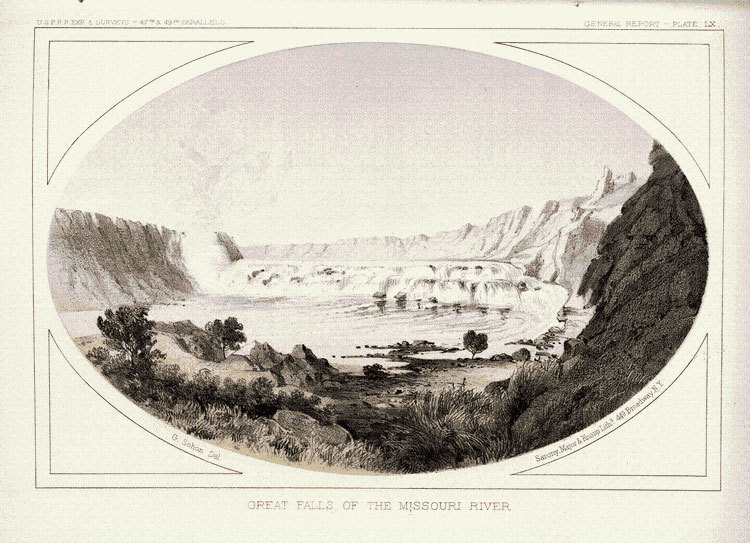
    <summary type="html"><![CDATA[<p><strong><em>In an unprecedented journey, the Lewis and Clark Expedition traveled nearly 8,000 miles across the newly-acquired Louisiana Purchase of the Northwestern half of the United States. Yet, of those 8,000 miles, the 21-mile on-foot portage around the Great Falls of the Missouri River were possibly the most gruesome and tiring of the entire voyage. </em></strong></p><img src="https://www.intermountainhistories.org/files/fullsize/649e436c528bb13cd37be0ee31b8deff.jpg" alt="&quot;Great Falls of the Missouri River&quot;" /><br/><p>The Lewis and Clark Expedition—or the Corps of Discovery, as it was officially known—reached the Great Falls of the Missouri River on June 13, 1805. The company was elated to arrive at the falls, becoming the “first white men to see the Great Falls of the Missouri River.” However, the grandeur and majesty of the falls meant that the company’s original path along the Missouri River was temporarily unsuitable for their trek. Consequently, they, along with all their cargo, would have to travel by land to circumvent the cascades. </p><p>The portage posed several challenges from unwelcome wildlife encounters to cached cargo and extreme physical exertion and injuries. When the corps realized that they would be unable to proceed by water, they spent several days creating wagons to tow their canoes, equipment and supplies. They cut small sections of tree trunks for the wheels, and used ropes, like they had on the water, to haul their canoes and cargo over steep and rough terrain. After only a few miles, the company was tormented by prickly pear cactus spines that easily poked through their moccasins into their feet, heatstroke, hail storms, and a plague of pests. On July 24, 1805, Meriwether Lewis lamented that "our trio of pests still invade and obstruct us on all occasions, these are the Musquetoes eye knats and prickley pears, equal to any three curses that ever poor Egypt laiboured under.” He continued: “at every halt these poor fellow tumble down and are so much fortiegued that many of them are asleep in an instant. In short their fatiegues are incredible; some are limping from the soreness of their feet, others faint and unable to stand for a few minutes, with heat and fatiegue, yet no one complains. All go with cheerfulness . . . “</p><p>If the 21-mile path through the Great Falls had been an ordinary stretch of the Missouri River, it would have taken only one or two days to travel; however, the portage around the Great Falls of the Missouri took the company over a month between June 13, 1805 and July 15, 1805. </p><p><em><strong><a href="https://www.intermountainhistories.org/items/show/411">For more (including 3 images) view the original article</a></strong></em></p>]]></summary>
    <published>2020-03-19T02:06:54+00:00</published>
    <updated>2026-04-17T19:32:08+00:00</updated>
    <link rel="alternate" type="text/html" href="https://www.intermountainhistories.org/items/show/411"/>
    <id>https://www.intermountainhistories.org/items/show/411</id>
    <author>
      <name>Lexi Vaughan, Brigham Young University</name>
    </author>
  </entry>
  <entry>
    <title type="html"><![CDATA[JFK at Great Falls High School Memorial Stadium: Story 3 of 5 of the John F. Kennedy’s Conservation Tour in September, 1963 Tour]]></title>
    <summary type="html"><![CDATA[<p><strong><em>Although the primary purpose of President Kennedy’s Conservation Tour was environmental protection and efficient use of natural resources, a significant part of his speech in Great Falls focused on U.S. foreign policy. Maintaining mutually beneficial relations with other countries of the world and promoting U.S. national interests were on the president’s international agenda.</em></strong></p><img src="https://www.intermountainhistories.org/files/fullsize/b27f99ad4998dc498f7014d9ec7025a8.jpg" alt="Conservation Tour of Western States: Montana, Great Falls: President Kennedy Addressing and Greeting Crowd at Great Falls High School Memorial Stadium" /><br/><p>The Great Falls High School Memorial Stadium in Great Falls, Montana was President Kennedy’s next stop during his Conservation Tour. The president departed Great Falls International Airport at 11:45 a.m. on Thursday, September 26, 1963, and arrived at the stadium at 12:25 p.m. Five minutes later, he was ready to deliver his speech.</p><p>The first part of the president’s address was dedicated to the United States’ foreign policy and highlighted the importance of preventing a nuclear war between the United States and the Soviet Union. Kennedy focused on the concentration of the most powerful nuclear missile systems in the state of Montana and urged the citizens to be conscious of every possible danger. However, he shared his hopes for a peaceful conclusion to the Cold War and emphasized the United States’ commitment to help other countries like Laos, Vietnam, or the Congo in maintaining their freedom. One of the major aspects of the U.S. international agenda was, according to President Kennedy, the country’s determination to develop a world in which all countries were free. He believed this would eventually decrease the threat to the United States’ security.</p><p>President Kennedy then focused on the elimination of possible environmental threats and introduced his administration’s plans to implement natural resource conservation. Preserving the natural resources and beauty of Montana would make the Northwest United States highly attractive to people from other states and from all over the world. Kennedy also hoped that the Columbia River Treaty with Canada would be ratified and that the Libby Dam Project in Northwest Montana would soon begin. </p><p>The President emphasized the importance of making American cities better places to live; he focused on the significance of good education for children, the prosperity of the country in general, and the nation’s interest in promoting freedom around the globe. At 1:05 p.m., President Kennedy departed Great Falls High School Memorial Stadium for the airport, leaving the more than twenty thousand people who gathered to hear his speech with positive thoughts about a bright future for the United States. </p><p>The Great Falls High School Memorial Stadium is located on the campus of the Great Falls High School in Great Falls, Montana. The stadium was built in November 1930 to honor the veterans of World War I and World War II.</p><p><em><strong><a href="https://www.intermountainhistories.org/items/show/223">For more (including 3 images) view the original article</a></strong></em></p>]]></summary>
    <published>2018-06-14T00:18:04+00:00</published>
    <updated>2026-08-18T15:59:56+00:00</updated>
    <link rel="alternate" type="text/html" href="https://www.intermountainhistories.org/items/show/223"/>
    <id>https://www.intermountainhistories.org/items/show/223</id>
    <author>
      <name>Anastasiia Shuvaeva, Northern Arizona University</name>
    </author>
  </entry>
  <entry>
    <title type="html"><![CDATA[Great Falls of the Missouri River: When they found the Great Falls of the Missouri in June 1805, Lewis and Clark were relieved to be on the right path, but faced a difficult portage over the feature.]]></title>
    <summary type="html"><![CDATA[<img src="https://www.intermountainhistories.org/files/fullsize/3aefe050f1e709328e0fbba870599870.jpg" alt="Great Falls of the Missouri" /><br/><p>The Corps of Discovery relied heavily upon the geographic knowledge of Native peoples. They had been told of a set of impassable waterfalls high up on the Missouri River and finding them would indicate they were on the correct. However, in the late Spring of 1805, they reached a confusing confluence of two large rivers. Their Native informants had not mentioned such a large tributary - the Marias. The existence of this river puzzled the captains, who were unsure which river was the Missouri since the Marias matched it in size. Knowing the optimal months for travel were quickly passing, the captains spent a week on the decision, carefully evaluating each option knowing that a wrong choice would be costly. Eventually, Lewis and some men traveled up the Missouri where, to Lewis’ delight, they came across the Great Falls in June 1805. Lewis sent a message to Clark labeled “from the Great falls of the Missouri,” and Clark and his men rejoined the group.</p><p>Confident of their path, the captains believed the next portion of their journey to be easy, but they would find their information from Natives again incorrect. Although they had told Lewis and Clark “that the portage around the falls was not more than a half mile, the actual portage proved to be a torturous, eighteen-mile traverse that consumed more than a month of travelling season already far gone.” The water route was almost impossible to travel, forcing the group to continuously go on shore and walk, carrying their belongings. They encountered grizzly bears, rattlesnakes, and mosquitos, which created various problems and hardships for them. Eventually, they made it through the Great Falls and crossed the Missouri River, traveling onward to the west coast of the continent. </p><p>Today, Great Falls has a Lewis and Clark National Historic Trail Interpretive Center where visitors can learn more about the expedition, participate in activities that the Corps would have done, and learn about the plants and animals Lewis and Clark documented during their journey through the Falls.</p><p><em><strong><a href="https://www.intermountainhistories.org/items/show/183">For more (including 3 images) view the original article</a></strong></em></p>]]></summary>
    <published>2018-05-26T03:14:38+00:00</published>
    <updated>2026-04-17T19:32:02+00:00</updated>
    <link rel="alternate" type="text/html" href="https://www.intermountainhistories.org/items/show/183"/>
    <id>https://www.intermountainhistories.org/items/show/183</id>
    <author>
      <name>Kelsey Cogswell, Brigham Young University</name>
    </author>
  </entry>
</feed>
