<?xml version="1.0" encoding="UTF-8"?>
<feed xmlns="http://www.w3.org/2005/Atom">
  <title type="text">Intermountain Histories</title>
  <updated>2026-04-17T19:32:21+00:00</updated>
  <generator uri="http://framework.zend.com" version="1.12.20">Zend_Feed_Writer</generator>
  <link rel="alternate" type="text/html" href="https://www.intermountainhistories.org/"/>
  <link rel="self" type="application/atom+xml" href="https://www.intermountainhistories.org/items/browse?output=rss2"/>
  <id>https://www.intermountainhistories.org/</id>
  <author>
    <name>Intermountain Histories</name>
    <uri>https://www.intermountainhistories.org</uri>
  </author>
  <link rel="hub" href="https://pubsubhubbub.appspot.com/"/>
  <entry>
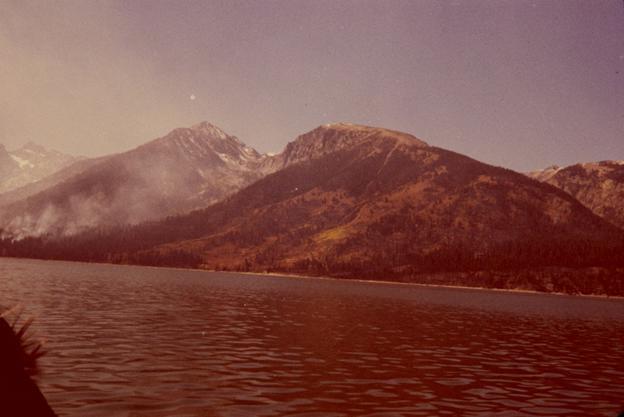
    <title type="html"><![CDATA[Waterfalls Canyon Fire, Grand Teton National Park]]></title>
    <summary type="html"><![CDATA[<p><strong><em>The 1974 Waterfalls Canyon Fire started in a designated let-burn area near Jackson Lake in Grand Teton National Park, so the National Park Service allowed it to burn. Smoke from the blaze impacted tourists and local communities, prompting public debates about the Park Service policy that allowed natural fires to burn. </em></strong></p><img src="https://www.intermountainhistories.org/files/fullsize/218d40ecfabb4d0268fec6ef7807fcd7.jpg" alt="Smoke in the mountains at Grand Teton National Park during a fire." /><br/><p>In 1968, the National Park Service (NPS) officially revised its approach to wildfires, stating that they played a key role in maintaining the health of forests. According to Department of the Interior reports, natural burns cleared dead timber and dense clusters of young trees that prevented new growth. In the wake of the decision, park managers experimented with different approaches to maintain healthy forests without causing severe damage. During prescribed burns, the Park Service started fires within strictly defined boundaries and weather conditions to control their severity. During let-burn situations, the agency monitored natural blazes and allowed them to burn. Grand Teton National Park experimented with both approaches.
On August 28, 1973, NPS officials ignited  the Uhl Hill Fire in a dense grove of sagebrush and aspen near the Grand Teton’s eastern edge. One of two prescribed fire experiments that year, NPS expected Uhl Hill to burn one-hundred acres. Cool, wet conditions made it easier to control, but fifty-six firefighters stood by to suppress it if it escaped approved boundaries. While snow and high wind quickly ended the project, which only burned thirty acres of brush, it showed that the Park Service could control blazes within park boundaries. This experiment proved useful on July 17, 1974, when lightning sparked the Waterfalls Canyon Fire near Jackson Lake. It started in the same area that a five-acre let-burn blaze impacted in 1973. Because of its location, park officials allowed it to burn. The Park Service closely monitored the flames, noting that they spread slowly unless high winds or heavy fuels stimulated them.
While NPS perceived Waterfalls Canyon as a successful test of let-burn management, decades of suppression had pushed the public to fear fire, generating controversy. By September 18, the blaze burned 1,900 acres, and smoke from it reached the nearby town of Jackson, Wyoming. The Park Service estimated that about 100,000 tourists observed the smoke, and it incensed Jackson’s citizens, many of whom relied on tourist traffic from Grand Teton to make a living. Residents complained that the let-burn policy ignored the needs of local communities, drawing increased attention to the flames. The National Broadcasting Company (NBC), the Columbia Broadcasting System (CBS), and <em>Time </em>magazine reported on Waterfalls Canyon in September, bringing it to national attention. In response to the controversy, the Park Service’s Rocky Mountain regional office issued a press release that explained the let-burn approach.
Despite public backlash, Park Service officials never suppressed Waterfalls Canyon. Snow finally extinguished it in November 1974, and it only burned 3,500 acres. However, the negative publicity pushed NPS to educate the public about the let-burn approach. In 1974, the Park Service issued a press release that argued that natural fires maintained a healthy landscape in parks. Three years later, a Park Service policy known as NPS-18 approved let-burn management nationwide.</p><p><em><strong><a href="https://www.intermountainhistories.org/items/show/914">For more (including 3 images) view the original article</a></strong></em></p>]]></summary>
    <published>2025-09-23T15:39:29+00:00</published>
    <updated>2026-04-17T19:32:21+00:00</updated>
    <link rel="alternate" type="text/html" href="https://www.intermountainhistories.org/items/show/914"/>
    <id>https://www.intermountainhistories.org/items/show/914</id>
    <author>
      <name>Kaylen Wilson, Northern Arizona University </name>
    </author>
  </entry>
  <entry>
    <title type="html"><![CDATA[Grand Teton National Park and Jenny Lake]]></title>
    <summary type="html"><![CDATA[<p><strong><em>Established in 1929, Grand Teton National Park (GTNP) is known for its iconic landscape of the Teton Range, as well as its glacial lakes that dot its foothills and wildlife that fill the Jackson Hole valley. Jenny Lake, lying at the foot of the mountains, has long been a jumping-off point for visitors eager to explore the park’s many attractions. </em></strong></p><img src="https://www.intermountainhistories.org/files/fullsize/13852c02bc409ba82f38315a626b2a97.jpg" alt="Kenneth Reimer’s cabin" /><br/><p>Grand Teton National Park (GTNP) is located in northwestern Wyoming and often attracts visitors eager to experience the West’s scenery and “rustic” qualities. Homesteaders entered the area in the 1800s, but soil and climate conditions made it hard to raise cattle and crops. The area turned to outdoor recreation activities as its economic drivers, attracting upper-class East Coasters looking for the authentic “Western” experience. Hurried cabins, saloons, and large advertisements sprang up in the 1920s. The area’s natural environment was in quick danger of overdevelopment when John D. Rockefeller, Jr., emerged on the scene.
            The East Coast philanthropist wanted to protect the Tetons under the model Yellowstone had set in 1872. President Theodore Roosevelt established the Teton National Forest in 1908, but plans of damming lakes and residential constructions still threatened the area. Local ranchers and hoteliers strongly opposed federal encroachment on their ventures. After touring the area in 1926, Rockefeller was determined to conserve the Tetons regardless of political opposition, quietly buying up large plots of land to give to the federal government. President Calvin Coolidge established GTNP in 1929 at half its current size. After some legal and political difficulties questioning the billionaire’s influence, President Franklin D. Roosevelt took Rockefeller’s land and turned it into the Jackson National Monument in 1943. President Harry Truman combined the monument with GTNP in 1950 to complete the park as it is today.
            Although such actions protected the Tetons from rampant development, concessionaires were still permitted to build visitor services. Jenny Lake, the largest undammed lake in the park, was recognized for its natural beauty long before the park was officially created. During the 1920s, Charles J. Wort had already been renting motor and row boats to visitors under a National Forest Special Use Permit. Along with his Jenny Lake operations, Wort had also built lodges across the park. After Congress established GTNP, the National Park Service (NPS) granted him the first concession in Grand Teton and included him in its first Master Plan, which outlined plans for development in the park. After Wort’s death, Kenneth Reimer took over boating concessions on Jenny Lake in 1935. Civilian Conservation Corps crews had developed Jenny Lake’s trail system and west boat dock in the 1930s, encouraging the expansion of shuttle boat services across the lake. Following the “rustic” architectural guidelines set by NPS, Reimer also built a personal residence near Wort’s boathouse.
The Jenny Lake area is still a hub for NPS administration facilities and recreation. Along with other visitor infrastructure in the area, the west boat dock at the mouth of Cascade Canyon has been renovated multiple times over the last century. Most prominently, the Jenny Lake Renewal Project in 2018 improved the west boat dock for easier access to trails and lookouts. Along with rental boats, the current boat concession shuttles mountaineers intent on scaling the range’s world-famous faces, as well as visitors of all backgrounds looking to enjoy Jenny Lake’s scenery. Just as they did in the park’s early days, passengers can step on foot the shuttle, peering up at the towering Teton Range, eager to embark on their adventures. </p><p><em><strong><a href="https://www.intermountainhistories.org/items/show/892">For more (including 6 images) view the original article</a></strong></em></p>]]></summary>
    <published>2025-09-23T15:30:20+00:00</published>
    <updated>2026-04-17T19:32:20+00:00</updated>
    <link rel="alternate" type="text/html" href="https://www.intermountainhistories.org/items/show/892"/>
    <id>https://www.intermountainhistories.org/items/show/892</id>
    <author>
      <name>Anaëlle DePoint, Northern Arizona University</name>
    </author>
  </entry>
  <entry>
    <title type="html"><![CDATA[Beaver Creek Administrative Area Historic District Cultural Landscape]]></title>
    <summary type="html"><![CDATA[<p><strong><em>Explore the beautiful mountain range of Grand Teton National Park and sneak a peek at exemplary rustic architecture while there. </em></strong></p><img src="https://www.intermountainhistories.org/files/fullsize/50f5f2bba465e7d5d66e479abeb52569.jpg" alt="Superintendent’s residence" /><br/><p>The first development at the Beaver Creek Administrative Area in what became Wyoming’s Grand Teton National Park was in 1908, when Forest Service ranger Al Austin built the Stewart Ranger Station in what was then known as Teton National Forest. Between 1908 and 1929, there were a few small additions to the landscape, including three buildings, a road, fencing, and a flagpole. When Grand Teton became a National Park in 1929, the National Park Service took over the land and used it as a utility and administrative site. The 1930s brought new infrastructure to the park which conformed to the Park Service’s rustic building style. With funds from the New Deal program, the Park Service had a superintendent residence built, and they designed this first construction in the area to look rustic. The Civilian Conservation Corps added log cabins, garages, and buildings to the landscape. In addition, replanting natural vegetation was key to blending human development with the region’s natural aesthetic. 
The Beaver Creek Administrative Area continued to serve as the park’s headquarters from 1929 until 1958, when a new site near Moose, Wyoming replaced it. The original administrative area remains one of the easiest-to-identify National Park Service rustic sites in the United States. The use of unprocessed building materials like the lodgepole pine trees and river stones create a sense that the building grew directly out of the landscape, and the dark brown paint and green-rolled asphalt roofing meld the buildings with the natural color palette of the Teton forest. The absence of decorative design helps these man-made structures further blend into their environment. The Forest Service buildings that remain in Beaver Creek have undergone renovations since their construction in 1908 which combined the two log buildings into one under a new roof and added porches to the east and west sides of the structure.
The historic administrative area has been a topic of debate for Grand Teton National Park in years past. The buildings are still in use as housing, offices, and storage, but the NPS believes the area is an opportunity to showcase National Park designed rustic architecture. Accommodating both tourism and administrative operation requires conscience respect for the the size and design of the historic district. These buildings stand the test of time and exemplify the conservation movement and rustic architecture that the National Parks strove for in the 1930s.</p><p><em><strong><a href="https://www.intermountainhistories.org/items/show/600">For more (including 3 images) view the original article</a></strong></em></p>]]></summary>
    <published>2022-06-09T20:57:46+00:00</published>
    <updated>2026-04-17T19:32:13+00:00</updated>
    <link rel="alternate" type="text/html" href="https://www.intermountainhistories.org/items/show/600"/>
    <id>https://www.intermountainhistories.org/items/show/600</id>
    <author>
      <name>Jennifer John, Northern Arizona University</name>
    </author>
  </entry>
</feed>
