<?xml version="1.0" encoding="UTF-8"?>
<feed xmlns="http://www.w3.org/2005/Atom">
  <title type="text">Intermountain Histories</title>
  <updated>2026-04-17T19:32:21+00:00</updated>
  <generator uri="http://framework.zend.com" version="1.12.20">Zend_Feed_Writer</generator>
  <link rel="alternate" type="text/html" href="https://www.intermountainhistories.org/"/>
  <link rel="self" type="application/atom+xml" href="https://www.intermountainhistories.org/items/browse?output=rss2"/>
  <id>https://www.intermountainhistories.org/</id>
  <author>
    <name>Intermountain Histories</name>
    <uri>https://www.intermountainhistories.org</uri>
  </author>
  <link rel="hub" href="https://pubsubhubbub.appspot.com/"/>
  <entry>
    <title type="html"><![CDATA[1967 Fire Season, Glacier National Park]]></title>
    <summary type="html"><![CDATA[<p><strong><em>Glacier National Park burned more frequently throughout its history than almost any other national park in the United States. Starting in 1910, the National Park Service persistently extinguished all wildfires that occurred within parks, but Glacier’s severe fire season in 1967 helped to end this suppression policy.</em></strong></p><img src="https://www.intermountainhistories.org/files/fullsize/75678ebbab988382ceaac098ab81df69.jpg" alt="Fire Safety Sign" /><br/><p>Throughout the early twentieth century, Glacier National Park in Montana utilized suppression, which required federal land management agencies to extinguish all forest fires. This approach gained national support after millions of acres of land burned in Idaho and Montana in 1910, including about 60,000 acres in Glacier. When 50,000 acres of Glacier burned in 1926, the National Park Service began to formulate official firefighting in the park. By 1929, Chief Forester John D. Coffman drafted the first national park fire management plan to organize firefighters and their equipment at Glacier. During the same year, the Half Moon Fire burned 50,000 acres in Glacier and destroyed numerous buildings. Coffman used analyses of Half Moon to revise and expand his initial strategy, making suppression an integral part of park policy.
In the 1960s, NPS developed a scientific approach to park management that changed the way it approached wildfires, but individual parks rarely aligned their management procedures with these ideas. In 1963, the Advisory Board on Wildlife Management, created by Interior Secretary Stuart Udall, published the Leopold Report. It stated that flames played a key role in maintaining healthy forests, advising administrators to contain wildfires and allow them to burn. Without routine burning, plant materials accumulated on the forest floor, fueling more destructive blazes. However, decades of fighting fires pushed park managers to fear the damage they caused. For decades, NPS managed forests to create attractive landscapes for visitors, and burned forests challenged this idealized image. As such, Glacier’s revised 1965 management plan upheld suppression.
In 1967, a significant drought and hot, windy weather created optimal conditions for flames to spread in Glacier. On August 11, 1967, lightning sparked approximately twenty-one fires throughout the park, including the Glacier Wall and Flathead blazes. They continued burning for a month despite containment efforts. The Office of Emergency Preparedness declared Glacier and the national forests surrounding it a national disaster area, contributing federal funding and labor to put out the flames. 1967 became the most destructive fire season Glacier had seen since 1929, and about 90,000 acres in the park burned.
The 1967 season quickly sparked a debate between the Park Service and the public over suppression. NPS officials contrasted it with the 1910 season  it to display the effectiveness of the policy, noting that less acres burned and less people died in the 1967 fires. However, inholders, who owned cabins, ranches, and hotels in Glacier, blamed the Park Service for mismanaging burns that damaged their properties. One vocal inholder, Montana Senator Burton Wheeler, brought these criticisms to national attention, prompting NPS to reassess its firefighting policies. In 1968, the Park Service acknowledged the ecological benefits of fire in the Green Book, a policy document that established budgets and dictated management policies for the entire park system. Revising this document made changing the suppression policy an issue of national importance. By 1977, Glacier’s management plan allowed natural fires to burn.</p><p><em><strong><a href="https://www.intermountainhistories.org/items/show/913">For more (including 5 images) view the original article</a></strong></em></p>]]></summary>
    <published>2025-09-23T15:39:29+00:00</published>
    <updated>2026-04-17T19:32:21+00:00</updated>
    <link rel="alternate" type="text/html" href="https://www.intermountainhistories.org/items/show/913"/>
    <id>https://www.intermountainhistories.org/items/show/913</id>
    <author>
      <name>Kaylen Wilson, Northern Arizona University </name>
    </author>
  </entry>
  <entry>
    <title type="html"><![CDATA[Waterton-Glacier International Peace Park and the International]]></title>
    <summary type="html"><![CDATA[<p><strong><em>Waterton-Glacier International Peace Park is a first-of-its-kind testament to the friendship between Canada and the United States. Glacial lakes, dramatic mountain faces, and abundant wildlife are just a few of the Glacier and Waterton Lakes’ shared features. The parks also feature the enduring craftsmanship of Captain J. W “Billy” Swanson, the prolific boat builder in the region.  </em></strong></p><img src="https://www.intermountainhistories.org/files/fullsize/24000f0abc2a900799c63e97227350e5.jpg" alt="The International, tinted-lantern slide, 1927" /><br/><p>In 1932, local rangers and Rotary Club members joined Glacier National Park (Montana, U.S.A.) and Waterton-Lakes National Park (Alberta, Canada) due to their contiguous landscape, similar ecosystems, and collaborative nature of their management. Though not erasing the international border, Glacier and Waterton already shared strong economic forces, like the Great Northern Railroad. The railroad’s Glacier Park Hotel Company (GPHC) built various chalets and hotels across Glacier, but its only Canadian property, the Prince of Wales Hotel, is emblematic of the international drive for nature-based tourism.
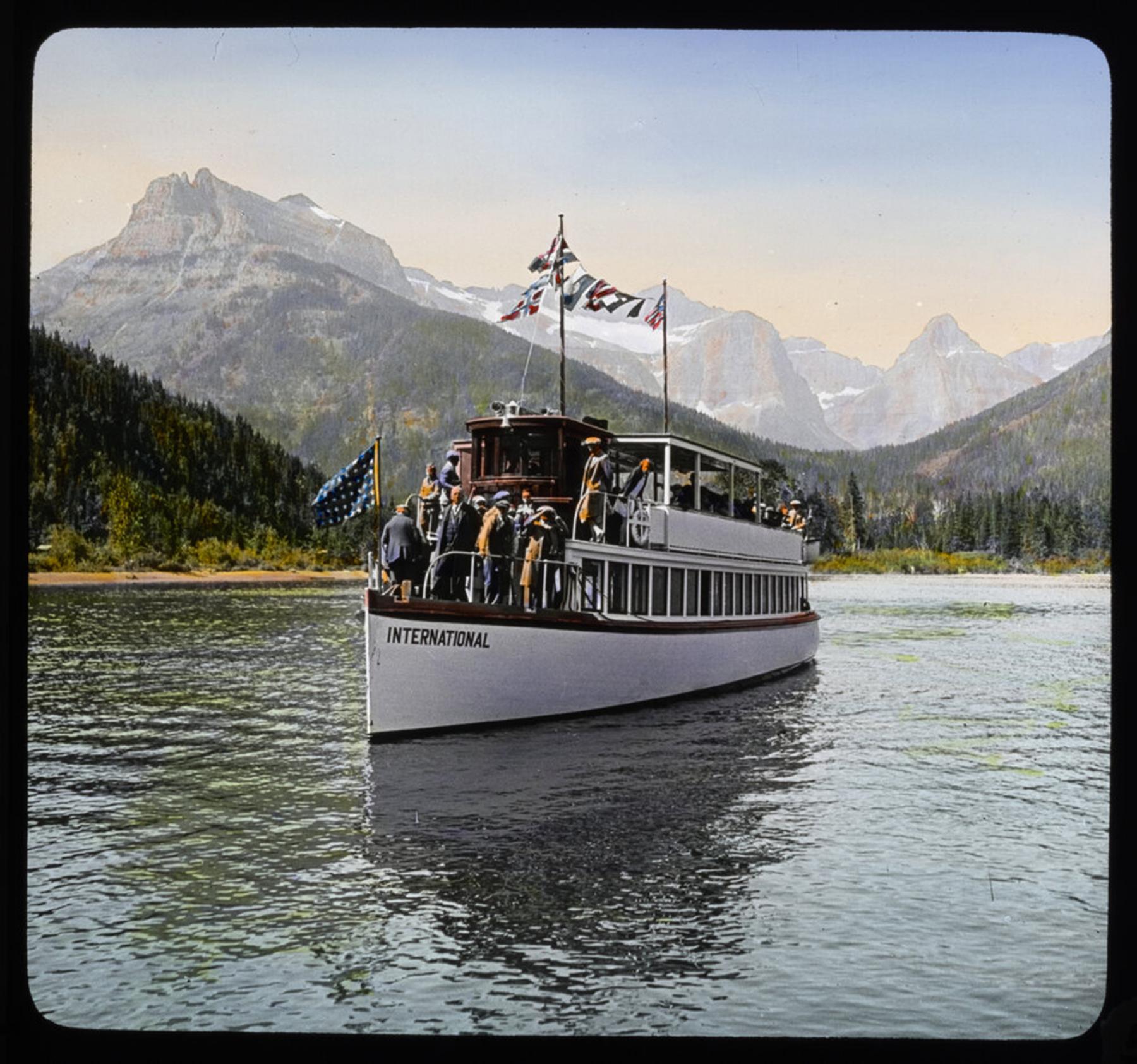
Opening in 1927, the sophisticated Prince of Wales Hotel needed travel amenities suitable for its upper-class clientele. The GPHC turned to Captain J.W. “Billy” Swanson, the prominent boat builder from Glacier National Park, to build his largest, grandest vessel: the <em>International</em>. To avoid Canadian labor and customs restrictions, the company insisted that Swanson build and register the boat on U.S. soil, even though it primarily served Canadian guests. The 250-passenger vessel was to transport guests to the remote Goat Haunt Chalet on the south side of Upper Waterton Lake. The <em>International </em>would also provide comfort and luxury to those coming from the chalet after a long trip on horseback. Though within Glacier’s borders and accessible via the park’s trail system, the backcountry chalet was easier to get to by boat from the lake’s Canadian side. However, materials were difficult to transport from Kalispell, about 150 miles away in Montana. Another boat concessionaire hauled parts for Swanson across the lake to Goat Haunt initially, but after the Captain deemed transportation prices too high, he simply built his own freighter boat. He and his small crew assembled the <em>International </em>in just two months, launching it on Upper Waterton Lake from the Prince of Wales Hotel in the summer of 1928.
Divided almost equally by the Canadian-American border, Upper Waterton Lake offers astounding views no matter which country one is in. However, some differences made the scenic trip even more sought-after from the Canadian side. The Prince of Wales Hotel initially drew Americans avoiding Prohibition laws, but by 1934, when they were repealed, Alberta still had restrictions on dancing and alcohol on Sundays. Despite the Great Depression, the vessel’s trips to the lake’s American side kept the <em>International </em>afloat. Canadians eager to escape Alberta laws hopped aboard her varnished, electrically lit deck for a good time, if only for a couple of hours.
Swanson had sold his Glacier operations by 1938 and moved on to other boat-building projects. However, as Canada entered World War Two in 1939, concession operations soon halted in the parks, though the <em>International </em>operated until 1940. The hiatus led to the neglect and eventual razing of Goat Haunt Chalet. The <em>International</em>, though, continues to transport Waterton-Glacier visitors across the lake, allowing them to experience a one-of-a-kind ride in a one-of-a-kind park.</p><p><em><strong><a href="https://www.intermountainhistories.org/items/show/891">For more (including 6 images) view the original article</a></strong></em></p>]]></summary>
    <published>2025-09-23T15:30:19+00:00</published>
    <updated>2026-04-17T19:32:20+00:00</updated>
    <link rel="alternate" type="text/html" href="https://www.intermountainhistories.org/items/show/891"/>
    <id>https://www.intermountainhistories.org/items/show/891</id>
    <author>
      <name>Anaëlle DePoint, Northern Arizona University</name>
    </author>
  </entry>
  <entry>
    <title type="html"><![CDATA[Glacier National Park’s Fleet and Captain J.W. “Billy” Swanson]]></title>
    <summary type="html"><![CDATA[<p><strong><em>Glacier National Park boasts a sprawling alpine landscape, with dozens of glacial lakes nestled between mountain faces and valleys. One concessionaire and expert craftsman, Captain J.W. “Billy” Swanson, constructed fleets of scenic cruisers and smaller boats that would allow visitors to soak in all Glacier had to offer.</em></strong></p><img src="https://www.intermountainhistories.org/files/fullsize/99b8e82e63e17fc192c50ed163a91c67.jpg" alt="Map of some of Captain J.W. Swanson’s Boats in Glacier National Park, with original launch sites, c.a. 1915-45, National Park Service (modified)" /><br/><p>Congress established Glacier National Park, located in northern Montana and close to the Canadian border, in 1910. The 1892 arrival of the Great Northern Railroad in the area facilitated an uptick in national park tourism. Glacier’s peaks and clear waters mirrored those featured in the traditional, lengthy European vacation. Early hotel concessionaires recognized this parallel and fashioned lodgings like Swiss chalets. Hiking trails and saddle ride routes first expanded access to the park, but as visitation increased, tourists wanted more comfortable, accessible ways to experience Glacier. Not only could boats link tourists to trails across lakes, but it could also connect guests from nearby towns to the park. Automobiles became the most efficient way to travel upon the completion of the Going-to-the-Sun Road in 1933, but boating remained a uniquely scenic way to explore the park.
Even before the federal government established Glacier, entrepreneurs were providing visitor services on Lake McDonald. By 1895, George Snyder purchased a steamship to ferry guests across the length of Lake McDonald to his hotel at the top, a trip that would often take an entire day.
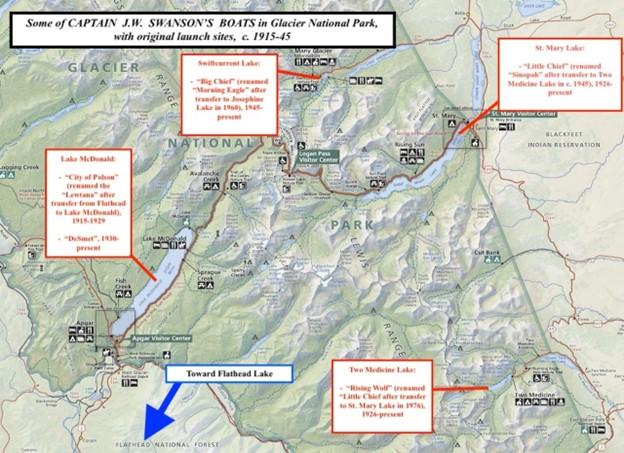
As Glacier’s popularity rose, so did the demand for boat travel. Captain J.W. “Billy” Swanson was the park’s most prominent boat concessionaire and builder for three decades. After running a boat-building operation on nearby Flathead Lake, Swanson moved his business to Glacier’s west side in 1911. He was known for his quality craftsmanship, ambitious personality, and willingness to go to extreme lengths in ensuring his boats’ success. In 1915, he hauled his steamship <em>City of Polson</em>, built for the Lewis Hotel owner John Lewis, upriver through a narrow canyon from Flathead Lake. After traveling over muddy, primitive roads to Lake McDonald, it was renamed <em>Lewtana</em> for ferrying and scenic touring on the lake.
Amongst other concessionaires, the captain built boats for the Great Northern’s tourism subsidiary, Glacier Park Hotel Company (GPHC). In 1920, the National Park Service granted him his own concession permit to build scenic cruisers and rental boats in Glacier’s eastern region. He built the <em>Little Chief </em>(St. Mary Lake) and the <em>Rising Wolf</em>  (Two Medicine Lake) for the GPHC in 1926. The company also commissioned the <em>International</em> for its Canadian-American operation in 1927. He returned to west Glacier to build the <em>DeSmet </em>for the Glacier Park Transport Company, another boat and bus tour concessionaire, in 1930. When Swanson’s finances declined in 1938, the Glacier Park Boat Company (GPBC) bought the captain’s boats and concession rights. Arthur Burch, the company head, ran the boats with Swanson until World War Two broke out. In 1945, they built the <em>Big Chief</em> on Swiftcurrent Lake together. This boat would turn out to be the captain’s last in Glacier.    
Captain Swanson maintained good relationships with park administrators and other concessionaires. Swanson’s superior craftsmanship is his strongest legacy, though. The GPBC, still run by the Burch family, operates with Swanson’s original fleet. Even though a century has passed, modern passengers can ride across the same waters, stand on the same decks, and view the same scenic landscapes that so many enjoyed before them.</p><p><em><strong><a href="https://www.intermountainhistories.org/items/show/890">For more (including 6 images) view the original article</a></strong></em></p>]]></summary>
    <published>2025-09-23T15:30:19+00:00</published>
    <updated>2026-04-17T19:32:20+00:00</updated>
    <link rel="alternate" type="text/html" href="https://www.intermountainhistories.org/items/show/890"/>
    <id>https://www.intermountainhistories.org/items/show/890</id>
    <author>
      <name>Anaëlle DePoint, Northern Arizona University</name>
    </author>
  </entry>
  <entry>
    <title type="html"><![CDATA[Many Glacier Hotel: Glacier National Park ]]></title>
    <summary type="html"><![CDATA[<p><strong><em>After Congress created Glacier National Park in 1910, the Great Northern Railway constructed a complex network of hotels, chalets, roads, trails, and tent camps in the region. The railroad modeled this system after luxury resorts in Europe, and Many Glacier Hotel served as one of its crown jewels.</em></strong></p><img src="https://www.intermountainhistories.org/files/fullsize/2eecb9d891c46a783d81ec6dcc049230.jpg" alt="Many Glacier Hotel, c. 1921" /><br/><p><span style="font-weight:400;">Constructed at the edge of what is now Swiftcurrent Lake, Many Glacier Hotel provided the Great Northern Railway’s second grand hotel at Glacier National Park. It served as the center of the Great Northern’s network of chalets and tent camps alongside the 1910 Glacier Park Hotel. From the grand hotels, tourists could access chalets and tent camps in Glacier’s backcountry. Visitors accessed these locations on horseback, but automobiles later drew tourists away from them. The Great Northern brought an unprecedented level of development into Glacier, and it spent approximately $1.5 million on hotels, chalets, campsites, trails, and roads by 1917. Many Glacier Hotel cost $400,000. </span>
<span style="font-weight:400;">Designed by Great Northern architect Thomas D. McMahon, the hotel comprises three separate buildings connected by covered walkways. The central portion opened in 1915, but the railroad did not complete the hotels’ north and south ends until 1917. Its rough stone siding and foundations resemble the rustic architecture that was becoming increasingly common in national parks. The architect further emphasized this feature in the lobby, which included a grand fireplace and tall wooden support pillars. This imitated the “forest” lobby at Glacier Park Hotel, which uses massive Douglas fir trees as pillars and includes an open fire pit. Many Glacier briefly featured an indoor pool, but the Great Northern removed it due to sanitary issues. </span>
<span style="font-weight:400;">The railroad also intended Many Glacier to match the Great Northern’s other buildings in the park, which imitate Swiss chalets. The hotel’s three sections look like individual Swiss chalets from a distance. Wooden pieces called moldings adorn their windows and balconies, and these pieces feature cutout patterns inspired by the Swiss chalet style. This created a unified sense of place in the region and emulated Glacier’s status as the “Switzerland of North America.” Early advertisements capitalized on this idea during World War I, encouraging guests to “see America first” instead of spending their vacation money to visit foreign locales. The Great Northern hired numerous artists to paint Glacier National Park, and their work hung in train depots and ticket offices. The railroad displayed a variety of paintings from the See America First in Many Glacier Hotel, but only a few remain today. </span>
<span style="font-weight:400;">While Glacier National Park quickly became a popular tourist attraction, the Great Northern’s vast building network became increasingly expensive to maintain. Initially, the railroad kept its resort system to draw train passengers into the park, but it made numerous attempts to sell the hotels as more visitors began to arrive by car. In 1957, the Great Northern hired the Knutson Hotel Company to prepare Glacier’s hotels for sale, and Glacier Park Inc. purchased them in 1960. In 2001, the National Park Service funded a $42 million restoration project that replaced the lodge’s roof and siding, restored original architectural features like balconies, and reinstalled an original circular staircase that the Knutson Hotel Company removed from the hotel lobby in 1957. Xanterra Parks and Resorts currently manages Many Glacier Hotel.</span></p><p><em><strong><a href="https://www.intermountainhistories.org/items/show/842">For more (including 5 images) view the original article</a></strong></em></p>]]></summary>
    <published>2024-05-29T21:10:56+00:00</published>
    <updated>2026-04-17T19:32:19+00:00</updated>
    <link rel="alternate" type="text/html" href="https://www.intermountainhistories.org/items/show/842"/>
    <id>https://www.intermountainhistories.org/items/show/842</id>
    <author>
      <name>Kaylen Wilson, Northern Arizona University</name>
    </author>
  </entry>
  <entry>
    <title type="html"><![CDATA[Glacier Park Hotel - Glacier National Park]]></title>
    <summary type="html"><![CDATA[<p><strong><em>In 1911, the Great Northern Railway began constructing a complex network of hotels and chalets in the fledgling Glacier National Park. Originally nicknamed the “Entrance hotel,” Glacier Park Hotel provided a gateway to this unique resort system.</em></strong></p><img src="https://www.intermountainhistories.org/files/fullsize/06a86c061b2ec07ad3f9f6d5b187daae.jpg" alt="Glacier Park Hotel lobby, c. 1910-20" /><br/><p><span style="font-weight:400;">The Great Northern Railway constructed Glacier Park Hotel in 1913 to provide visitors touring Glacier National Park with a starting point along the railroad. From Glacier Park Hotel, these tourists entered a complex system of smaller chalets and tent camps. Each hotel and chalet included a guide operation that provided saddle horses to visitors, who entered the area from a train depot connected to the Glacier Park complex. Resorts in Europe inspired this system, and an American national park had never utilized it. The resort brought an unprecedented level of development into Glacier, and the Great Northern spent about $1.5 million dollars (about $36 million today) on hotels, chalets, campsites, trails, and roads by 1917. </span>
<span style="font-weight:400;">The Great Northern Railroad executive F.I. Whitney encouraged the railroad to seek out tourist attractions in the Glacier region as soon as it reached the park’s southern end. Famous conservationists like George Bird Grinnell and John Muir, who brought Glacier to the attention of railroad founder James J. Hill and his son Louis, reinvigorated Whitney’s efforts. The failure of local oil and copper and oil industries provided a political opening for conservationists, and James J. Hill soon began to advocate for the area’s protection. However, Hill opposed the conservationists’ idea of a vast forest reserve at Glacier, and this ultimately shaped the park’s development. President William Howard Taft signed the bill that protected Glacier National Park in 1910. </span>
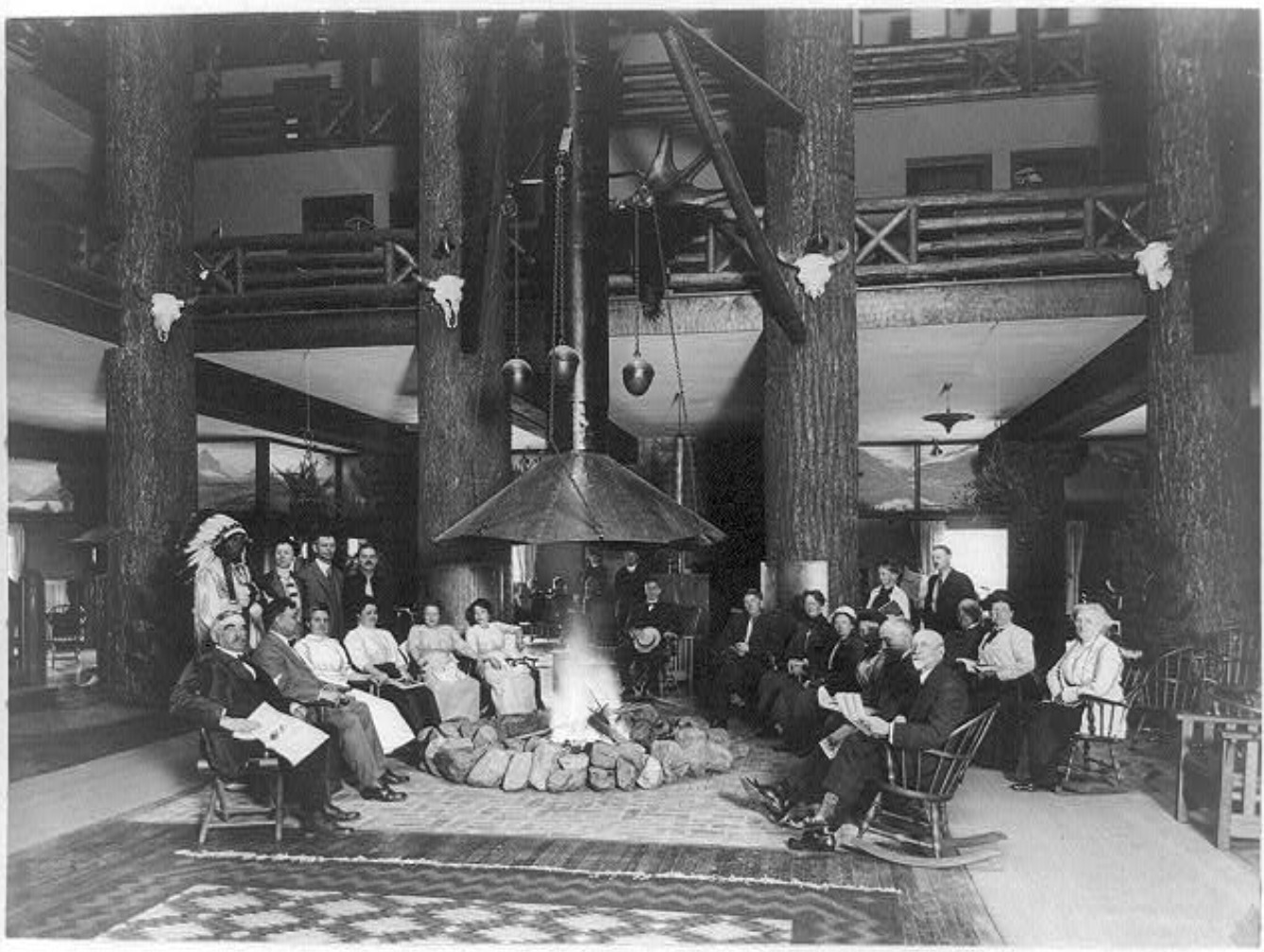
<span style="font-weight:400;">Luxurious chalets in Switzerland inspired the architecture of Glacier Park Hotel and the Great Northern’s other buildings, which catered to the tastes of wealthy travelers. Louis Hill, who served as president of the Great Northern during construction, chose this style. It connected the system visually and advertised Glacier’s reputation as the “Switzerland of North America.” Glacier Park Hotel, designed by Samuel Bartlett, is particularly famous for its massive log pillars, which support the hotel’s vast roof. These logs vary in size, with the largest being over forty feet tall and three to four feet wide, and they are most prevalent in the hotel’s lobby. Advertised as a “forest,” these log posts retain their bark, emphasizing their organic nature and contributing to the idea of an indoor forest. The lobby even includes a fire pit in its center. These features emphasized the hotel’s environment and emulated the rough, handcrafted style popularly defined as rustic architecture. The luxurious complex included a</span> <span style="font-weight:400;">music room, writing room, a sun parlor, and a hospital in case of emergencies. </span>
<span style="font-weight:400;">In 1957, the Great Northern hired Knutson Hotel Company to renovate its hotels for sale. The $3 million project expanded the hotel gift shop, installed bathrooms in all the guest rooms, added a swimming pool to the hotel complex, and renamed the hotel Glacier Park Lodge. In 1960, Glacier Park Inc. purchased the Glacier resort system from the Great Northern. The National Park Service granted Xanterra Parks and Resorts concession rights in Glacier in 2013, but Glacier Park Inc. retained Glacier Park Lodge and several other properties.</span></p><p><em><strong><a href="https://www.intermountainhistories.org/items/show/841">For more (including 4 images) view the original article</a></strong></em></p>]]></summary>
    <published>2024-05-29T20:53:22+00:00</published>
    <updated>2026-04-17T19:32:19+00:00</updated>
    <link rel="alternate" type="text/html" href="https://www.intermountainhistories.org/items/show/841"/>
    <id>https://www.intermountainhistories.org/items/show/841</id>
    <author>
      <name>Kaylen Wilson, Northern Arizona University</name>
    </author>
  </entry>
  <entry>
    <title type="html"><![CDATA[Blackfeet Removal from Glacier National Park]]></title>
    <summary type="html"><![CDATA[<p><strong><em>Before the arrival of white settlers, Blackfeet territory included western Montana and southern parts of Canada. Blackfeet land claims were challenged as American settlers moved west and railroads expanded. As a result of starvation and government neglect in the late nineteenth century, they were forced to sell 800,000 acres of their reservation, land that would eventually make up the eastern portion of Glacier National Park. </em></strong></p><img src="https://www.intermountainhistories.org/files/fullsize/7a4db0d8cd0faf06f15da0d798e2989e.jpg" alt="Blackfeet in the Two Medicine Area, ca. 1914" /><br/><p>The Blackfeet Confederacy is made up of four bands: Piegan Blackfeet, Siksika, Piikani, and Kainai. Similar to other Great Plains tribes, they followed a yearly cycle which included hunting and gathering in the Rocky Mountains, what they called the “backbone of the world.” </p><p>In 1855, the Blackfeet signed the Lame Bull Treaty with the U.S. government which guaranteed their claims to land in Northern Montana and provided them with an Indian agent and annuities. </p><p>In 1870, following the revenge murder of a white rancher and his son, General Philip Sheridan sent Major Eugene Baker to find the leader of the attack. A camp of Piegans led by Heavy Runner was misidentified as the hostile band, and despite efforts by Heavy Runner and an army interpreter to prove their innocence, Baker ordered an attack. The number of deaths is disputed, but between 173 and 217 Piegan Blackfeet were killed. 140 were captured and became refugees at Fort Benton. The event became known as the Baker Massacre and marked the end of active Blackfeet hostility.</p><p>In the late 1870s, the Blackfeet faced starvation on their reservation. The government had eradicated the buffalo and rations were limited. The Blackfeet left the reservation to hunt, but were forced back by an army escort in 1880. Following their return, they became fully dependent on the government. Hundreds of Blackfeet starved to death on the reservation during the winter of 1883-1884. In need of money for food and supplies, they sold 800,000 acres of the western part of their reservation to the government in 1895. During the negotiations, Piikani Chief White Calf complained about the loss of sacred mountain land, calling it his people’s “last refuge,” and Little Dog reminded commissioners that they “did not ask the government to come and buy their land.” </p><p>In 1897, the ceded land was made a forest reserve, and Glacier National Park was created in 1910. The Blackfeet were central to many of the park’s advertising campaigns, especially those produced by the Great Northern Railroad. The Blackfeet accounted for over a third of Great Northern’s advertising images, making up more of the campaign than images of scenery. They were employed in the park and officials kept many Blackfeet place names. Unlike other National Parks, Glacier became synonymous with Indian presence. </p><p>With the park’s creation however, courts ruled that Blackfeet rights to access the mountains in the park were obsolete. In 1932, a US District Court ruled conclusively that they had no rights to hunt in the park. Claims resurfaced in 1973, when a judge ruled in favor of the Blackfeet, protecting their right to enter the park without paying the entrance fee. Even with limited access, the Blackfeet still feel the responsibility of their peoples’ “Covenant with the Creator.” One Kootenai woman said recently, “we are put here for a purpose and that is to guard our Columbia River Basin...that is why we are still here and that is why the [Spirits] are never going to let us go.” </p><p><em><strong><a href="https://www.intermountainhistories.org/items/show/341">For more (including 4 images) view the original article</a></strong></em></p>]]></summary>
    <published>2019-09-24T20:59:05+00:00</published>
    <updated>2026-04-17T19:32:06+00:00</updated>
    <link rel="alternate" type="text/html" href="https://www.intermountainhistories.org/items/show/341"/>
    <id>https://www.intermountainhistories.org/items/show/341</id>
    <author>
      <name>Allie Patterson, Brigham Young University</name>
    </author>
  </entry>
</feed>