<?xml version="1.0" encoding="UTF-8"?>
<feed xmlns="http://www.w3.org/2005/Atom">
  <title type="text">Intermountain Histories</title>
  <updated>2026-04-17T19:32:06+00:00</updated>
  <generator uri="http://framework.zend.com" version="1.12.20">Zend_Feed_Writer</generator>
  <link rel="alternate" type="text/html" href="https://www.intermountainhistories.org/"/>
  <link rel="self" type="application/atom+xml" href="https://www.intermountainhistories.org/items/browse?output=rss2"/>
  <id>https://www.intermountainhistories.org/</id>
  <author>
    <name>Intermountain Histories</name>
    <uri>https://www.intermountainhistories.org</uri>
  </author>
  <link rel="hub" href="https://pubsubhubbub.appspot.com/"/>
  <entry>
    <title type="html"><![CDATA[Rosebud Battlefield State Park and General Crook]]></title>
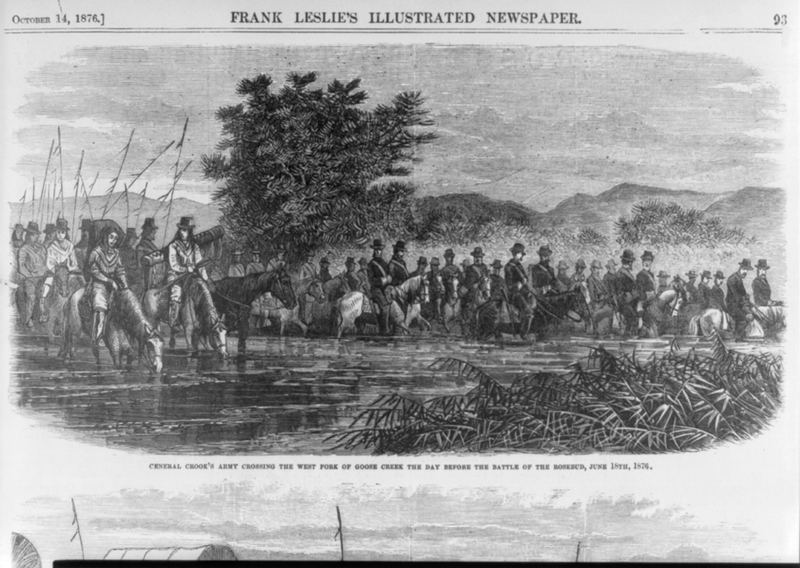
    <summary type="html"><![CDATA[<p><strong><em>At Rosebud Creek, Montana, Northern Cheyenne and Sioux warriors attacked Brigadier General George R. Crook's forces in June 1876. Crook's complex philosophical differences with General Philip Sheridan, and his sympathetic sentiments toward the plight of his Indian adversaries, influenced his cautious, tactical decisions in the days following the battle.</em></strong></p><img src="https://www.intermountainhistories.org/files/fullsize/baff63751c5ff6ce3544c63a1971fbcd.jpg" alt="General Crook&#039;s Army before the Battle of Rosebud" /><br/><p>In January, 1876, the Sioux failed to report to the reservation at Standing Rock, Dakota Territory, after being driven off their homeland by the United States' attempt to accommodate the Black Hills gold rush.  General George Crook's forces deployed from Fort Fetterman in May 1876 in pursuit of the Sioux and their Northern Cheyenne allies. The expedition consisted of over 1,000 soldiers and civilians. Among the latter were teamsters, packers, and five journalists. On June 17, 1876, Sioux and Northern Cheyenne warriors, led by Crazy Horse and Two Moon attacked Crook's first Yellowstone Expedition.       </p><p>In response, Crook deployed his cavalry to control high ground to the North and East of Rosebud Creek. “They were from two or three miles distant, coming at full speed towards us, cheering,” Captain Anson Mills recounted. The infantry formed an inner defensive perimeter, while the packers remained in a fracas behind a rocky outcropping known today as 'Packers Rocks'. The following six hours consisted of a cacophony of gunfire, yelling, dust, smoke, stench, and screams. During the melee, a Cheyenne warrior, Comes In Sight, had his horse shot out from under him. A young Cheyenne woman rode out to his rescue. The Northern Cheyenne say she was Buffalo Calf Road Woman, the sister of Comes In Sight. The Cheyenne remember the conflict as 'Where the girl saved her brother'. At approximately 2pm, Crook ordered his men to disengage, fearing a greater ambush from the North.                                             </p><p>The Army's official casualty report was ten killed in action with thirty wounded.  The Department of Interior revised the number to include fifty seven wounded.  Crazy Horse and Two Moon had reported their losses at twenty seven killed and sixty three wounded.. General Anson Mills recalled, “We then all realized for the first time that while we were lucky not to have been entirely vanquished, we had been most humiliatingly defeated.”  After the battle, a dejected General Crook responded to counter attack orders from General Philip Sheridan, “I wish Sheridan would come here himself and show us how to do it. It is rather difficult to surround three Indians with one soldier.” </p><p>Eight days following the engagement at Rosebud Creek, the Sioux and Northern Cheyenne annihilated five companies of the 7th Cavalry under the command of Lieutenant Colonel George A. Custer, less than fifty miles north at Little Big Horn Creek. This fact has led many historians to criticize Crook's decision to withdraw from the battle and return the Yellowstone Expedition to Fort Fetterman and Camp Cloud Peak to re-supply and rest.  They have also critiqued Crook's reluctance to counter attack as being a contributing factor to the defeat at the Battle of the Little Bighorn.</p><p>The secluded 3,052 acres of Rosebud Battlefield State Park were in ranch lands until acquired by the state of Montana in 1978. Thirty years later, the National Park Service designated this scenic valley as a National Historic Landmark.</p><p><em><strong><a href="https://www.intermountainhistories.org/items/show/338">For more (including 4 images) view the original article</a></strong></em></p>]]></summary>
    <published>2019-09-18T04:05:54+00:00</published>
    <updated>2026-04-17T19:32:06+00:00</updated>
    <link rel="alternate" type="text/html" href="https://www.intermountainhistories.org/items/show/338"/>
    <id>https://www.intermountainhistories.org/items/show/338</id>
    <author>
      <name>Robert M. Estrada, Northern Arizona University</name>
    </author>
  </entry>
  <entry>
    <title type="html"><![CDATA[Fort Verde State Park and General Crook]]></title>
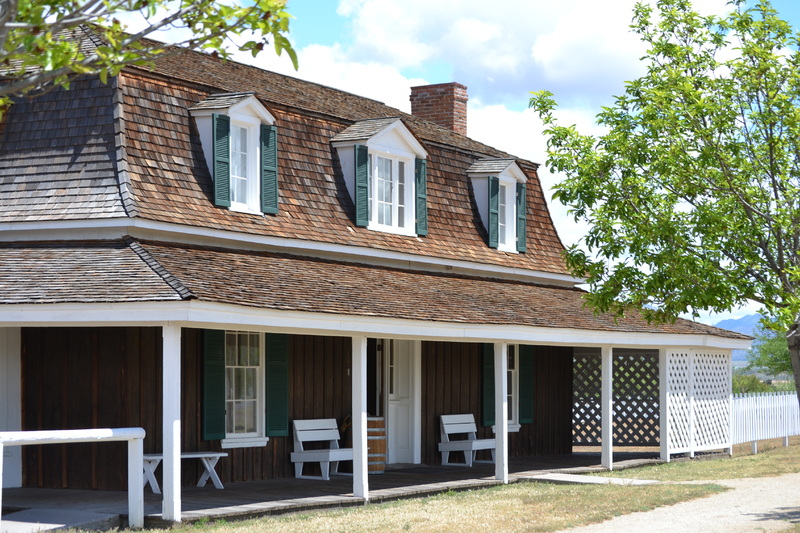
    <summary type="html"><![CDATA[<p><strong><em>Brigadier General George R. Crook (September 8, 1828 -March 21, 1890) is popularly recognized as the quintessential 'Indian Fighter' of the late nineteenth century, despite the fact that he sometimes expressed anger not at the native peoples but toward the interfering white settlers. In 1871 Crook's forces deployed from Fort Verde in the northern Arizona Territory in pursuit of the Tonto Apache.</em></strong></p><img src="https://www.intermountainhistories.org/files/fullsize/6c733c5983f11c9a8df63d66a11a7fcc.jpg" alt="Married Officers&#039; Quarters" /><br/><p>General George R. Crook used Fort Verde in northern Arizona Territory as his primary base of operations for the unenviable task of relocating Apache tribes in the Arizona territory onto reservations. Located at the confluence of the East Fork of Beaver Creek and the 'Rio' Verde River, at the base of the Colorado Plateau, Fort Verde housed officers, doctors, enlisted men, families, and scouts. Many of the officers' wives enjoyed their time at the fort because of its many modern amenities including, bath tubs, silver ware, and draperies. Martha Summerhayes (wife of Lt. John Summehayes) recounted that she felt as though they had finally reached “civilization” when arriving at Fort Verde. </p><p>Crook's objective at Ft. Verde was to provide protection to the early settlers, the Butterfield Stage, and to facilitate the removal of all Indians from both Verde Valley and the Tonto Basin to the east. Crook appreciated the necessity of recruiting scouts. Captain John G. Bourke remembered, “There were Navajoes(sic), Apaches, Yaquis, Mexicans, and half-breeds of any tribe one could name.” Among the most celebrated scouts were Alchesay, and Chiquito, both of whom received the Medal of Honor for their actions against the Tonto Apache. Crook also admired how   “Our Indian allies would crawl upon their hands and knees for long distances.” in pursuit of renegades.  Crook especially appreciated this dedication given the challenge of the rugged Tonto terrain north of the fort, “There is hardly a space of ten miles square, that has not some lava bed, precipitous canyons, or caves with which the Indians can hold out.” After three years of driving the Tonto Apache from their rugged homeland, the Army force marched the survivors 180 miles to the reservation at San Carlos. The War Department  also required the peaceful Yavapai people to join their Apache neighbors on the journey referred to as the 'Exodus'.    </p><p>Ironically, one of the greatest challenges for the Army was protecting the Indians from the homesteaders. In a letter to General Philip H. Sheridan, Crook described, “There are large flocks of human vultures wrangling over the patronage to be bestowed, and who in greed do not hesitate at any deed; the complications arising can be imagined.” The most egregious incident resulted in the death of a young cavalry officer in a conflict with local settlers.  Lieutenant Jacob Arny lost his life, defending the Indians from the settlers.  Despite Crook's request for punishment, the courts never prosecuted the locals responsible for the deed.  </p><p>The State of Arizona established Fort Verde State Park in 1972, in recognition of it being the finest, preserved military facility of the Indian Wars in the state. The Park features the former administrative building, the doctor's quarters, the officer's quarters, the married officer's quarters, and a significant collection of military artifacts.</p><p><em><strong><a href="https://www.intermountainhistories.org/items/show/337">For more (including 4 images) view the original article</a></strong></em></p>]]></summary>
    <published>2019-09-18T03:58:22+00:00</published>
    <updated>2026-04-17T19:32:06+00:00</updated>
    <link rel="alternate" type="text/html" href="https://www.intermountainhistories.org/items/show/337"/>
    <id>https://www.intermountainhistories.org/items/show/337</id>
    <author>
      <name>Robert M. Estrada, Northern Arizona University</name>
    </author>
  </entry>
  <entry>
    <title type="html"><![CDATA[Fort Fetterman State Historic Site and General Crook]]></title>
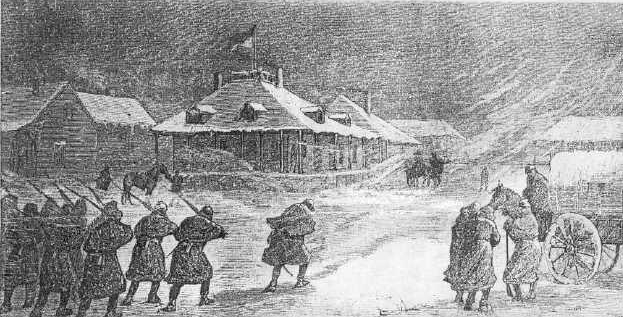
    <summary type="html"><![CDATA[<p><strong><em>Brigadier General George R. Crook (September 8, 1828 -March 21, 1890) is popularly recognized as the quintessential 'Indian Fighter' of the late nineteenth century, despite expressing sympathy for his native adversaries. In the summer of 1876, Crook's forces deployed from Fort Fetterman in central Wyoming on three Yellowstone Expeditions to force the Plains Indians onto reservations.</em></strong></p><img src="https://www.intermountainhistories.org/files/fullsize/ab8b9b567b5421ec48af7c746016a2a0.jpg" alt="Fort Fetterman, 1876" /><br/><p>In 1876, Fort Fetterman, near present-day Douglas, Wyoming, served as the embarkation site for General George Crook's three Yellowstone Expeditions into the Powder River region. General Philip H. Sheridan ordered Crook to facilitate the relocation of the Sioux and Northern Cheyenne onto the reservations at Standing Rock and Pine Ridge, Dakota Territory, after they had been driven from the Black Hills.  Crook had the support from the 7th Cavalry of Lieutenant Colonel George A. Custer to the North and General J.J. Reynold's 2nd Cavalry to the East. </p><p>The Fort had been named for Captain William J. Fetterman, who was killed on December 21, 1866 near Fort Kearney, Wyoming. A year later, the army constructed Fort Fetterman to provide protection for European Americans traveling west on the Bozeman trail. After the Fort Laramie Treaty of 1868, Ft. Fetterman became the most remote outpost on the Northern Plains.               </p><p>The journey to Fort Fetterman possessed its own share of hardship. To reach the fort, it was necessary for troopers and teamsters to cross the high spring waters of the North Platte.  The fast current made it necessary to ferry the mules across the river, “because the animals would not approach the swollen Platte; here they showed more sense than the men in charge” recounted Captain John G. Bourke. Despite their cautions, a teamster fell into the river and drowned in late July 1876.                                                              </p><p>Once at the fort, Crook and his men learned Fort Fetterman was one of the worst outposts to be assigned to during the 1870's. Troopers wrote home about the “lack of female society” and the harsh winter conditions. The soil did not support a garden, which normally would provide vegetables for the soldiers. To be stationed at Fort Fetterman was considered a punishment in the cavalry.          </p><p>To prepare for the Yellowstone Expedition, soldiers at the fort organized and packed the 103 wagons and hundreds of pack mules.  Crook's 1,000 man force then departed Fort Fetterman on May 23, 1876. Crook hoped that this imposing force of strength would encourage the Sioux and Northern Cheyenne to report to their reservations. Crook felt optimistic about his mission to relocate the Plains Indians, recanting, “He is more ready to abandon his old habits and accept civilization, than civilization is to accept him.” Two weeks later, warriors surprised Crook with a frontal assault at Rosebud Creek, forcing his troops to retreat to Camp Cloud Peak and Ft. Fetterman.                                                 </p><p>Today, Fort Fetterman State Historic Site is administered by the State of Wyoming.  Only the officer's quarters and the ordnance building remain. These are decorated in period furnishings and feature multiple military artifacts, including maps and drawings of the 1870's. The State of Wyoming also has developed an interpretive trail, camping, and RV facilities for visitors.</p><p><em><strong><a href="https://www.intermountainhistories.org/items/show/336">For more (including 3 images) view the original article</a></strong></em></p>]]></summary>
    <published>2019-09-18T03:49:02+00:00</published>
    <updated>2026-04-17T19:32:06+00:00</updated>
    <link rel="alternate" type="text/html" href="https://www.intermountainhistories.org/items/show/336"/>
    <id>https://www.intermountainhistories.org/items/show/336</id>
    <author>
      <name>Robert M. Estrada, Northern Arizona University</name>
    </author>
  </entry>
  <entry>
    <title type="html"><![CDATA[Fort Apache Historic District and General Crook]]></title>
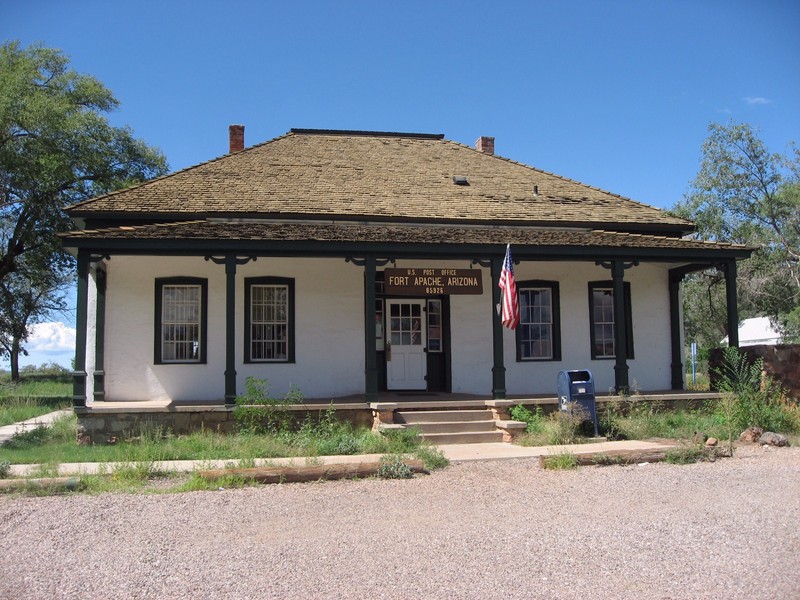
    <summary type="html"><![CDATA[<p><strong><em>Brigadier General George R. Crook (September 8, 1828 -March 21, 1890) is popularly recognized as the quintessential 'Indian Fighter' of the late nineteenth century, despite expressing admiration for his adversaries. In December 1870, Crook's forces established a camp known as Fort Apache in the territory of the White Mountain Apache.</em></strong></p><img src="https://www.intermountainhistories.org/files/fullsize/728298278231858bb3a3ca390e8c9870.jpg" alt="Former 1876 Adjutant&#039;s Office" /><br/><p>Fort Apache was the main terminus for General George Crook's recruiting efforts with the White Mountain Apache and in the forced relocation of most indigenous people in the area in 1874. In 1871, Camp Apache was a semi permanent bivouac with only a single log cabin for General Crook.  The majority of the permanent construction began in 1874 during the Apache and Yavapai 'Exodus' from the Verde Valley to the San Carlos Reservation. Captain John Bourke of the Third Cavalry recorded, “The post, still in the rawest state, is situated on a gently sloping mesa, surrounded by higher hills.”  Ten months later, the United States negotiated a treaty establishing the White Mountain Agency in November, 1871. In exchange, the White Mountain people supported the Army against the other tribes and were promised to retain their ancestral land and receive farming equipment.      </p><p>The tactical support of the White Mountain Apache was indispensable for the success of the Army's mission, and Crook responded with friendship. According to Captain James Shannon, “The Indian cannot be beaten at his own game. He is like a wild animal stalking his prey.” General Crook befriended Alchesay, a local chief and scout. During the campaign against the Tonto Apache, Alchesay was virtually inseparable from 'Gray Wolf', or General Crook. Many enlisted men were perplexed by the apparent friendship between the two men. Captain John G. Bourke remembered about Crook, “He wanted to treat the Apache just the same as he would treat any other man--as a man. He did not believe in one kind of treatment for the white and another for the Indian.”                                </p><p>Prior to the 'Exodus' relocation of the Tonto and Yavapai, Crook complained to General Philip H. Sheridan about the corruption with Indian agents in delivering promised material to the White Mountain Allies, “It was a grievance among the Indians at Fort Apache that they could get nothing from the Government, not even farming implements.” Crook was desirous to enforce the U.S. obligations in the treaty with the White Mountain Apache in order to maintain peace in  northern Arizona. In 1875, with much unfinished business, the army ordered General Crook to leave Arizona and report to the Department of the Platte. </p><p>The Fort Apache Historic District is the original site of the Fort Apache military post. Fort Apache was a major outpost during the Apache wars (1871-1886) and remained a military post until 1922. In 1923 the fort became the site of the Theodore Roosevelt Indian Boarding School. The district contains over thirty structures, ranging from a reconstruction of an early log building to original two-story dormitories.  Included in the Historic Site are the headquarters building, barracks, corrals, warehouses, a guardhouse, an armory, stables, and an old cemetery. The museum and surrounding property is operated by the White Mountain Apache Reservation.</p><p><em><strong><a href="https://www.intermountainhistories.org/items/show/335">For more (including 3 images) view the original article</a></strong></em></p>]]></summary>
    <published>2019-09-18T03:32:07+00:00</published>
    <updated>2026-04-17T19:32:06+00:00</updated>
    <link rel="alternate" type="text/html" href="https://www.intermountainhistories.org/items/show/335"/>
    <id>https://www.intermountainhistories.org/items/show/335</id>
    <author>
      <name>Robert M. Estrada, Northern Arizona University</name>
    </author>
  </entry>
  <entry>
    <title type="html"><![CDATA[Forest Service Road 300 and General Crook]]></title>
    <summary type="html"><![CDATA[<p><strong><em>Brigadier General George R. Crook (September 8, 1828 -March 21, 1890)  is popularly recognized as the quintessential 'Indian Fighter' of the late nineteenth century. In the Apache Campaign, Crook's troopers frequented the Mogollon Rim above Fort Verde in central Arizona Territory on the path to engage the Tonto Apache. This crest trail is designated as Forest Service Road 300.</em></strong></p><img src="https://www.intermountainhistories.org/files/fullsize/d160b0efcada34d1ed16a5a3c1f4d869.jpg" alt="General Crook and William Alchesay" /><br/><p>Located at the crest of the Mogollon Rim, the trail that became Forest Service Road 300 (FS 300) served as the primary path for engagements against the Tonto Apache. FS 300 traverses the 2,000 feet above the Verde Valley on the Colorado Plateau. There are several historical landmarks along the route, such as the '13 mile rock', military telegraph lines, and the grave of Andres Moreno of 'E' Company. Thirteen miles from Fort Verde, near the ridge of the Colorado Plateau, is an original rock carving, marking the troopers' ascent from the Verde Valley. A quarter of a mile onto FS 300, there are white insulators scattered in the forest, from the original nineteenth century telegraph lines. One mile from Hwy 87 is the grave of Andres Moreno who served in the 1st Arizona Infantry, under the command of Lieutenant Primitivo Cervantes in 1865. In 1887, teamster Knox Lee murdered Moreno. Lee plead guilty for manslaughter and was sentenced to seven years. </p><p>In 1871, Crook used this route as he began the unenviable mission of  attempting to separate native Apache on the Colorado Plateau from white settlers in the Verde Valley. According to Lt. John G. Bourke, “Our line of travel was due east--at the base of the great Mogollon range to Camp Verde.” General Crook was usually the first man to 'saddle-up' each morning onto his mule 'Apache'.                                                                                    </p><p>In April that year, following raids on early homesteaders, Crook's men routed a band of over twenty Tonto Apache.  The after action report recorded thirty one “Indians killed”, no wounded, and two captured. Apache oral history states that the incident was a “massacre” by the Army.  The lack of any 'wounded Indians,' along with no record of the commanding officer, leads to suspicion over the circumstances of the engagement.  Crook recorded, “One of the difficulties in managing such Indians is that you must delegate your powers and depend upon others to execute. There are questions constantly arising which require prompt action, even if the most summary punishment should be melted out to them.” Unfortunately, General Crook's legitimate concerns over junior officers implementing his concerns over restraint, landed on General Sheridan's desk, who supported the “extermination” of the Indians. In August 1871, the Apache's retribution may have resulted in the killing of farmer Joseph Burroughs, a homesteader in the 'Rio Verde.'                                                                                                     	 </p><p>In 1875, General Crook departed the Department of Arizona to report to the Department of the Platte. Many of  his concerns with the Apache remained unresolved, but his route became FS 300,  a well- established supply route to the Colorado Plateau and the White Mountains.  </p><p><em><strong><a href="https://www.intermountainhistories.org/items/show/331">For more (including 5 images) view the original article</a></strong></em></p>]]></summary>
    <published>2019-09-13T06:45:32+00:00</published>
    <updated>2026-04-17T19:32:06+00:00</updated>
    <link rel="alternate" type="text/html" href="https://www.intermountainhistories.org/items/show/331"/>
    <id>https://www.intermountainhistories.org/items/show/331</id>
    <author>
      <name>Robert M. Estrada, Northern Arizona University</name>
    </author>
  </entry>
</feed>