<?xml version="1.0" encoding="UTF-8"?>
<feed xmlns="http://www.w3.org/2005/Atom">
  <title type="text">Intermountain Histories</title>
  <updated>2026-04-17T19:32:11+00:00</updated>
  <generator uri="http://framework.zend.com" version="1.12.20">Zend_Feed_Writer</generator>
  <link rel="alternate" type="text/html" href="https://www.intermountainhistories.org/"/>
  <link rel="self" type="application/atom+xml" href="https://www.intermountainhistories.org/items/browse?output=rss2"/>
  <id>https://www.intermountainhistories.org/</id>
  <author>
    <name>Intermountain Histories</name>
    <uri>https://www.intermountainhistories.org</uri>
  </author>
  <link rel="hub" href="https://pubsubhubbub.appspot.com/"/>
  <entry>
    <title type="html"><![CDATA[Camelops Hesternus at Fillmore]]></title>
    <summary type="html"><![CDATA[<p><strong><em>With the help of a camel skull found by a local denizen of Fillmore, Utah, paleontologists drastically revised the extinction date for Camelops hesternus, an ancient camel of the Americas.</em></strong></p><img src="https://www.intermountainhistories.org/files/fullsize/c3a488c9a8c769c3f10043833583de37.jpg" alt="Camel skull" /><br/><p>Along with two of his friends, Hector Lee, a student from Fillmore, Utah, discovered a camel skull in a cave in the lava beds of nearby Meadow Hot Springs in 1928. He passed it along to professor A.L. Matthews of the University of Utah, who then sent it to the paleontologist Alfred Romer at the University of Chicago. The skull apparently had muscle tissue still attached to it, indicating a relatively recent provenance. Romer noted “the most obvious explanation” was that the skull was a remnant of the 1856–1866 US Camel Corps, a government experiment in using camels to service military forts and survey expeditions. Comparison with contemporary Bactrian and dromedary skulls, however, revealed this specimen was of an entirely different species: the <em>Camelops hesternus</em>, which had been thought to have gone extinct half a million years ago.
Romer determined this find refuted the theory of such an early period of extinction for two reasons. First, the persistence of muscle on the bone could only be credible after several thousand years at the most, not half a million. Second, he drew on an 1890 geological study by G.K. Gilbert to determine that the cave in which the skull was found formed only after the fourth glaciation period, around 15,000 years ago. Romer excitedly suggested the timeline for extinction needed revision.
Dr. Oliver P. Hay, who had established the previously-held early Pleistocene extinction date for <em>C. hesternus</em>, witheringly denounced Romer’s suggestions in an article published six months later. He contended ancient fossils could maintain muscle tissue for more than a few thousand years given the right conditions. He furthermore argued G.K. Gilbert was not aware of the multiple glacial stages that subsequent science had identified, and thus was not credible. He sardonically requested geologists, paleontologists, and anthropologists present more cogent arguments against his original theory.
The question of the dating of this camel skull did, in fact, involve the anthropological field. When species such as the <em>Camelops</em> had been confined to the early Pleistocene, the incidence of human remains in association with them had indicated to scientists that humans must have existed at the same early time. To find that this species and others like it could have existed far later would deprive anthropology of one argument for a quite early date for human existence on the continent. Other articles in the <em>Science</em> journal where this debate played out confirm that other geologists, paleontologists, and anthropologists did take up Hay’s challenge and Romer’s invitation to determine whether previously-held extinction dates remained legitimate for dating the human record. The May 9, 1930 edition of Park City’s <em>Park Record</em> noted Hector Lee, the original skull-discoverer, helped to establish the <em>Camelops hesternus</em> extinction date to 25,000 years ago.
Eventually, in the late 1970s, paleontologists at the University of Utah used radiocarbon technology to date the skull to about 11,000 years ago, redeeming both Romer and his revised extinction date for <em>Camelops hesternus</em>.</p><p><em><strong><a href="https://www.intermountainhistories.org/items/show/529">For more (including 3 images) view the original article</a></strong></em></p>]]></summary>
    <published>2021-10-22T22:19:54+00:00</published>
    <updated>2026-04-17T19:32:11+00:00</updated>
    <link rel="alternate" type="text/html" href="https://www.intermountainhistories.org/items/show/529"/>
    <id>https://www.intermountainhistories.org/items/show/529</id>
    <author>
      <name>Emily Moore, Northern Arizona University</name>
    </author>
  </entry>
  <entry>
    <title type="html"><![CDATA[Fillmore: Utah Territory’s First Capital]]></title>
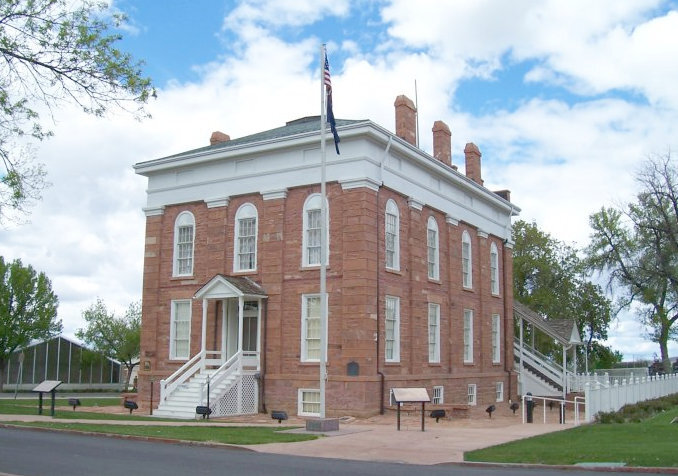
    <summary type="html"><![CDATA[<p><strong><em>Controversy arose during Brigham Young’s time as governor of the Utah territory while Fillmore served as the territorial capital of Utah. Although poised to grow into a prolific settlement with a grand statehouse, Fillmore could not fulfill or maintain the territory’s expectations. Instead, the small farming community’s duration as territorial capital proved short lived, lasting from 1851 to 1856 when it was replaced by Salt Lake City. Though the legislature only met here once in 1855, Fillmore played an important role in Utah’s territorial history.</em></strong></p><img src="https://www.intermountainhistories.org/files/fullsize/18f99296cb52e1568c4b646dc915584c.jpg" alt="The statehouse in Fillmore" /><br/><p>Nestled in the Pahvant Valley of south-central Utah, Fillmore was envisioned as Utah’s magnificent territorial capital in the geographic center of Utah Territory 148 miles south of Salt Lake City and 162 miles north of Saint George. Jesse W. Fox surveyed the town on October 28, 1851. Anson Call led the colonization party of thirty families that built homes, the sawmill, and the gristmill. Renowned church architect Truman O. Angell—designer of the Salt Lake City and St. George temples—fashioned a lovely design for the territorial statehouse. Though somewhat desolate, Fillmore developed modestly within several years. Construction of the statehouse began in 1852 and the completed west wing housed the first legislative session in 1855. Farmers channeled irrigation systems from the Sevier River bringing water to their crops and livestock.
Ute resistance to Latter-day Saint intrusions into their traditional homeland suppressed the town’s expansion. Ute leader Chief Kanosh tried to maintain amicable relations with the pioneers, but finite resources limited his generosity. Tension between Mormon settlers and their Indian neighbors led to several confrontations in the 1850s and ’60s: the Gunnison massacre of 1853; the Walker War of 1853–55; the Tintic War of 1856; and the Black Hawk War of 1865–67. The Saints erected Fort Fillmore in 1853–54 and nearby Cove Fort in 1867 as protection against Indian raids.
Notwithstanding Fillmore’s designation as the official territorial capital, Brigham Young and other Church leaders continued to govern the Saints from Salt Lake City. The mountainous expanse of distance between Fillmore and Salt Lake coupled with insufficient resources meant Fillmore had not developed the prestige nor population needed to become the capital city. In December 1855, legislators met in the completed west wing of the state house in Fillmore and decided to officially build a new capitol in Salt Lake City following the final legislative session in the statehouse in 1856. The town of Fillmore was left to maintain its welfare in arid southern Utah, and the statehouse forever remained incomplete.
The Utah War from 1856–57 exacerbated Fillmore’s remote conditions. In March 1857, President James Buchanan sent 2,500 United States troops to Salt Lake City to quell the supposed Mormon rebellion and depose Brigham Young as governor. The federal government distrusted the Mormons and persecuted them for their practice of polygamy. The situation deteriorated when Church leaders pressed for the nation to admit their proposed state of Deseret into the Union and moved the territorial capital to Salt Lake City, a populace entirely governed by the Church. The national government determined to replace Young as territorial governor with Alfred Cumming to ensure that the United States government could maintain control. Fortunately, Thomas Kane helped negotiate peace in exchange for Utah’s acceptance of the new governor in 1858, and the Saints received amnesty for their alleged crimes.
Fillmore remained too small to hold its position as Utah’s capital. Salt Lake City had better resources, a larger population, and the added advantage of not being isolated in the heart of indigenous territory. Preserved by the devoted families living there, historic Fillmore stands as a reflection of Utah’s territorial past, a shadow of unfulfilled ambitions.</p><p><em><strong><a href="https://www.intermountainhistories.org/items/show/466">For more (including 3 images) view the original article</a></strong></em></p>]]></summary>
    <published>2021-09-09T23:28:33+00:00</published>
    <updated>2026-04-17T19:32:09+00:00</updated>
    <link rel="alternate" type="text/html" href="https://www.intermountainhistories.org/items/show/466"/>
    <id>https://www.intermountainhistories.org/items/show/466</id>
    <author>
      <name>Rebekah Cannon, Brigham Young University</name>
    </author>
  </entry>
  <entry>
    <title type="html"><![CDATA[Utah Territorial Statehouse<br />
]]></title>
    <summary type="html"><![CDATA[<p><strong><em>The Utah Territorial Statehouse stands as a reminder that the small city of Fillmore, Utah was once the capital of a vast US territory.</em></strong></p><img src="https://www.intermountainhistories.org/files/fullsize/3f34bfb2ba935f48f6ae0ba6c87e50e5.jpg" alt="[Untitled]" /><br/><p>The oldest government building in Utah is now a museum full of pioneer relics such as ox yokes and a grain cradle and other important artifacts and documents. After the organization of the Utah Territory on September 9, 1850, the legislature had to charge to decide where their official capital would be located. Although Salt Lake City was the original chosen location, the city of Fillmore, located 150 miles from Salt Lake and situated in a sparsely populated secluded desert area, was named the site of the capital. LDS Church leaders, including the President of the Church, Brigham Young, had hopes for Mormons to settle throughout the Intermountain West. The Federal Government gave the territorial legislature $20,000 and the new territory and Utah legislature used it to construct a statehouse. </p><p>Orson Pratt, Albert Canington, Jesse W. Fox, and William C. Staines were chosen by President Young along with other leaders to head to Fillmore the fall of 1851 to find identify the exact location where the statehouse would be built. Along with the chosen four, Young delegated Anson Call to take members to settle the area while the construction was underway. Truman 0. Angel, architect of the Salt Lake Temple, was given the charge to make the plans for the statehouse. His original plans called for large, imposing, domed building with four radiating wings in the form of a cross. There was a slow start after the location was chosen because of the denial of requested funds from Washington and the lack of skilled workers. As a result, only one wing was constructed which was eventually completed by winter of 1855. After the location was chosen and the community slowly grew, some of the government officials that had been assisting began to return to Salt Lake City by October 30, 1851. The statehouse was comprised of two floors and a basement. The first floor contained 6 rooms, the second floor contained a large legislative chamber, and lastly the basement contained 8 rooms. The Fillmore statehouse only served one legislature and two one-day sessions. Because of the slow development of southern Utah and inadequate accommodations in Fillmore, on December 18, 1856 during second legislature session the legislature chose to move to Salt Lake City. </p><p>The very short life of the Fillmore statehouse was followed by its service as a jail house, a school, and a site for religious gatherings. While it was eventually abandoned, the building was saved by The Daughters of Utah Pioneers in 1930 who turned it into a museum. The museum is opened to the public all year long, except for a few holidays. The museum opens its doors to about about 22,000 tourists each year.  </p><p><em><strong><a href="https://www.intermountainhistories.org/items/show/441">For more (including 3 images) view the original article</a></strong></em></p>]]></summary>
    <published>2020-10-27T07:56:49+00:00</published>
    <updated>2026-04-17T19:32:09+00:00</updated>
    <link rel="alternate" type="text/html" href="https://www.intermountainhistories.org/items/show/441"/>
    <id>https://www.intermountainhistories.org/items/show/441</id>
    <author>
      <name>Christian Hernandez, Brigham Young University </name>
    </author>
  </entry>
</feed>