<?xml version="1.0" encoding="UTF-8"?>
<feed xmlns="http://www.w3.org/2005/Atom">
  <title type="text">Intermountain Histories</title>
  <updated>2026-04-17T19:32:17+00:00</updated>
  <generator uri="http://framework.zend.com" version="1.12.20">Zend_Feed_Writer</generator>
  <link rel="alternate" type="text/html" href="https://www.intermountainhistories.org/"/>
  <link rel="self" type="application/atom+xml" href="https://www.intermountainhistories.org/items/browse?output=rss2"/>
  <id>https://www.intermountainhistories.org/</id>
  <author>
    <name>Intermountain Histories</name>
    <uri>https://www.intermountainhistories.org</uri>
  </author>
  <link rel="hub" href="https://pubsubhubbub.appspot.com/"/>
  <entry>
    <title type="html"><![CDATA[Lagoon&#039;s Patio Gardens]]></title>
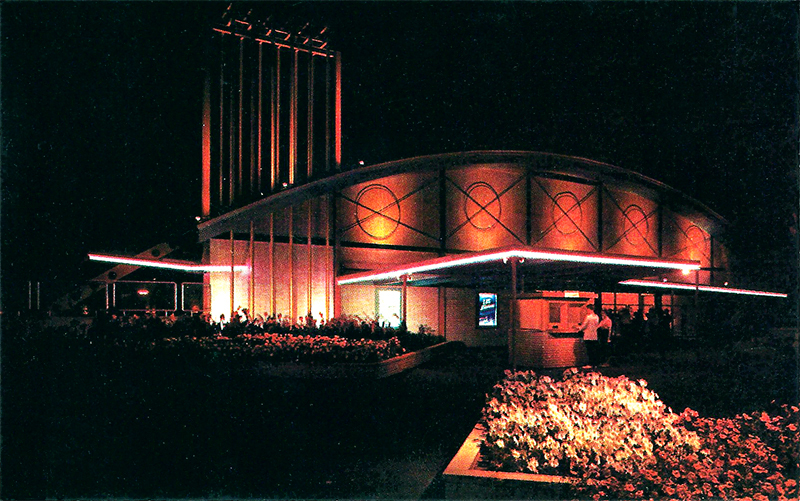
    <summary type="html"><![CDATA[<p><strong><em><span style="font-weight:400;">Utah’s Lagoon used to be more than just an amusement park; it once housed a large concert venue within its gates, hosting many performances by music legends from the 1950s to the early 1970s.</span></em></strong></p><img src="https://www.intermountainhistories.org/files/fullsize/22bf785d177cfc260f8fabc152cf11d6.jpg" alt="Postcard of Patio Gardens" /><br/><p><span style="font-weight:400;">In 1953 a fire tore throughout Lagoon, Utah’s only amusement park, and destroyed many buildings there. Then owner, Robert Freed, saw this as an opportunity to update the architecture of the park to something much more modern–to create the “New Lagoon.” One of the buildings constructed during the renovations was the Patio Gardens, a concert venue to replace an old, ruined Dancing Pavilion. While Lagoon had live performances before the 1950s, Patio Gardens, with its stage and dance floor, became the new house for concerts. The performances in Patio Gardens over the next two decades included some of the most popular national artists and would make Lagoon nationally known, especially within the 1960s counterculture music scene. </span>
<span style="font-weight:400;">One such popular group was the Beach Boys who, on September 7, 1963, thrilled their youthful Utah audience with their song “Salt Lake City,” claiming that Salt Lake City had “the grooviest kids.” The Beach Boys returned to Lagoon again and again with their final performance of fourteen appearances taking place on September 12, 1970.</span>
<span style="font-weight:400;">The Beach Boys were just one of many popular groups that performed at Patio Gardens. Other notable counterculture bands such as The Rolling Stones, The Monkees, The Who, Janis Joplin, and Jefferson Airplane also performed there. Even The Beatles were in discussions to perform at Lagoon, but their high asking price led to their exclusion. Patio Gardens also housed more classic acts, such as Benny Goodman, the Utah Symphony, and Ella Fitzgerald. </span>
<span style="font-weight:400;">Most bands had a good experience, with some even returning to perform again or immortalizing the venue in songs, as the Beach Boys did. However, there were also bands who hated the venue and, more importantly, the crowds. On May 25, 1968, The Doors performed to a crowd of about 3,500, nearing the venue’s 4,000-person capacity limit. Jim Morrison, the band’s lead singer, declared that the crowd was dead for his first performance of the day, hurled vulgar insults to the audience, and after three songs walked off of the stage, never to return. </span>
<span style="font-weight:400;">Regardless of the failure of The Doors concert, Patio Gardens is remembered fondly by many Utahns. Patio Gardens closed in 1973 after operating for twenty years. Where music legends used to perform is now the home of the dark ride Dracula’s Castle and Lagoon’s arcade. The original light fixtures and the top of the stage (the rest of which is hidden by a wall) are the only reminders of what helped make Lagoon so famous.</span></p><p><em><strong><a href="https://www.intermountainhistories.org/items/show/778">For more (including 3 images) view the original article</a></strong></em></p>]]></summary>
    <published>2024-02-22T22:07:05+00:00</published>
    <updated>2026-04-17T19:32:17+00:00</updated>
    <link rel="alternate" type="text/html" href="https://www.intermountainhistories.org/items/show/778"/>
    <id>https://www.intermountainhistories.org/items/show/778</id>
    <author>
      <name>Mikelle Andersen, Brigham Young University</name>
    </author>
  </entry>
  <entry>
    <title type="html"><![CDATA[The Clark Lane Historical District: Farmington, Utah]]></title>
    <summary type="html"><![CDATA[<p><strong><em>Listed on the National Register of Historic Places in 1994, the Clark Lane Historical District is a locally area. The district represents the architectural development of Farmington, Utah. </p></strong></p><img src="https://www.intermountainhistories.org/files/fullsize/c311fd69202c60f44b54104ed171d45e.jpg" alt="Ezra Clark House" /><br/><p><span style="font-weight:400;">The Clark Lane Historic District was founded by the Clark family. The district thrived on a system of communal ownership which continued well into the 20th century. The homes in the district offer a wide array of styles and plans popular in Utah between 1856 and 1940. The majority of Clark family homes continue to be inhabited by third and fourth generations. </span>
<span style="font-weight:400;">Ezra Thompson Clark (1823-1901) settled in Farmington, Utah in 1850 with his family.</span> <span style="font-weight:400;">Clark was part of Heber C. Kimball's pioneer company that arrived in Salt Lake City on October 12</span><span style="font-weight:400;">th</span><span style="font-weight:400;">, 1848.</span> Soonafter in 1850, Clark was one of the first settlers in Farmington. That spring he established a farm in the area. <span style="font-weight:400;">He served several missions for the Church of Jesus Christ of Latter Day Saints.</span> <span style="font-weight:400;">In addition to his service to the church, he donated generously to the Perpetual Emigration Fund Company, which helped fund the journey of other members to Utah.</span> <span style="font-weight:400;">He contributed oxen teams, wagons, and money to the building of the historic Salt Lake City temple.</span> <span style="font-weight:400;">One of his last donations to the church was $1,000 dollars to the Latter Day Saints University in Salt Lake City.</span>
<span style="font-weight:400;">In 1856, Clark completed his two-story home at 368 West State Street in Farmington.</span> <span style="font-weight:400;"> Clark and his wife, Mary Stevenson Clark (1825-1911), had five children. In 1861,</span> <span style="font-weight:400;">Ezra Thompson Clark “entered into the principle of plural marriage” and married Susan Leggett Clark (1838-1902).</span> <span style="font-weight:400;">He married his third wife, Nancy Areta Porter Clark (1825-1888), in 1870. He had 21 children with his wives.</span><span style="font-weight:400;"> </p><p>Exra Clark was extremely involved in Farmington. He founded the Davis County Bank and, in 1891, was elected as its first president. He helped organize and was the chairman of the Board of Directors for the Farmington Commercial & Manufacturing Company. Established in 1891, the company provided a general store to the community. In addition to these offices, he served as the Davis County treasurer. His sons, namely Amasa Lyman Clark, also served in the community alongside him and continued to do so after his death in 1901. Before his death, all family property was under a system modeled after the United Order which was guided by community ownership. At the end of his life, Ezra Thompson Clark owned 700 acres of land in Farmington. He had personally seen to the division of his property amongst his children prior to his passing. Each was given a homestead, a farm, cattle, and stock in the bank and the general store. </p>
<span style="font-weight:400;">In 1870, Clark built his and Susan L. Clark’s home across the street from the home of Mary S. Clark.</span><span style="font-weight:400;"> His son, Amasa Lyman Clark (1865-1968), and his wife, Alice Steed Clark (1867-1895), built their home on West State Street in 1885. His other sons, Joseph Smith Clark (1854-1957) and Eugene Henry Clark (1873-1931), built their respective homes in 1895. Additionally, their brother Timothy Baldwin (1847-1924) renovated and added onto a home built by John Leavitt in 1895. Nathan George (1875-1956) joined them in 1899 with his Victorian era home and his sister Annie Clark Tanner (1864-1942) built there in 1901. Hyrum Don Carlos(1856-1938) built his family home in the “T” cottage style popular in Utah in 1908. The Joseph Smith Clark home was the first home in Farmington with indoor plumbing. The district developed as generations of the Clark family built their homes around or, in some cases, on the same side of the street of their childhood home. </span>
<span style="font-weight:400;">Although most of these homes have undergone renovation throughout the years, they stand as a tribute to the prosperity of Ezra Thompson Clark; his property holdings, his family, his contribution to both the local and church communities, and his legacy as a pioneer of the Church of Jesus Christ of Latter Day Saints. </span></p><p><em><strong><a href="https://www.intermountainhistories.org/items/show/690">For more (including 8 images) view the original article</a></strong></em></p>]]></summary>
    <published>2022-11-02T20:48:42+00:00</published>
    <updated>2026-04-17T19:32:15+00:00</updated>
    <link rel="alternate" type="text/html" href="https://www.intermountainhistories.org/items/show/690"/>
    <id>https://www.intermountainhistories.org/items/show/690</id>
    <author>
      <name>Michelle Robinson, Weber State University</name>
    </author>
  </entry>
  <entry>
    <title type="html"><![CDATA[Davis County Memorial Courthouse <br />
]]></title>
    <summary type="html"><![CDATA[<p><strong><em><span style="font-weight:400;">The Davis County Courthouse was first built in 1890. The federal-style courthouse was then remodeled three different times to account for the conuty's growing population. The first phase was completed in 1932, and others were completed in 1957 and 1979, with renovations in 1997.</span></em></strong></p><img src="https://www.intermountainhistories.org/files/fullsize/e82dc2bdd36fa1a5b143723746da6127.jpg" alt="The First Davis County Courthouse" /><br/><p><span style="font-weight:400;">On March 22, 1852, the Davis County Commissioner told the county clerks to create three blueprints for the county’s courthouse to be approved. The winning design was a small two-story 35x45 foot adobe building. This courthouse was built upon a rocky knoll just south of State Street. The building was erected using donations and taxes, and the people of the North Cottonwood LDS Ward had donated so much to the courthouse that the ward was permitted to use an upper room of the courthouse for meetings, and parties if the room was not in use. Rooms of this first courthouse were also used as a general store, practice  hall, and dance hall. </span>
<span style="font-weight:400;">On May 20, 1889, a new courthouse was approved by the county commissioner; this courthouse would be built just a few feet south of where the existing courthouse stood so State Street could be expanded without obstruction. The second courthouse was finished on August 18, 1890 and led by architect William Allen. The original courthouse was torn down in September of 1890.</span>
<span style="font-weight:400;">Davis County continued to grow, and before long more room in the courthouse was required. In 1929, the county commissioner announced the expansion of the courthouse. The county hired architect Theo Pope and contractors F.R. Knowlton and George Rupert for the project. This expansion was paid for by a memorial levy, thus the building was named the Davis County Memorial Courthouse. The second building was to remain in place, only the large tower at the front being removed. The entrance was increased and redesigned. Two wings extending off the original structure gave the building a neoclassical look. The expansion finished in 1932. In August 1956, plans to increase the courthouse were again approved with Theo Pope serving as architect once again. Another expansion of the courthouse occurred in 1979. The County Commissioner met again with Pope in May to renovate the jail from one story to two and to build a service tunnel between the courthouse and the library. </span>
<span style="font-weight:400;">After 50 years of expansion, Davis County continued to accomodate a growing population. Iin 1990, the jail and courts had outgrown the Memorial Courthouse and moved to new facilities west of downtown Farmington. In 1996, the Memorial Courthouse had a small renovation, and the1889 building's  ceiling was uncovered. In 2010, the 1929 portion of the Memorial Courthouse joined both the Farmington Historic Landmark Register and the National Register of Historic Places. In 2010, the Farmington City Council voted to list the Davis County Memorial Courthouse as a city historic resource. In 2021, the newer section of the building was razed due to structural concerns. </span></p><p><em><strong><a href="https://www.intermountainhistories.org/items/show/685">For more view the original article</a></strong></em></p>]]></summary>
    <published>2022-10-28T17:24:48+00:00</published>
    <updated>2026-04-17T19:32:15+00:00</updated>
    <link rel="alternate" type="text/html" href="https://www.intermountainhistories.org/items/show/685"/>
    <id>https://www.intermountainhistories.org/items/show/685</id>
    <author>
      <name>Marina Kenner, Weber State University </name>
    </author>
  </entry>
  <entry>
    <title type="html"><![CDATA[Farmington Rock Chapel and the First Latter-day Saint Primary]]></title>
    <summary type="html"><![CDATA[<p><strong><em>Built of rock and gravel, the Farmington Rock Chapel was the birthplace of the Primary Association, a Latter-day Saint church group which has grown to be a significant world-wide children’s organization. The chapel continues to serve as a worship place for Farmington residents today.</em></strong></p><img src="https://www.intermountainhistories.org/files/fullsize/4402dd70afb18b42ed4999a08fbccde0.jpg" alt="Rock Chapel" /><br/><p>The Farmington Rock Chapel has long provided the community of Farmington with a place to worship and to gather. Before its construction, members of The Church of Jesus Christ of Latter-day Saints living in Farmington met for church services in one another’s homes, the schoolhouse, and courthouse, but none were large enough—or appropriate enough in the case of the courthouse—for all to meet in. When a windstorm caused a rockslide which provided enough rocks, sand, and gravel to build a chapel for themselves, Farmington’s Latter-day Saints considered it a miracle. They began construction on the chapel in 1861 and finished in 1863.
The biggest event of general significance in the Rock Chapel was the formation of the Church’s Primary Association, a subunit of the Church dedicated to children’s education and spiritual development, on August 11, 1878 by Aurelia Spencer Rogers, a Farmington resident, and Eliza R. Snow, the general Relief Society President of the Church. They held the first Primary meeting on August 25, 1878 in the Farmington Rock Chapel, where 115 children attended. Rogers felt that forming a children’s organization in the Church was necessary because the children of Farmington had too much unsupervised time. She and Snow founded the Primary Association to teach children lessons on gospel principles, civic and cultural duties, and good manners. The Primary eventually spread to other congregations, and it was adopted churchwide in 1880.
Since the organization of the Primary, the Rock Chapel has been the home of several congregations and the site of events of varying significance. Latter-day Saints continue to worship in the Rock Chapel to this day. The Church added three additional wings to the original in 1941 and 1980. Because of its significance to the residents of Farmington, the chapel was added to the U.S. National Register of Historic Places in October 2011, and tourists can visit the Rock Chapel as part of a historic trail along Farmington’s Main Street.</p><p><em><strong><a href="https://www.intermountainhistories.org/items/show/558">For more (including 4 images) view the original article</a></strong></em></p>]]></summary>
    <published>2021-12-18T03:27:47+00:00</published>
    <updated>2026-04-17T19:32:12+00:00</updated>
    <link rel="alternate" type="text/html" href="https://www.intermountainhistories.org/items/show/558"/>
    <id>https://www.intermountainhistories.org/items/show/558</id>
    <author>
      <name>Brittany Leonard, Brigham Young University</name>
    </author>
  </entry>
  <entry>
    <title type="html"><![CDATA[Lagoon’s Desegregation]]></title>
    <summary type="html"><![CDATA[<p><strong><em>Lagoon was a place of tradition turned trailblazer when its owner, Robert E. Freed, was one of the first venue owners to invite racial integration.</em></strong></p><img src="https://www.intermountainhistories.org/files/fullsize/86424cbc29d3496eff31b25048b983a3.jpg" alt="Colossus Roller Coaster" /><br/><p>Originally situated on the shores of the Great Salt Lake and later relocating to Farmington, UT, Lagoon was (and still is) a constantly evolving business. It began as Lake Park, offering a mule-drawn carousel, roller skating, and bowling, and today is a large amusement park with record-breaking multi-million-dollar steel roller coasters and over a million visitors every year. While Lagoon has evolved economically, perhaps even more significant is its demonstration of social progress. Lagoon set the stage when it officially desegregated in the 1940s, and many other public venues followed. </p><p>Unlike some of the states where the Civil Rights movement of the mid-20th century was intensely focused, Utah never had Jim Crow laws or other legislation explicitly forcing white and black people to stay separated. However, racial minorities in Utah were victim to de facto segregation (which was often due indirectly to legislation, whether intentional or not). Though Utah wasn’t on the forefront of national civil rights news, the issues were pertinent and pressing in Utah cities as well. Between 1940 and 1950, the Black population in Utah more than doubled, and tensions between the white majority and marginalized minorities continued to rise.</p><p>Without official segregation laws and few cities with more than one school, it was up to business owners to change the public’s mind about who was allowed where. After World War II, some businesses began to desegregate. One of the first was Lagoon. Lagoon had been closed during the war, and was reopened and revamped in 1946-1947. Then, Robert E. Freed, one of the owners, made the attractions at Lagoon, as well as his Rainbow Rendezvous Ballroom in Salt Lake City, available to all races. After this bold move, it didn’t take long for other businesses and city pools to open their doors to minorities as well. </p><p>Appropriately-named Robert Freed made a pivotal move when he integrated his park in the 1940s, and Utah has been working for racial equality ever since.</p><p><em><strong><a href="https://www.intermountainhistories.org/items/show/85">For more (including 5 images) view the original article</a></strong></em></p>]]></summary>
    <published>2017-08-16T21:20:56+00:00</published>
    <updated>2026-04-17T19:31:59+00:00</updated>
    <link rel="alternate" type="text/html" href="https://www.intermountainhistories.org/items/show/85"/>
    <id>https://www.intermountainhistories.org/items/show/85</id>
    <author>
      <name>Aubrey Glazier, Brigham Young University</name>
    </author>
  </entry>
</feed>
