<?xml version="1.0" encoding="UTF-8"?>
<feed xmlns="http://www.w3.org/2005/Atom">
  <title type="text">Intermountain Histories</title>
  <updated>2026-04-17T19:32:15+00:00</updated>
  <generator uri="http://framework.zend.com" version="1.12.20">Zend_Feed_Writer</generator>
  <link rel="alternate" type="text/html" href="https://www.intermountainhistories.org/"/>
  <link rel="self" type="application/atom+xml" href="https://www.intermountainhistories.org/items/browse?output=rss2"/>
  <id>https://www.intermountainhistories.org/</id>
  <author>
    <name>Intermountain Histories</name>
    <uri>https://www.intermountainhistories.org</uri>
  </author>
  <link rel="hub" href="https://pubsubhubbub.appspot.com/"/>
  <entry>
    <title type="html"><![CDATA[The Children of Aaron: EskDale]]></title>
    <summary type="html"><![CDATA[<p><strong><em>EskDale is a communal settlement in the west Utah desert that combines elements of Mormonism, Christianity and Judaism. Members see themselves as the successors of the biblical priests leading back to Aaron.</em></strong></p><img src="https://www.intermountainhistories.org/files/fullsize/67e193c5427ffaf63d27a421ba0ef2e9.jpg" alt="Maurice Glendenning" /><br/><p><span style="font-weight:400;">EskDale was founded by chiropractor Maurice Glendenning (1891-1969), who heard heavenly music as a boy while picking berries and fishing in Kansas; later a voice dictated cryptic poems to him. Eventually, he stopped transcribing the poems, perceiving them as the work of Satan. Believing that God had placed a curse upon him for disobedience, he wandered from place to place without professional success. Eventually he and his family settled in Provo, Utah, where he resumed recording the poems. Here, in 1929, he was baptized into the Church of Jesus Christ of Latter-day Saints (LDS, Mormon) and found people in the congregation who were interested in his revelations. </span>
<span style="font-weight:400;">In 1938, Glendenning related a vision in which the Angel Elias anointed him as a priest of Aaron; he later organized his group of followers as the Aaronic Order, for which he and several of his followers were excommunicated from the LDS Church. The Aaronic Order interacted with other religious groups over the next two decades, including Quakers, Hutterites, Christian evangelists, and Pentecostal preachers, all of whom influenced their beliefs.</span>
<span style="font-weight:400;">In 1948, Glendenning had a revelation encouraging the community to establish communal settlements in the tradition of the early Christians. After several settlement attempts, the group acquired some land in the desert of western Utah with an underground stream that they named the River Esk after a Scottish waterway. The settlement’s name honors this river. After drilling wells for irrigation and amending the alkaline soil, the community was able to cultivate alfalfa, small grains, vegetables, and fruits. EskDale survived rudimentary conditions for the first few decades, not having electricity or telephone service until the 1970s. The community’s main source of income has always been from raising dairy cattle, although there were several unsuccessful business ventures over the years, including egg production, furniture making, propane delivery, and ceramics.</span>
<span style="font-weight:400;">EskDale is run as a for-profit common fund community and includes members who live in the commune and others who join for worship and special events. As of 2000, there were 34 adults and 25 children living as full members. All finances are managed centrally, and the community pays for individuals’ utilities, taxes, insurance, health care, food, and a small monthly allowance. There are also communally-owned vehicles that residents check out if travelling out of EskDale.</span>
<span style="font-weight:400;">The community has a daily routine of prayer and hymns marked by bells and celebrates weekly sacrament services and Passover, Pentecost, and Tabernacles. They combine traditions from Judaism such as blowing the shofar, wearing a prayer shawl, and abstaining from pork with traditions from Christianity such as partaking of bread and wine as the body and blood of Christ. Some dancing and some music are prohibited.</span>
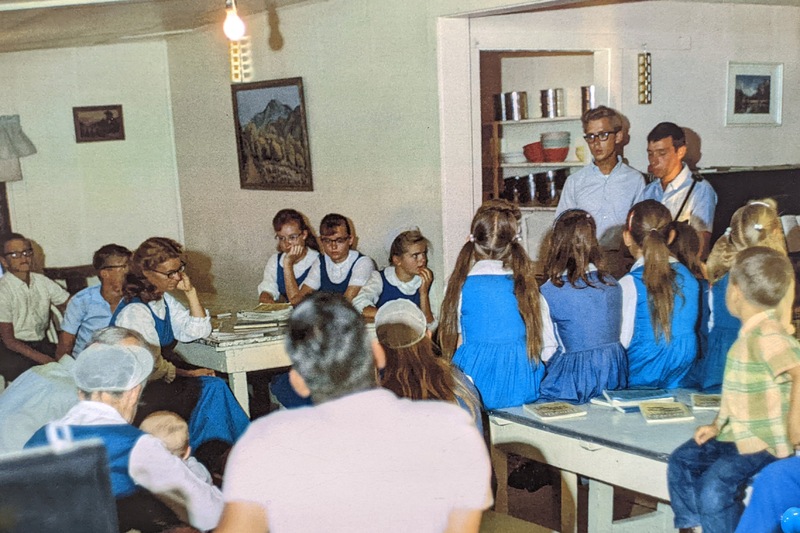
<span style="font-weight:400;">EskDale’s rules and rituals have changed over the years. Meals were once all eaten in silence and all members wore uniforms, but these practices have fallen by the wayside. Women did not play a role in the administration in the early days, but have since gained more positions of authority. Some members have regretted these changes, seeing them as a loss of identity for the community.</span></p><p><em><strong><a href="https://www.intermountainhistories.org/items/show/705">For more (including 7 images) view the original article</a></strong></em></p>]]></summary>
    <published>2023-02-21T19:50:36+00:00</published>
    <updated>2026-04-17T19:32:15+00:00</updated>
    <link rel="alternate" type="text/html" href="https://www.intermountainhistories.org/items/show/705"/>
    <id>https://www.intermountainhistories.org/items/show/705</id>
    <author>
      <name>Evan Železny-Green, Northern Arizona University</name>
    </author>
  </entry>
  <entry>
    <title type="html"><![CDATA[The Aaronic Order of Eskdale, Utah]]></title>
    <summary type="html"><![CDATA[<p><strong><em>Just outside of Great Basin National park in western Utah lies an isolated community full of faithful individuals who fully live the law of consecration and spend their days busily preparing for the Second Coming of the Lord Jesus Christ.</em></strong></p><img src="https://www.intermountainhistories.org/files/fullsize/d13c1e0371026176d5f63b8eeb853dac.jpg" alt="Young men singing in the Eskdale schoolhouse ca. 1975" /><br/><p>Early in his life, Maurice L. Glendenning (1891-1969) began hearing music in his head that soon gave way to songs, poetry, and eventually the spoken words of the prophet Elias. After sharing his revelations with other Latter-day Saints around Provo in the 1920s and 1930s, Glendenning established a church known as the Aaronic Order. Communal living and full consecration soon became fundamental to the faith of the Aaronites. In order to escape the worldly influence of the cities along the Wasatch Front and claim more space for agricultural ventures, the Aaronites left their original settlement in Springville for the West Desert of Utah. </p><p>In 1955, Aaronic Order members settled Eskdale using Desert Entry Act land. Unlike with federal land acquired through the Homestead Act, Aaronites were able to pool together the original lots and build community buildings in close proximity to one another. The chapel, school, community kitchen and dining hall were the first buildings constructed on the site. Since the mid-twentieth century, community members have built additional homes, school buildings, and a dairy. Although the bread and butter of Eskdale is still bread and butter, employment has expanded from subsistence agriculture to now include metal manufacturing and remote professional work for the University of Utah, Boeing, and a law firm in Salt Lake City. </p><p>The social atmosphere of Eskdale has changed considerably over the past few decades. These social changes can be attributed to the change in leadership from Maurice Glendenning to Robert Conrad and then John Conrad, as none of the social expectations were canonized in Dr. Glendenning's Levitical Writings. Men, women, and children who belonged to the Aaronic Order used to wear homemade uniforms, but as of the late-twentieth century, these are no longer required. Church leaders had warned against "wreck-reation" like dancing, hunting, fishing, sports, and riding motorized vehicles. These activities are now commonplace and, in the case of dancing, actively encouraged within the community. Communal meals are now held only once per day in the community building instead of three times a day. School children used to live in a dormitory within the community instead of with their parents, though this has also changed. In recent decades and in all domains of life, Aaronites have bridged the gap between their community and the world.</p><p><em><strong><a href="https://www.intermountainhistories.org/items/show/649">For more (including 3 images) view the original article</a></strong></em></p>]]></summary>
    <published>2022-09-13T19:21:59+00:00</published>
    <updated>2026-04-17T19:32:14+00:00</updated>
    <link rel="alternate" type="text/html" href="https://www.intermountainhistories.org/items/show/649"/>
    <id>https://www.intermountainhistories.org/items/show/649</id>
    <author>
      <name>Brian Joseph Fitzsimmons, Brigham Young University</name>
    </author>
  </entry>
</feed>