<?xml version="1.0" encoding="UTF-8"?>
<feed xmlns="http://www.w3.org/2005/Atom">
  <title type="text">Intermountain Histories</title>
  <updated>2026-04-17T19:32:17+00:00</updated>
  <generator uri="http://framework.zend.com" version="1.12.20">Zend_Feed_Writer</generator>
  <link rel="alternate" type="text/html" href="https://www.intermountainhistories.org/"/>
  <link rel="self" type="application/atom+xml" href="https://www.intermountainhistories.org/items/browse?output=rss2"/>
  <id>https://www.intermountainhistories.org/</id>
  <author>
    <name>Intermountain Histories</name>
    <uri>https://www.intermountainhistories.org</uri>
  </author>
  <link rel="hub" href="https://pubsubhubbub.appspot.com/"/>
  <entry>
    <title type="html"><![CDATA[Lagoon&#039;s Patio Gardens]]></title>
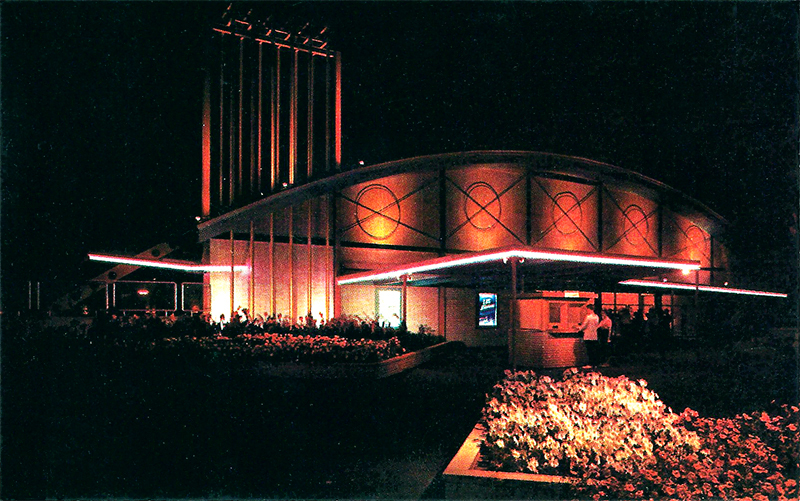
    <summary type="html"><![CDATA[<p><strong><em><span style="font-weight:400;">Utah’s Lagoon used to be more than just an amusement park; it once housed a large concert venue within its gates, hosting many performances by music legends from the 1950s to the early 1970s.</span></em></strong></p><img src="https://www.intermountainhistories.org/files/fullsize/22bf785d177cfc260f8fabc152cf11d6.jpg" alt="Postcard of Patio Gardens" /><br/><p><span style="font-weight:400;">In 1953 a fire tore throughout Lagoon, Utah’s only amusement park, and destroyed many buildings there. Then owner, Robert Freed, saw this as an opportunity to update the architecture of the park to something much more modern–to create the “New Lagoon.” One of the buildings constructed during the renovations was the Patio Gardens, a concert venue to replace an old, ruined Dancing Pavilion. While Lagoon had live performances before the 1950s, Patio Gardens, with its stage and dance floor, became the new house for concerts. The performances in Patio Gardens over the next two decades included some of the most popular national artists and would make Lagoon nationally known, especially within the 1960s counterculture music scene. </span>
<span style="font-weight:400;">One such popular group was the Beach Boys who, on September 7, 1963, thrilled their youthful Utah audience with their song “Salt Lake City,” claiming that Salt Lake City had “the grooviest kids.” The Beach Boys returned to Lagoon again and again with their final performance of fourteen appearances taking place on September 12, 1970.</span>
<span style="font-weight:400;">The Beach Boys were just one of many popular groups that performed at Patio Gardens. Other notable counterculture bands such as The Rolling Stones, The Monkees, The Who, Janis Joplin, and Jefferson Airplane also performed there. Even The Beatles were in discussions to perform at Lagoon, but their high asking price led to their exclusion. Patio Gardens also housed more classic acts, such as Benny Goodman, the Utah Symphony, and Ella Fitzgerald. </span>
<span style="font-weight:400;">Most bands had a good experience, with some even returning to perform again or immortalizing the venue in songs, as the Beach Boys did. However, there were also bands who hated the venue and, more importantly, the crowds. On May 25, 1968, The Doors performed to a crowd of about 3,500, nearing the venue’s 4,000-person capacity limit. Jim Morrison, the band’s lead singer, declared that the crowd was dead for his first performance of the day, hurled vulgar insults to the audience, and after three songs walked off of the stage, never to return. </span>
<span style="font-weight:400;">Regardless of the failure of The Doors concert, Patio Gardens is remembered fondly by many Utahns. Patio Gardens closed in 1973 after operating for twenty years. Where music legends used to perform is now the home of the dark ride Dracula’s Castle and Lagoon’s arcade. The original light fixtures and the top of the stage (the rest of which is hidden by a wall) are the only reminders of what helped make Lagoon so famous.</span></p><p><em><strong><a href="https://www.intermountainhistories.org/items/show/778">For more (including 3 images) view the original article</a></strong></em></p>]]></summary>
    <published>2024-02-22T22:07:05+00:00</published>
    <updated>2026-04-17T19:32:17+00:00</updated>
    <link rel="alternate" type="text/html" href="https://www.intermountainhistories.org/items/show/778"/>
    <id>https://www.intermountainhistories.org/items/show/778</id>
    <author>
      <name>Mikelle Andersen, Brigham Young University</name>
    </author>
  </entry>
  <entry>
    <title type="html"><![CDATA[Serving My People and the Earth Mother: Bear Tribe Medicine Society]]></title>
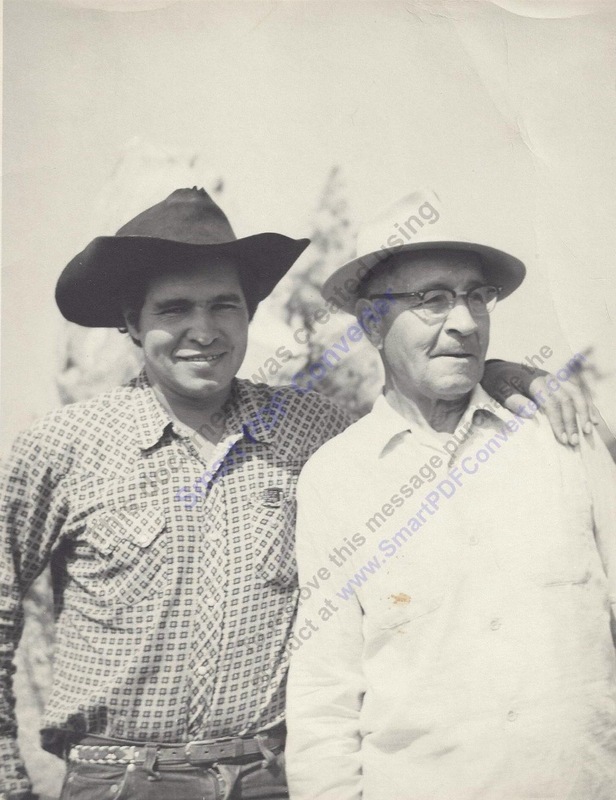
    <summary type="html"><![CDATA[<p><strong><em>Bear Tribe Medicine Society was an interracial center founded in 1971 by Sun Bear, an Ojibwe man who had a vision of people of all ethnicities coming together to learn to live in harmony with the Earth. It was controversial among some Native American groups who felt that he was commercializing Native spirituality.</em></strong></p><img src="https://www.intermountainhistories.org/files/fullsize/8e7de5dc5d0dc54c37cd2525860f464c.jpg" alt="Sun Bear" /><br/><p><p style="font-weight:400;">Bear Tribe Medicine Society was founded by Sun Bear (1929-1992), a half-Ojibwe man born as Vincent LaDuke on the White Earth Reservation in Minnesota. After travelling the country, he landed in California, where he worked as a Hollywood actor. He also was involved with various self-help and fundraising activities for Native communities.
<p style="font-weight:400;">Sun Bear related that he learned the ways of medicine men from his uncles and older brothers on the reservation, and then studied with other tribes around the country. He worked as a medicine man exclusively for Native people until 1971, when he had visions of catastrophic changes to the Earth due to the imbalances created by modern secular society, and a revelation that he should start working with non-Native people. He later stated that his purpose was to look for ways to serve his people and the Earth Mother and clarified that “his people” referred to not only Native people but others seeking a more harmonious way of living. He went on to establish the Bear Tribe Medicine Society, described as an “ecologically oriented cooperative community striving to relearn a harmonious relationship to the Earth Mother, the Great Spirit, and the mineral, plant, animal, and human kingdoms of the earth.”
<p style="font-weight:400;">As of 1988, the Society had a full-time community of fifteen to twenty<span> </span>members who lived on a forty-acre farm on Vision Mountain in Tumtum, near Spokane, Washington, as well as 320 apprentices who lived across the country. The society offered a ten-day screening program in order to select new apprentices. The community valued self-sufficiency. Aside from organizing seminars and workshops, members engaged in various economic activities including publishing a magazine and books and organizing events where Native craftspeople from reservations could earn income. They raised 80-90% of their own food and collected timber left by local loggers for fuel.
<p style="font-weight:400;">Upon Sun Bear’s death in 1992, leadership of the Bear Tribe Medicine Society passed to his assistant Wabun Wind, who led the group for four years until passing the role on to Wind Daughter, a long-time student. She continues to lead the community under the name of Panther Lodge Bear Tribe Medicine Society in Mobile, AL.
<p style="font-weight:400;">Sun Bear encountered criticism from some Native American groups who labelled him as a “plastic medicine man” and claimed that he was commercializing Native American spiritual practices. They felt that he was not a recognized leader in any tribe and that one cannot simply start one’s own tribe. Sun Bear contended that he was not teaching truly Indian spirituality but rather something else, as he took inspiration from the practices of various tribes and added to them with his own ideas. In response to the claim that Sun Bear was profiting from traditional cultural practices, one author commented that Sun Bear drove a beat-up car and lived on a small stipend.
<p style="font-weight:400;">Winona LaDuke, the daughter of Sun Bear and a Jewish-American woman, is an activist who became the first Green Party candidate and the first Native-American woman to receive an electoral college vote for vice president of the United States.</p><p><em><strong><a href="https://www.intermountainhistories.org/items/show/707">For more (including 4 images) view the original article</a></strong></em></p>]]></summary>
    <published>2023-02-22T16:19:26+00:00</published>
    <updated>2026-04-17T19:32:15+00:00</updated>
    <link rel="alternate" type="text/html" href="https://www.intermountainhistories.org/items/show/707"/>
    <id>https://www.intermountainhistories.org/items/show/707</id>
    <author>
      <name>Evan Železny-Green, Northern Arizona University</name>
    </author>
  </entry>
  <entry>
    <title type="html"><![CDATA[Aryan Nations Compound]]></title>
    <summary type="html"><![CDATA[<p><strong><em><span style="font-weight:400;">Aryan Nations was a community founded in 1973 by White nationalist, Richard Butler, to serve as the nucleus of an Aryan (White) homeland in northern Idaho. It closed in 2000 due to a court judgment after members assaulted two local Native American people.</span></em></strong></p><img src="https://www.intermountainhistories.org/files/fullsize/ccbe800e83299d88222551b757292630.jpg" alt="The Founder" /><br/><p><span style="font-weight:400;">Aryan Nations was a White-nationalist community founded on the Christian Identity movement which was based on the belief that people of Northern European ancestry are the true descendants of the ancient Israelites. The most prominent early figure in the movement was California minister Wesley A. Swift (1913-1970), who added the belief that people of color are subhuman and that Jews are descendants of Satan with inordinate power who want to destroy the White race. </span>
<span style="font-weight:400;">Richard Girnt Butler (1918-2004) was an aeronautical engineer who was inspired by the caste system while working in India during WWII and hoped to import the idea to the United States. Later, while living in California, he began to attend Swift’s sermons and became active in the church, eventually taking over as leader upon Swift’s death in 1970. In 1973, he moved his congregation to a twenty-acre property near the town of Hayden Lake, Idaho, hoping that it would be the nucleus of a future “Aryan homeland” in the northwestern states.</span>
<span style="font-weight:400;">Some parishioners moved with Butler from California to Idaho, and he used various recruiting methods to enlarge the congregation, including offering land to local struggling farmers and conducting prison outreach. He constructed a bunkhouse where formerly incarcerated men could live in exchange for printing and distributing his literature, and a watchtower with armed guards after an unknown person bombed his church.</span>
<span style="font-weight:400;">Only four people lived permanently on the grounds, but there were normally other residents staying there for periods of time ranging from months to years, and people living outside of the compound attended regular Sunday services, Bible studies, and holiday celebrations. Members were expected to abstain from alcohol, drugs, swearing, and extra-marital sex. There were numerous collective projects such as home-schooling residents’ children, operating the printing press, and administering the prison ministry.</span>
<span style="font-weight:400;">Over the next few decades, the Aryan Nations compound served as a gathering place for the White-supremacist movement, as exemplified by the annual Aryan Youth Festival and the Aryan World Congress, attended by hundreds of members of various White-supremacist groups, such as the KKK, neo-Nazis, and skinheads throughout the 1980s. Butler referred to it as the “international headquarters of the White race.” </span>
<span style="font-weight:400;">In the early 1980s the organization received public attention because of a series of bank robberies and a murder committed by a splinter group. The organization also faced increased resistance from locals in Cœur d’Alene; Kootenai County established a task force for human rights and residents would often protest the group’s activities.</span>
<span style="font-weight:400;">Aryan Nations was deteriorating by the late 1990s, however it met with a sudden, dramatic dénouement.  On July 1, 1998, two security guards assaulted Victoria Keenan, a local Native American woman, and her son on the road outside the compound. In a 2000 verdict, a district court found the organization negligent in the management of the guards and required it to pay $6.3 million to the victims. Butler declared bankruptcy and the compound was awarded to the Keenans. After leadership disputes following Butler’s death in 2004, Aryan Nations splintered into various factions.</span></p><p><em><strong><a href="https://www.intermountainhistories.org/items/show/706">For more (including 4 images) view the original article</a></strong></em></p>]]></summary>
    <published>2023-02-22T03:23:02+00:00</published>
    <updated>2026-04-17T19:32:15+00:00</updated>
    <link rel="alternate" type="text/html" href="https://www.intermountainhistories.org/items/show/706"/>
    <id>https://www.intermountainhistories.org/items/show/706</id>
    <author>
      <name>Evan Železny-Green, Northern Arizona University</name>
    </author>
  </entry>
  <entry>
    <title type="html"><![CDATA[The Children of Aaron: EskDale]]></title>
    <summary type="html"><![CDATA[<p><strong><em>EskDale is a communal settlement in the west Utah desert that combines elements of Mormonism, Christianity and Judaism. Members see themselves as the successors of the biblical priests leading back to Aaron.</em></strong></p><img src="https://www.intermountainhistories.org/files/fullsize/67e193c5427ffaf63d27a421ba0ef2e9.jpg" alt="Maurice Glendenning" /><br/><p><span style="font-weight:400;">EskDale was founded by chiropractor Maurice Glendenning (1891-1969), who heard heavenly music as a boy while picking berries and fishing in Kansas; later a voice dictated cryptic poems to him. Eventually, he stopped transcribing the poems, perceiving them as the work of Satan. Believing that God had placed a curse upon him for disobedience, he wandered from place to place without professional success. Eventually he and his family settled in Provo, Utah, where he resumed recording the poems. Here, in 1929, he was baptized into the Church of Jesus Christ of Latter-day Saints (LDS, Mormon) and found people in the congregation who were interested in his revelations. </span>
<span style="font-weight:400;">In 1938, Glendenning related a vision in which the Angel Elias anointed him as a priest of Aaron; he later organized his group of followers as the Aaronic Order, for which he and several of his followers were excommunicated from the LDS Church. The Aaronic Order interacted with other religious groups over the next two decades, including Quakers, Hutterites, Christian evangelists, and Pentecostal preachers, all of whom influenced their beliefs.</span>
<span style="font-weight:400;">In 1948, Glendenning had a revelation encouraging the community to establish communal settlements in the tradition of the early Christians. After several settlement attempts, the group acquired some land in the desert of western Utah with an underground stream that they named the River Esk after a Scottish waterway. The settlement’s name honors this river. After drilling wells for irrigation and amending the alkaline soil, the community was able to cultivate alfalfa, small grains, vegetables, and fruits. EskDale survived rudimentary conditions for the first few decades, not having electricity or telephone service until the 1970s. The community’s main source of income has always been from raising dairy cattle, although there were several unsuccessful business ventures over the years, including egg production, furniture making, propane delivery, and ceramics.</span>
<span style="font-weight:400;">EskDale is run as a for-profit common fund community and includes members who live in the commune and others who join for worship and special events. As of 2000, there were 34 adults and 25 children living as full members. All finances are managed centrally, and the community pays for individuals’ utilities, taxes, insurance, health care, food, and a small monthly allowance. There are also communally-owned vehicles that residents check out if travelling out of EskDale.</span>
<span style="font-weight:400;">The community has a daily routine of prayer and hymns marked by bells and celebrates weekly sacrament services and Passover, Pentecost, and Tabernacles. They combine traditions from Judaism such as blowing the shofar, wearing a prayer shawl, and abstaining from pork with traditions from Christianity such as partaking of bread and wine as the body and blood of Christ. Some dancing and some music are prohibited.</span>
<span style="font-weight:400;">EskDale’s rules and rituals have changed over the years. Meals were once all eaten in silence and all members wore uniforms, but these practices have fallen by the wayside. Women did not play a role in the administration in the early days, but have since gained more positions of authority. Some members have regretted these changes, seeing them as a loss of identity for the community.</span></p><p><em><strong><a href="https://www.intermountainhistories.org/items/show/705">For more (including 7 images) view the original article</a></strong></em></p>]]></summary>
    <published>2023-02-21T19:50:36+00:00</published>
    <updated>2026-04-17T19:32:15+00:00</updated>
    <link rel="alternate" type="text/html" href="https://www.intermountainhistories.org/items/show/705"/>
    <id>https://www.intermountainhistories.org/items/show/705</id>
    <author>
      <name>Evan Železny-Green, Northern Arizona University</name>
    </author>
  </entry>
  <entry>
    <title type="html"><![CDATA[Polygamy on the State Line: Short Creek Settlement]]></title>
    <summary type="html"><![CDATA[<p><strong><em>Short Creek was an isolated fundamentalist Mormon intentional community where locals practiced polygamy and communalism. It drew public attention due to a government raid in the 1950s and the imprisonment of its leader in the 2000s.</em></strong></p><img src="https://www.intermountainhistories.org/files/fullsize/1b0bce102b2c4e32a46d16d967d6663f.jpg" alt="Lorin C. Wooley (1856-1934)" /><br/><p><span style="font-weight:400;">Mainstream members of the Church of Jesus Christ of Latter-day Saints (LDS, or Mormons) practiced and accepted polygamy from its introduction to Church practice in the 1840s until the Church prohibited it in 1890 and 1904. This came after years strong anti-polygamy sentiments in the United States and legal persecution of its practitioners. Though facing excommunication after this, some continued the practice and began to coalesce in isolated rural sites, producing their own leaders such as Lorin C. Wooley (1856-1934). He wanted to revive another nineteenth-century practice, the United Order program, intended to emulate the collectivism of the early Christian community by establishing communities based on income equality, group self-sufficiency, and the elimination of poverty. Generally, members contributed their economic property to the community and received a share of the proceeds as income or as housing and food. </span>
<span style="font-weight:400;">Aiming to continue these two traditions, Woolley’s followers established settlements such as Short Creek. Located on the Arizona side of the border with Utah, Short Creek was difficult to reach from Arizona due to the Grand Canyon, an ideal location for remaining out of public scrutiny and for escaping to Utah in case of trouble. Polygamists settled in Short Creek in the 1920s and 1930s, eventually reaching forty families as the Church continued to excommunicate practicing polygamists. Cooperative living was a goal of the inhabitants from the beginning, and in 1936, the community created a trust holding title to land and farm equipment; it also collected clothing and fuel and redistributed these items among the members, who worked the community’s lands.</span>
<span style="font-weight:400;">The community entered public awareness in the early 1950s. Following a complaint from a judge in Kingman, the county seat, the Arizona attorney general planned a raid. He commissioned a detective agency to explore the settlement under the guise of Hollywood agents scouting movie locations. For the operation, the attorney general received $50,000 from the Arizona legislature, though they were not alerted to the purpose of the funds. On July 26, 1953, state police entered the community. Residents had been tipped off in advance by sympathetic law enforcement and some managed to escape into Utah; however, most of the community assembled in the small schoolhouse where Arizona national guardsmen took them into custody. Arizona Governor Howard Pyle announced the raid by radio the following day. Public reaction was mixed, with one editorial worrying about the effect on the women and children. Twenty-six men received one-year suspended sentences and were ordered not to further practice polygamy. The state attempted to retain the children, but the Arizona Supreme Court ordered that they be released.</span>
<span style="font-weight:400;">The raid remained significant in local memory for decades. Ironically, press coverage of the incident raised awareness of the fundamentalist movement, drawing new members to the community. In the 1960s, a new road improved accessibility from the outside. Locals later incorporated the community as Colorado City, Arizona, and Hildale, Utah. The community opened up more to the outside world, establishing hotels and restaurants catering to travelers. However, Short Creek faced new challenges in the early twenty-first century. Its leader, Warren Jeffs (1955- ), was imprisoned for sexual assault against two female minors whom he had married, and the community experienced an epidemic of fumarase deficiency, a debilitating congenital disorder. The community has recently seen several changes, including a new resort, a female mayor, and a public school. </span></p><p><em><strong><a href="https://www.intermountainhistories.org/items/show/704">For more (including 7 images) view the original article</a></strong></em></p>]]></summary>
    <published>2023-02-21T18:20:20+00:00</published>
    <updated>2026-04-17T19:32:15+00:00</updated>
    <link rel="alternate" type="text/html" href="https://www.intermountainhistories.org/items/show/704"/>
    <id>https://www.intermountainhistories.org/items/show/704</id>
    <author>
      <name>Evan Železny-Green, Northern Arizona University</name>
    </author>
  </entry>
  <entry>
    <title type="html"><![CDATA[Back to the Land: New Buffalo ]]></title>
    <summary type="html"><![CDATA[<p><strong><em>New Buffalo was a hippie commune founded in 1967 with the goal of getting back to the land and creating a self-sufficient community. It was emblematic of the Taos area commune scene, which encountered a number of environmental and cultural challenges.</em></strong></p><img src="https://www.intermountainhistories.org/files/fullsize/6dacaae9fe0157eec7e32948bb70d7a4.jpg" alt="Tipis in New Buffalo " /><br/><p><span style="font-weight:400;">During the late 1960s, the US saw an unprecedented explosion of commune formation driven by the hippie counterculture. Alienated by the mainstream conformist, consumption-oriented society, a generation of young people left their places of origin to “tune in and drop out” and “get back to the land.” New Mexico was one of the epicenters for commune development, however the reasons for this are not entirely clear. The climate is harsh and life difficult. Nevertheless, New Mexico had inexpensive land and a reputation for artistic communities around Taos and Santa Fe starting in the early 20</span><span style="font-weight:400;">th</span><span style="font-weight:400;"> century.</span>
<span style="font-weight:400;">In 1967, Rick Klein used his inheritance of $50,000 to purchase 100 acres of land in Arroyo Hondo near Taos and established New Buffalo with a group of friends. They quickly faced several challenges including the loss of their main structure to fire in 1968 and an influx of more residents than the infrastructure could handle. Membership experienced constant turnover and extreme seasonal fluctuations. The residents lived frugally; dozens of inhabitants were supported for only forty dollars per week. Aside from growing their own vegetables and grain, communards hunted their own meat and collected firewood from thirty miles away. </span>
<span style="font-weight:400;">Following New Buffalo, as many as twenty-five communes appeared in the area around Taos and Santa Fe. This influx of new inhabitants had an impact on the local communities. The relationship with local Native Americans was complex. On one hand, some of the communes had good relations with local tribes such as the Taos Pueblo. For example, Klein named New Buffalo in honor of the significance of the buffalo for the Indians, and the members were interested in Indian architectural and sartorial practices and studied the ceremonial use of peyote under Native teachers. However, some scholars have accused the communards of “playing Indian.” </span>
<span style="font-weight:400;">In contrast, the relationship with the local Hispanic population was much more contentious and the area around Taos became the site of the US’s most explosive conflict between local inhabitants and hippies, known locally as the “Hippie-Chicano War.” Nearby Hispanic communities resented the communards, perceiving that they came from prosperous backgrounds yet chose to live in poverty, that they flaunted social norms, that they were unhygienic, sex-crazed dope fiends, and that they might negatively affect the economically important local tourist industry. Incidents such as dynamiting, arson, and telephone threats occurred. The conflict came to a head when one nearby commune member was murdered, two others beaten, and a third raped. Soon after, the pace of commune establishment slowed and cultural conflicts became less salient.</span>
<span style="font-weight:400;">New Buffalo came to public attention when it served as the inspiration for some commune scenes in the film </span><i><span style="font-weight:400;">Easy Rider</span></i><span style="font-weight:400;">, although shooting did not take place on the property itself. By the early 1980s, New Buffalo’s population had dwindled and Rick Klein decided to turn the property into a hippie-themed bed and breakfast referred to as the “Far Out Inn” by the </span><i><span style="font-weight:400;">LA Times</span></i><span style="font-weight:400;">.  It was later purchased by a person interested in preserving the historic site.</span></p><p><em><strong><a href="https://www.intermountainhistories.org/items/show/703">For more (including 5 images) view the original article</a></strong></em></p>]]></summary>
    <published>2023-02-21T14:56:45+00:00</published>
    <updated>2026-04-17T19:32:15+00:00</updated>
    <link rel="alternate" type="text/html" href="https://www.intermountainhistories.org/items/show/703"/>
    <id>https://www.intermountainhistories.org/items/show/703</id>
    <author>
      <name>Evan Železny-Green, Northern Arizona University</name>
    </author>
  </entry>
</feed>