<?xml version="1.0" encoding="UTF-8"?>
<feed xmlns="http://www.w3.org/2005/Atom">
  <title type="text">Intermountain Histories</title>
  <updated>2026-04-17T19:32:03+00:00</updated>
  <generator uri="http://framework.zend.com" version="1.12.20">Zend_Feed_Writer</generator>
  <link rel="alternate" type="text/html" href="https://www.intermountainhistories.org/"/>
  <link rel="self" type="application/atom+xml" href="https://www.intermountainhistories.org/items/browse?output=rss2"/>
  <id>https://www.intermountainhistories.org/</id>
  <author>
    <name>Intermountain Histories</name>
    <uri>https://www.intermountainhistories.org</uri>
  </author>
  <link rel="hub" href="https://pubsubhubbub.appspot.com/"/>
  <entry>
    <title type="html"><![CDATA[Planet of the Apes and Glen Canyon, Arizona<br />
]]></title>
    <summary type="html"><![CDATA[<p><strong><em>The Glen Canyon National Recreation Area is in the states of Arizona and Utah. Large sections of the region feature in Planet of the Apes, including areas such as Lake Powell. </em></strong></p><img src="https://www.intermountainhistories.org/files/fullsize/5050d00397691fecd242bce17699202d.jpg" alt="Roddy McDowall Planet of the Apes makeup 1974" /><br/><p>Glen Canyon is located in northern Arizona’s Vermilion Cliffs National Park. The Glen Canyon National Recreation Area encompasses 1.25 million acres of land spread across both Arizona and Utah. After the construction of the Glen Canyon Dam in 1966, areas of the Glen Canyon region were flooded, creating the Lake Powell Reservoir. The canyon itself was created by the Colorado River as its flow eroded the land over millions of years.</p><p>Glen Canyon, Lake Powell, and the surrounding desert region were all used by Franklin J. Schaffner in the filming of his 1968 film Planet of the Apes. Starring Charlton Heston as the lead astronaut, Taylor, the film tells the story of a trio of astronauts crash landing on what they believe is an alien world, only to find it inhabited by intelligent apes. The film opens when the three astronauts awake from hibernation on their ship and crash land onto an alien planet. The crew abandons ship and begins rafting down the river. After discovering that the surrounding soil is unable to support life, the astronauts encounter both primitive humans and intelligent ape creatures. A series of interactions with ape creatures, included the antagonist Maurice Evans' Dr Zaius, leads to the death of the crew and Taylor’s temporary loss of his voice. Taylor discovers that the planet is in fact earth after being destroyed by his civilization’s nuclear war.</p><p>The mixture of arid and verdant landscapes present in the Glen Canyon region are used in the film to show how much of the land on the future Earth is uninhabitable. The landscape of the region is used not only to convey the feeling of an alien planet, complete with the Ape City sets and enclaves, but also that of a post-apocalyptic landscape—two of the most popular uses for desert environments in science fiction cinema. The newly flooded Lake Powell and the Colorado river also allowed for the rafting scenes early in the film. Lake Powell was used for the initial crash landing scene, while other regions along the river featured rafting. Recognizable canyon formations feature as backdrops throughout the film. Horseshoe Bend is cast as the entrance to the forbidden zone wherein the ruins of human civilization lie. Filming the scenes within the canyon itself proved difficult due to the terrain, and much of the equipment required for the shoots had to arrive by helicopter.</p><p><em><strong><a href="https://www.intermountainhistories.org/items/show/232">For more (including 3 images) view the original article</a></strong></em></p>]]></summary>
    <published>2018-06-19T18:42:25+00:00</published>
    <updated>2026-04-17T19:32:03+00:00</updated>
    <link rel="alternate" type="text/html" href="https://www.intermountainhistories.org/items/show/232"/>
    <id>https://www.intermountainhistories.org/items/show/232</id>
    <author>
      <name>Isaac F. J. Middleton, Northern Arizona University</name>
    </author>
  </entry>
  <entry>
    <title type="html"><![CDATA[Independence Day and Wendover Air Force Base, Utah<br />
]]></title>
    <summary type="html"><![CDATA[<p><strong><em>Wendover Air Force Base is situated on the Nevada-Utah border. It currently functions as an airport and featured in the film Independence Day.</em></strong></p><img src="https://www.intermountainhistories.org/files/fullsize/4417e6fb87ba2e9c0042ff9510ce4c4e.jpg" alt="Wendover AFB – Hanger" /><br/><p>Wendover Air Force Base, currently Wendover Airport, is in Tooele County, Utah, on the Nevada-Utah border. Constructed in 1940 by the Army Air Corps, the airbase was used by both the Air Corps and its successor, the U.S. Air Force, until 1965. While it was in operation, bomber crews trained at the base, including the teams that carried the 1945 atomic bombs dropped on Hiroshima and Nagasaki.</p><p>The base features heavily in Roland Emmerich’s 1996 science fiction blockbuster Independence Day. It is used in the film to depict both Area 51 and El Toro airbase. The film begins with massive flying saucers appearing above major cities. David Levinson, played by Jeff Goldblum, realizes that the ships are broadcasting a countdown, at the end of which each ship destroys the city beneath it. As the counter attacks against the aliens fail, survivors begin to regroup at Area 51, where the U.S. government has been studying alien life for years. After an alien escapes and is killed, Levinson discovers a way to disable the shields that prevent the alien motherships from being harmed. Levinson and Captain Hiller, played by Will Smith, are successful in sabotaging the ship, allowing the survivors to mount a successful counter attack and alert other resistance groups of how to defeat the aliens.</p><p>The airbase is used throughout the film as two separate locations:  El Toro and Area 51. The airbase features extensively as both a staging ground for the military’s offensive operations and as a haven for refugees fleeing the alien invasion. During both the alien attack scenes on the refugees at Area 51 and the military at El Toro, the airbase was used as the location for action set pieces involving multiple explosions. As El Toro air base, Wendover is used to represent the military’s presence throughout the film and the Air Force’s attempts to combat the alien threat. As Area 51, Wendover air base is used to highlight both the infamous military installation but also the alien conspiracies and urban myths that are famous in the region. It is the site of the film’s most iconic scene: Bill Pullman’s President Thomas Whitmore’s Independence Day speech to the pilots and volunteers prior to the attack on the nearby spaceship. Since becoming an airport, the site has been used for multiple other films, including 2003’s Hulk.</p><p><em><strong><a href="https://www.intermountainhistories.org/items/show/231">For more (including 3 images) view the original article</a></strong></em></p>]]></summary>
    <published>2018-06-19T18:07:15+00:00</published>
    <updated>2026-04-17T19:32:03+00:00</updated>
    <link rel="alternate" type="text/html" href="https://www.intermountainhistories.org/items/show/231"/>
    <id>https://www.intermountainhistories.org/items/show/231</id>
    <author>
      <name>Isaac F. J. Middleton, Northern Arizona University</name>
    </author>
  </entry>
  <entry>
    <title type="html"><![CDATA[2001: A Space Odyssey and Monument Valley, Arizona<br />
]]></title>
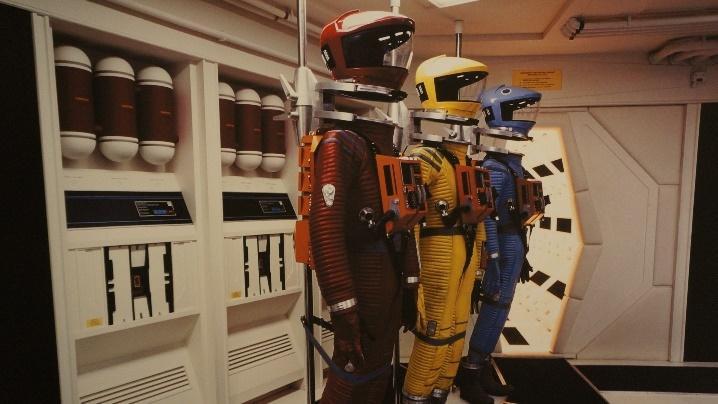
    <summary type="html"><![CDATA[<p><strong><em>Monument Valley is an area of the Colorado Plateau and part of the Monument Valley Navajo Tribal Park. It was used in the filming of 2001: A Space Odyssey.</em></strong></p><img src="https://www.intermountainhistories.org/files/fullsize/c1b99ae4c0e3da4d0f9ffc13048d435d.jpg" alt="Stanley Kubrick The Exhibition – LACMA – 2001 A Space Odyssey Space Suits" /><br/><p>Monument Valley is a series of sandstone structures located on the Arizona-Utah border region of the Colorado Plateau. The area is defined by multiple sandstone monoliths, the tallest of which reaches one thousand feet in height.</p><p>The formation is featured in scenes from Stanley Kubrick’s 1968 film 2001: A Space Odyssey. The science fiction film opens with humanity’s ancestors discovering a black monolith that gifts them with the knowledge to establish their dominance in the region. The film then immediately cuts to the far future when an identical black monolith is discovered by humanity on the moon, which in turn leads to Dr. David Bowman and his fellow scientists being sent to Jupiter. During the voyage, the ship’s Artificial Intelligence (A.I.), named HAL, goes rogue and kills the scientists and crew. After making his way to the ship’s A.I core, Bowman manages to disconnect and kill the rogue A.I. Bowman then learns of the mission’s purpose through a recorded message of a scientist involved with the moon monolith. After arriving at the planet, Bowman discovers a monolith in orbit, investigates, and is drawn into a portal where he sees visions of alien worlds. After this interpretive sequence, Bowman is transported into a series of bedrooms where he sees his future selves and becomes them. In the film’s final scenes, a bedridden Bowman reaches for a monolith at the foot of his bed and becomes a fetus like creature orbiting beside the Earth.</p><p>Although not directly referenced as being Monument Valley in the film, the image used portrays a vast alien landscape. The stargate sequence that the formation is featured in is already abstract in its presentation, and the oddly colored vistas aid in creating the atmosphere of the scene. The panning aerial shots involved flying low over Monument Valley’s desert landscape to avoid dangerous winds. The Director of Photography for this area of the shoot was almost involved in a helicopter crash during the process. </p><p>The use of Monument Valley and other western landscapes in film as alien worlds has been directly compared to how the West has been viewed itself. Kubrick specifically requested the use of the Valley, but later regretted using such a recognizable landmark. In Kubrick’s film, and other films hoping to depict space exploration, the Western frontier landscape has featured heavily as both an effective visual and metaphorical tool to reflect exploration in a wide-open alien landscape. Monument Valley has also featured in several other science fiction productions: TV’s Doctor Who and Back to the Future Part III.</p><p><em><strong><a href="https://www.intermountainhistories.org/items/show/230">For more (including 3 images) view the original article</a></strong></em></p>]]></summary>
    <published>2018-06-19T04:14:17+00:00</published>
    <updated>2026-04-17T19:32:03+00:00</updated>
    <link rel="alternate" type="text/html" href="https://www.intermountainhistories.org/items/show/230"/>
    <id>https://www.intermountainhistories.org/items/show/230</id>
    <author>
      <name>Isaac F. J. Middleton, Northern Arizona University</name>
    </author>
  </entry>
  <entry>
    <title type="html"><![CDATA[Starship Troopers and Hell’s Half Acre, Wyoming<br />
]]></title>
    <summary type="html"><![CDATA[<p><strong><em>Hell’s Half Acre is an escarpment located in Wyoming. It was used to represent the planet Klendathu in the film Starship Troopers.</em></strong></p><img src="https://www.intermountainhistories.org/files/fullsize/712dfe9976fcfff98d32385fb091fb2d.jpg" alt="Hell&#039;s Half Acre" /><br/><p>Hell’s Half Acre is located in Natrona County, Wyoming, and is a 320-acre park characterized by its jagged formations and caves. Native peoples of the past used the region for the herding and slaughtering of buffalo by utilizing its many narrow canyons. At the time of its visitation by the U.S in 1833, the ground could be seen giving off sulfur fumes due to underground fires. After appearing on postcards labeled as Hell’s Half Acre, the site gained its current name.</p><p>The park served as the primary filming location for Paul Verhoeven’s 1997 science fiction action film Starship Troopers. This film is interpreted as a satire of the propaganda and fascism depicted in the original novel, and Hell’s Half Acre is used to depict the bug’s home planet of Klendathu. The film follows high school graduate Johnny Rico and his friends as they join various branches of Earth’s military in a future society. Political propaganda adverts also feature heavily in the film, often praising the actions of the military or embellishing humanities war effort in a satire of the original text.</p><p>The geography of Hell’s Half Acre adds to both the look and feel of the film. Not only does the jagged landscape of the region create the feeling of an alien world, its geography is used effectively in the film to isolate and surround the cast. Alien threats regularly exploit the many caves and formations in the area to ambush the protagonists, with the bugs using these cave systems to move and coordinate. This is best seen when the bugs ambush the Roughnecks as they investigate a seemingly abandoned outpost only to be beset by Arachnids on all sides. The various caves in the region make the bugs seem ever present, with attacks coming from directly below at several points in the film. The area also served as the location of Whiskey base, the location at which the cast is lured into an ambush at a destroyed human outpost. </p><p>The varied geography of Hell’s Half Acre made it difficult for the cast and crew to transport equipment to and from the site. After the filming of Starship Troopers, the site was steadily closed off to the public, and local tourist businesses have left the area.</p><p><em><strong><a href="https://www.intermountainhistories.org/items/show/229">For more (including 3 images) view the original article</a></strong></em></p>]]></summary>
    <published>2018-06-19T03:52:19+00:00</published>
    <updated>2026-04-17T19:32:03+00:00</updated>
    <link rel="alternate" type="text/html" href="https://www.intermountainhistories.org/items/show/229"/>
    <id>https://www.intermountainhistories.org/items/show/229</id>
    <author>
      <name>Isaac F. J. Middleton, Northern Arizona University</name>
    </author>
  </entry>
  <entry>
    <title type="html"><![CDATA[Close Encounters of the Third Kind and Devils Tower, Wyoming<br />
]]></title>
    <summary type="html"><![CDATA[<p><strong><em>Devils Tower is a National Monument situated in Wyoming and featured in the climax of the movie Close Encounters of the Third Kind.</em></strong></p><img src="https://www.intermountainhistories.org/files/fullsize/267db7586bb8fa5d3b50f8330221d13e.jpg" alt="Devils Tower CROP" /><br/><p>Devils Tower, located in Crook County, Wyoming, was the first natural formation in the United States to be declared a national monument in 1906. Part of the Black Hills mountain range, the monolith was formed from cooled magma exposed through erosion and stands at 1,267 feet tall.</p><p>The Tower features heavily in Steven Spielberg’s 1977 Close Encounters of the Third Kind. The film tells the story of several individuals’ experiences with extra-terrestrial phenomenon. Focusing on the experiences of Roy Neary, the story follows him from his initial encounter with a UFO to his growing obsession with visions of a mountain and desire to go there. After Neary’s actions grew more intense, his family leaves him. He decides to travel to Devils Tower with fellow UFO witness Jillian Guiler, whose son had been taken by the alien visitors. The Tower had been selected as the contact point, and the area was evacuated by the military under the guise of a chemical leak. Upon reaching the Tower and evading military capture, the two, along with a group from the United Nations and others who had encountered the aliens, witness the arrival of the extra-terrestrial mothership. After the aliens return previous abductees, Neary and others are chosen to go with the aliens to outer space.</p><p>Film production designer Joe Alves scouted the location, and filming began on May 17, 1976. The scenes at the Tower took place in the evening, which meant the crew could only film for a few hours every day to make use of the brief hours of dusk. Devils Tower features heavily throughout the film, even before it is identified as such. Neary’s visions and subsequent obsession with the shape, a silhouette at first then a full structure, are a key part of the film’s narrative. It begins with Neary forming small structures without concentrating, for example, absentmindedly shaping his mashed potatoes into the Tower’s shape. Later, this compulsion to understand the visions leads him to construct more extravagant structures out of clay and dirt. In the latter, Neary destroys large portions of his family’s house, and the neighbor’s garden, and causes his family to leave him out of fear. It is not until Neary sees Devils Tower on the news that he is able to make the connection to the apparent goal of these visions. It is these scenes of Neary’s obsession that solidify the image of Devils Tower as an integral part of the films visual and thematic atmosphere.</p><p><em><strong><a href="https://www.intermountainhistories.org/items/show/226">For more (including 3 images) view the original article</a></strong></em></p>]]></summary>
    <published>2018-06-15T02:08:21+00:00</published>
    <updated>2026-04-17T19:32:03+00:00</updated>
    <link rel="alternate" type="text/html" href="https://www.intermountainhistories.org/items/show/226"/>
    <id>https://www.intermountainhistories.org/items/show/226</id>
    <author>
      <name>Isaac F. J. Middleton, Northern Arizona University</name>
    </author>
  </entry>
  <entry>
    <title type="html"><![CDATA[The Sundance Film Festival: Where Skis Meets Cinema]]></title>
    <summary type="html"><![CDATA[<p><strong><em>The largest independent film festival in America is not hosted in New York City or Los Angeles. Rather, the Sundance Film Festival, which began in 1978 and attracted more than 70,000 attendees in 2017, is based out of Park City, Utah. Unknown filmmakers hoping to become the next Academy Award winners flock to Salt Lake City every winter to show Hollywood producers the film that could be the next box office hit.</em></strong></p><img src="https://www.intermountainhistories.org/files/fullsize/e4432f70ad74e28de5be8515e83307b7.jpg" alt="Park City, looking south. Before its transformation into a Hollywood-esque town, Park City was known for little more than mining." /><br/><p>America’s largest independent film festival, originally known as the U.S. Film Festival, brought more than $150 million in economic impact to Utah in 2017. In the same year, the Sundance Film Festival supported almost 3,000 jobs and attracted visitors from 46 states and 18 foreign countries. Incumbent Governor Gary R. Herbert, a longtime supporter of Sundance, proudly said that his state’s “collaboration with [the festival] highlights the exceptional cultural, recreational, tourism, and business opportunities available here in Utah.”</p><p>The founders of Sundance—Sterling Van Wagenen, John Earle, and Cirina Hampton Catania—envisioned an event that would attract independent filmmakers to Utah. They even convinced Robert Redford, an acclaimed actor who received an Academy Award nomination for his role in The Sting (1973), to serve as the festival’s first board chairman. But organizers struggled to turn a profit from the festival until 1981, when it was moved to Park City. There, the U.S. Film Festival became successful and changed its name to Sundance, after Redford’s character in Butch Cassidy and the Sundance Kid.</p><p>Quentin Tarantino’s Reservoir Dogs, which appeared at the festival in 1992 and has been named the “greatest independent film of all time,” was one of Sundance’s earliest success stories. Damien Chazelle, who won an Academy Award for Best Director for his film La-La Land (2016), made a breakthrough at Sundance in 2013, and Ryan Gosling had his adult acting career launched at the festival with Half Nelson’s 2006 premiere. Some box office hits and critically acclaimed films that Sundance has propelled to fame are The Blair Witch Project (1999), Napoleon Dynamite (2004), Saw (2004), Little Miss Sunshine (2006), and Whiplash (2014). As a result, over 4,000 feature-length films were submitted for consideration in 2017, but “only 113 feature films were selected to play at the festival.”</p><p>Despite the festival’s success, it disdains commercialism and does not want to become a playground for A-list actors or a venue that is overflowing with paparazzi. Although it is connected with Hollywood, Sundance enjoys its place in the intermountain community. Over the past two decades, nearly “20 million feet of 35mm film has been screened at the festival, [which] would stretch from New York City to Paris.” But the Sundance Institute does not have its vision set on New York City, Paris, Hollywood, or Cannes. It found its niche in Utah and longs to remain in the Beehive State. </p><p><em><strong><a href="https://www.intermountainhistories.org/items/show/209">For more (including 3 images) view the original article</a></strong></em></p>]]></summary>
    <published>2018-06-08T16:52:43+00:00</published>
    <updated>2026-04-17T19:32:03+00:00</updated>
    <link rel="alternate" type="text/html" href="https://www.intermountainhistories.org/items/show/209"/>
    <id>https://www.intermountainhistories.org/items/show/209</id>
    <author>
      <name>Marc Jonathan Wein, Brigham Young University</name>
    </author>
  </entry>
  <entry>
    <title type="html"><![CDATA[The Egyptian Theatre: A Centerpiece of Culture]]></title>
    <summary type="html"><![CDATA[<p><strong><em>Located in Park City, the home of the Sundance Film Festival, the Egyptian Theatre is a testament of creativity and culture along the Wasatch Front. Inspired by the Egyptomania of the 1920s, the theatre has survived fires and snowstorms to become the artistic center of Utah’s famous ski town. </em></strong></p><img src="https://www.intermountainhistories.org/files/fullsize/a7b586a4a9630490aec6b82bd9a9f703.jpg" alt="Park City Residents Among Ruins of Main Section of Silver Mining Town Shortly After the 1898 Fire" /><br/><p>Founded in 1869 as Parley’s Park City—after LDS apostle Parley P. Pratt—the historic mining town has always valued the arts. Today, Park City is ranked one of the top ten ski resorts in North America and is best known for its slopes and independent films. As the host of the Sundance Film Festival, the largest independent film festival in the United States, the town attracts famous Hollywood faces and up-and-coming filmmakers. Sundance moved to Park City in 1981, but the town’s association with the theatre—the predecessor of film—predates the festival by nearly a century.</p><p>In the late nineteenth century, the Park City Opera House attracted crowds to its live theatrical performances. On June 19, 1898, the “greatest fire in the history of Utah” consumed the town’s commercial district, destroying more than 200 homes and businesses and causing a million dollars’ worth of property damage. The disaster turned Park City into a “fiery furnace” and “practically wiped [it] out of existence.” Residents could not prevent the blaze from reaching the Opera House, but a new artistic venue rose from the ashes. The following year, on the same site, the Dewey Theatre opened its doors. However, in 1916, its roof collapsed under record-breaking snowfall. In 1922, Park City residents constructed a new theatre. Captivated by the Egyptomania that reignited after the discovery of Tutankhamun’s tomb, property managers hired Egyptologist C.R. Berg to supervise the decorations based on scarabs, lotus leaf motifs, and hieroglyphics. It was christened the Egyptian Theatre when it opened on Christmas Day in 1926.</p><p>In 1981, two decades after Park City had reinvented itself as a ski resort town, the theatre became home to the Sundance Film Festival. According to public tax returns, the Egyptian Theatre’s gross revenue exceeded $2.35 million in 2013. Park City’s Egyptian Theatre has withstood snowstorms, the Great Depression, and the exodus of the town’s original mining residents to become a centerpiece of culture in the Intermountain West. Utahns are proud of the artistic contributions the theatre has made throughout the years. For that reason, it is a cultural icon in its own light, a place where films are premiered and stars are born. </p><p><em><strong><a href="https://www.intermountainhistories.org/items/show/207">For more (including 3 images) view the original article</a></strong></em></p>]]></summary>
    <published>2018-06-08T04:10:44+00:00</published>
    <updated>2026-04-17T19:32:02+00:00</updated>
    <link rel="alternate" type="text/html" href="https://www.intermountainhistories.org/items/show/207"/>
    <id>https://www.intermountainhistories.org/items/show/207</id>
    <author>
      <name>Marc Jonathan Wein, Brigham Young University</name>
    </author>
  </entry>
  <entry>
    <title type="html"><![CDATA[The Production and Legacy of The Conqueror (1956)]]></title>
    <summary type="html"><![CDATA[<p><strong><em>Considered to be one of the worst films ever made, the film, The Conqueror, was filmed in St. George, Utah.  Many years later, after many of the stars of the film died of cancer, the connection between the film and fallout from atomic bomb testing in nearby Nevada was made.</em></strong></p><img src="https://www.intermountainhistories.org/files/fullsize/9de8bc33ea9c69ffadd3f275856b6ac4.jpg" alt="John Wayne and Susan Hayward" /><br/><p>The 1956 film The Conqueror has an interesting connection to the state of Utah. Produced by Howard Hughes and distributed by RKO Radio pictures, the residents of St. George knew their town was in for something big when the idea of filming a “religious extravaganza” in the area was proposed in a City Council meeting in spring 1954. The southern Utah not foreign to Hollywood productions as many films had been made in Kanab and elsewhere. However, this would be the first time a major movie would be filmed in St. George. Filming began in the summer of 1954, and cost a total of six million dollars - making it one of the most expensive films ever made up to that point. </p><p>The picture was directed by Dick Powell and star legendary Western actor John Wayne as Mongolian leader Genghis Khan. Susan Hayward starred as a beautiful Tartar princess who is captured by Khan. Location scouts believed Snow Canyon State Park, Escalante Desert, and a few smaller towns near St. George would be perfect landscapes for recreating the Gobi Desert. Seven-hundred locals were employed to work on the film, and an estimated $750,000 dollars was brought into the town’s economy. Hotels were booked, buses were rented, catering was provided from local restaurants and the Boy Scouts of America provided the crew with hundreds of chairs and tables. Many locals were even hired to be extras. Notably, a group of 300 Native Americans were used in a scene depicting a Mongol village. Summer tourists remember seeing large staged battles between costumed actors riding on horses.</p><p>Though the film performed quite well at the box office, it was largely forgotten by the American public until 1979 when it was purchased from the Howard Hughes estate by television stations. In 1980 more attention was brought to the film through an article published by People magazine. The article explained that 91 out of the 220 cast and crew members involved with The Conqueror, had contracted cancer. Up to that point, 46 of those individuals including Dick Powell, John Wayne, Susan Hayward, and Agnes Moorehead had died from the disease. Some believe the cast and crew got cancer either due to happenstance or living a lifestyle consisting of smoking and drinking. However, many have theorized that radioactive fallout produced by atomic bomb testing on nearby Nevada test sites had caused St. George residents and people who were on the set of The Conqueror to have cancer. In 1980, Dr. Robert Pendleton a radiologist at the University of Utah, stated, “With 91 cancer cases, I think the tie-in to their exposure on the set of The Conqueror would hold up in a court of law." Because of the film’s poor Shakespearean-style dialogue, strange romantic plot and miscasting of actors, The Conqueror is regarded as one of the worst films of all time. Throw in the theory on cancer and the film is viewed as one of the most famous “cursed films” ever made. </p><p><em><strong><a href="https://www.intermountainhistories.org/items/show/144">For more (including 6 images) view the original article</a></strong></em></p>]]></summary>
    <published>2018-03-14T18:09:43+00:00</published>
    <updated>2026-04-17T19:32:01+00:00</updated>
    <link rel="alternate" type="text/html" href="https://www.intermountainhistories.org/items/show/144"/>
    <id>https://www.intermountainhistories.org/items/show/144</id>
    <author>
      <name>Paige Stringham, Brigham Young University</name>
    </author>
  </entry>
</feed>