<?xml version="1.0" encoding="UTF-8"?>
<feed xmlns="http://www.w3.org/2005/Atom">
  <title type="text">Intermountain Histories</title>
  <updated>2026-04-17T19:32:19+00:00</updated>
  <generator uri="http://framework.zend.com" version="1.12.20">Zend_Feed_Writer</generator>
  <link rel="alternate" type="text/html" href="https://www.intermountainhistories.org/"/>
  <link rel="self" type="application/atom+xml" href="https://www.intermountainhistories.org/items/browse?output=rss2"/>
  <id>https://www.intermountainhistories.org/</id>
  <author>
    <name>Intermountain Histories</name>
    <uri>https://www.intermountainhistories.org</uri>
  </author>
  <link rel="hub" href="https://pubsubhubbub.appspot.com/"/>
  <entry>
    <title type="html"><![CDATA[Bryce Canyon Lodge and Deluxe Cabins - Bryce Canyon National Park]]></title>
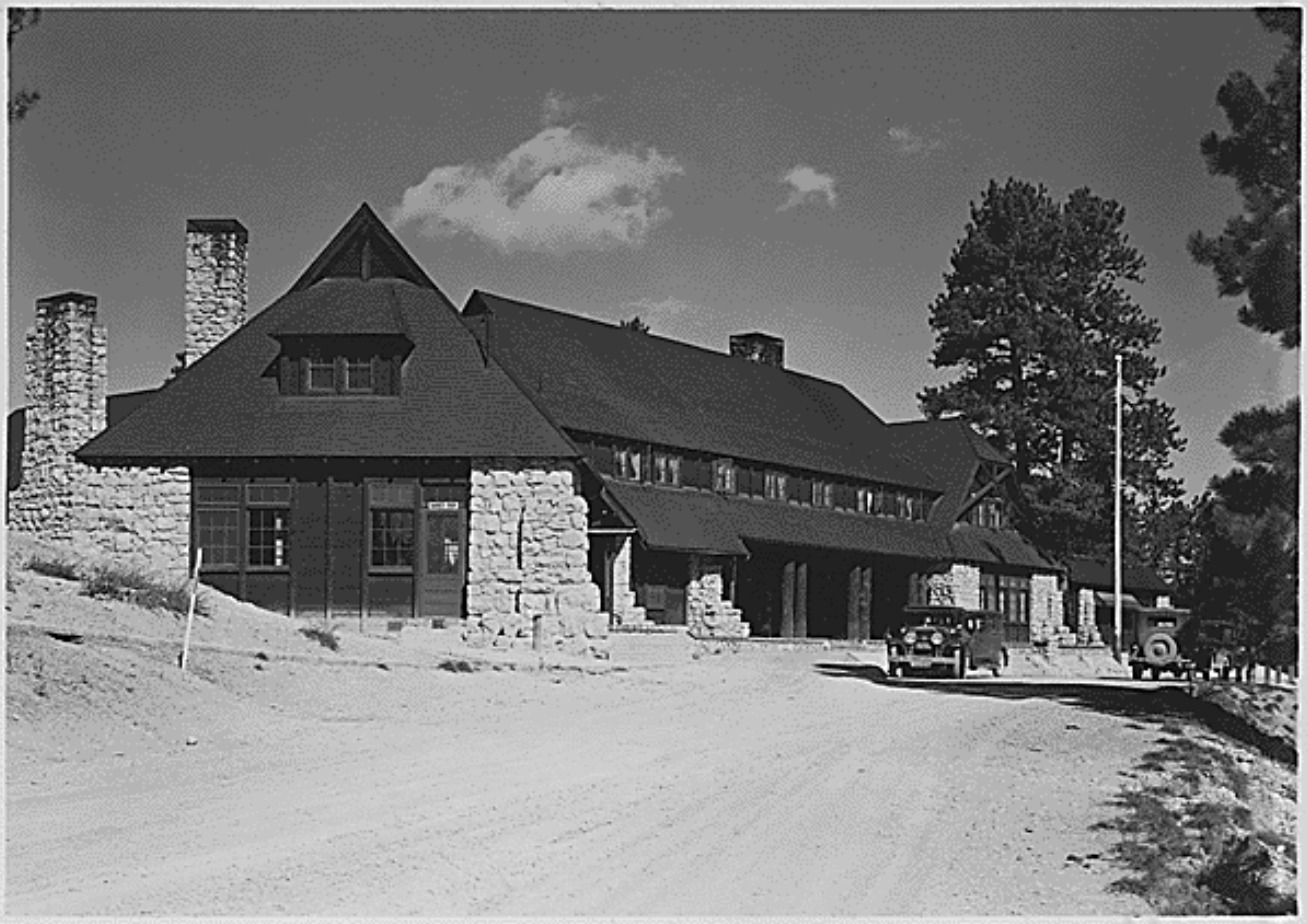
    <summary type="html"><![CDATA[<p><strong><em><span style="font-weight:400;">In 1923, the Union Pacific Railroad created the Utah Parks Company, which connected its rail line to attractions such as Zion National Park and the North Rim of Grand Canyon National Park. The Bryce Canyon Lodge and Deluxe Cabins linked Bryce Canyon State Park to this system of resorts in 1925. </span></em></strong></p><img src="https://www.intermountainhistories.org/files/fullsize/2d65ab73bf5bf337b81a40dba1d6d45e.jpg" alt="Bryce Canyon Lodge, c. 1929" /><br/><p><span style="font-weight:400;">In 1874, Bryce Canyon became part of a cattle ranch owned by Ebenezer Bryce. His ranch was unsuccessful, but automobile tourism revitalized the area when passable roads reached what is now Zion National Park in 1917. In 1921, Utah’s state legislature accepted a proposition from Park Service director Stephen Mather that protected Bryce Canyon as a state park. Utah made no attempt to develop the area for public use, but the Union Pacific Railroad spurred development in Bryce Canyon by creating the Utah Parks Company in 1923. This connected the Union Pacific’s Cedar City spur line to Bryce Canyon, the North Rim of Grand Canyon National Park, and Zion via bus lines. By establishing a network of parks and resorts, the Union Pacific aimed to compete with other successful railroad companies such as the Northern Pacific, Atchison-Topeka Santa Fe, and Great Northern. These companies had established successful tourist attractions at the South Rim of Grand Canyon, Yellowstone National Park, and Glacier National Park. As tourism brought in profit, road construction improved access to rural points of interest like Bryce Canyon. In 1924, Congress established Utah National Park, and the Utah Parks Company constructed Bryce Canyon Lodge and Deluxe Cabins in the same year to provide visitors with accommodations. Congress enlarged Utah National Park and renamed it Bryce Canyon in 1928. </span>
<span style="font-weight:400;">The Utah Parks Company enlisted Gilbert Stanley Underwood, one of the Union Pacific’s consulting architects, to design Bryce Canyon Lodge. Underwood’s designs are notable for their commitment to rustic architecture, which used natural materials and textures to blend a building with its natural surroundings. He utilized locally quarried stone and large, exposed wooden details throughout the structure, figuratively connecting the building to its location. After the company completed the original building in 1925, it added two new wings in 1926 to make room for an increasing number of visitors. The Utah Parks Company constructed fifteen deluxe guest cabins the following year in a pine grove near the main structure. Their design used rough stone and natural wood to imitate the design of Bryce Canyon Lodge. </span>
<span style="font-weight:400;">During the 1950s, the National Park Service renovated Bryce Canyon Lodge to make room for updated amenities. The hotel originally housed a barber shop, but the Park Service replaced it with a soda fountain. The Park Service also enlarged a road at the hotel’s front entrance to make room for larger vehicles, but the Park service expanded a plaza outside Bryce Canyon Lodge’s front entrance by removing the original bus lane in 1989. In 1985, the Park Service removed sixty-one of the lodge’s original sixty-seven standard cabins. The Sunrise Motel and Sunset Motel replaced them. In 1995, the National Register of Historic Places officially listed forty-two buildings in Bryce Canyon, including Bryce Canyon Lodge. This restricted future renovations, allowing the complex to retain most of its architectural significance. Today, Bryce Canyon Lodge operates as a historic hotel alongside five standard cabins and fifteen deluxe cabins. </span></p><p><em><strong><a href="https://www.intermountainhistories.org/items/show/843">For more (including 5 images) view the original article</a></strong></em></p>]]></summary>
    <published>2024-05-29T21:42:39+00:00</published>
    <updated>2026-04-17T19:32:19+00:00</updated>
    <link rel="alternate" type="text/html" href="https://www.intermountainhistories.org/items/show/843"/>
    <id>https://www.intermountainhistories.org/items/show/843</id>
    <author>
      <name>Kaylen Wilson, Northern Arizona University </name>
    </author>
  </entry>
  <entry>
    <title type="html"><![CDATA[Indigenous People of Bryce Canyon]]></title>
    <summary type="html"><![CDATA[<p><strong><em><span style="font-weight:400;">The place known today by millions of people as Bryce Canyon National Park has been known by different names to many other people over centuries. The history of those who have journeyed along the canyon before paths were paved there still have a deep connection to the land. And over the past century, an increasing number of people admire the beauty and appreciate such a connection.</span></em></strong></p><img src="https://www.intermountainhistories.org/files/fullsize/83f8b3ce41456cf4cf8fa80c55f1fc6d.jpg" alt="[Untitled]" /><br/><p><span style="font-weight:400;">Unka tumpee wun-nurrx tungwatsini xoopakichu ahnax, Sikyaatutukwi, Bios to chi bi kool, Angka-ku-wass-a-wits, Bryce’s Canyon. </p><p>These are the former names of the geographic marvel now known as Bryce Canyon National Park. Southern Paiutes, Hopi, Zuni, Ute, and Navajo tribes all lived in this region and enjoyed its natural beauty and wonders. Even before these nations, other ancient peoples lived here for centuries. The Indian names, meaning “place of yellow points,” “red painted faces,” and “red rock standing like a man in a hole,” come from ancient legends of the rock formations now called “hoodoos,” meaning scary or a bad omen. Some claimed that the hoodoos were once people who had been turned to stone. This incredible landscape provided a place for indigenous peoples to hunt and gather grass seeds and other foods, creating a deep connection with the land. </span>
<span style="font-weight:400;">Sadly, from 1850 to 1890, through various laws, acts, and atrocities, Native Americans were forced from Bryce Canyon, some to distant reservations. Those that were far removed from Bryce Canyon, like the Navajo, remembered its beauty through oral histories. The Paiutes were not driven out until about 1880, five years after LDS Scottish Rancher Ebenezer Bryce settled there. From the turn of the century onward, new people began coming into the area to settle or sight-see. In 1916, with help from the Union Pacific Railroad, lodges and rest stations began to be built, providing a place for visitors to stay. In 1923, Bryce Canyon became a National Monument and in 1928 it became a National Park, with the boundaries expanded in 1931 and again in 1942. In 1934 workers of the Civilian Conservation Corps created much of the infrastructure that helped make Bryce Canyon more accessible to the public. Today this beautiful National Park is visited by over 1.5 million people annually.</span>
<span style="font-weight:400;">Though this park is now accessible to many people, the indigenous nations that once lived there still have a great connection to the land through their histories and traditions. In past decades most members of those nations lack the resources needed to visit Bryce Canyon, though more indigenous people are able to visit these sacred sites today. They continue to pass on the traditions and stories to new generations. Some Paiutes have returned to the area and still live nearby. Dozens of people currently reside within Bryce Canyon's lands. Leigh Kuwanwisiwma, a member of the Hopi Tribe, teaches “This is our heaven. This is the human people’s heaven, and we need to appreciate that.” A sacred place to many tribes, and now a nationally protected park, Bryce Canyon deserves respect and reverence as visitors admire its wonders.</span></p><p><em><strong><a href="https://www.intermountainhistories.org/items/show/787">For more (including 3 images) view the original article</a></strong></em></p>]]></summary>
    <published>2024-03-01T23:35:49+00:00</published>
    <updated>2026-04-17T19:32:17+00:00</updated>
    <link rel="alternate" type="text/html" href="https://www.intermountainhistories.org/items/show/787"/>
    <id>https://www.intermountainhistories.org/items/show/787</id>
    <author>
      <name>Rachel Feilbach, Brigham Young University</name>
    </author>
  </entry>
  <entry>
    <title type="html"><![CDATA[Origins of Bryce Canyon National Park]]></title>
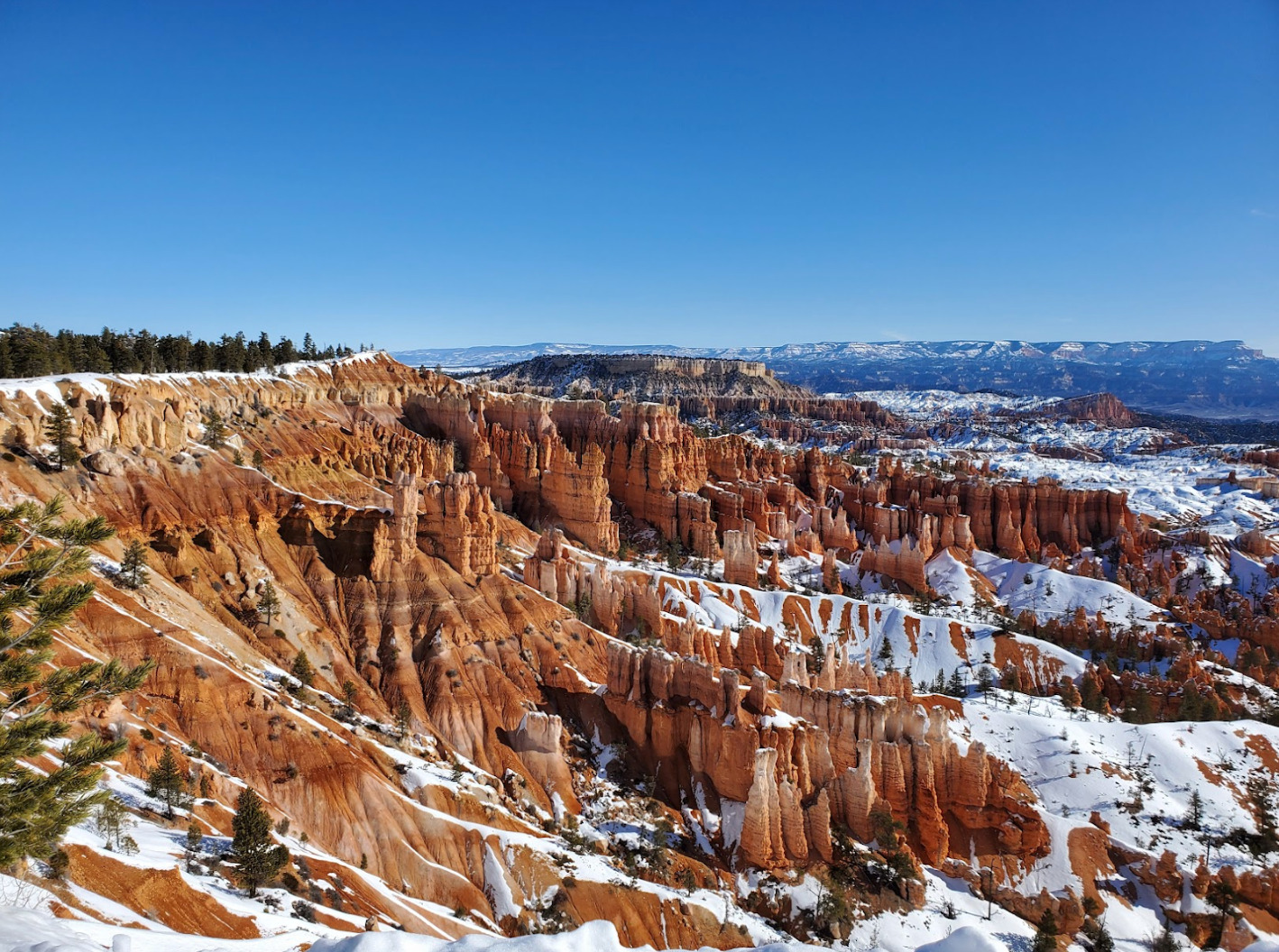
    <summary type="html"><![CDATA[<p><strong><em><span style="font-weight:400;">The land around Bryce Canyon was owned by Paiutes, Mormon settlers, the Union Pacific Railroad, and the federal government before it became a national park in 1924. This gorgeous geological wonder is now enjoyed by millions of visitors each year.</span></em></strong></p><img src="https://www.intermountainhistories.org/files/fullsize/4583d33941339bd9472eeb68144da8cd.jpg" alt="Snow on the Rim of Bryce Canyon" /><br/><p><span style="font-weight:400;">According to archaeological surveys, Bryce Canyon has been inhabited for at least 10,000 years. Paiutes hunted small game and gathered pine nuts in the area. After the Black Hawk War in the 1860s, Mormon settlers moved into areas previously occupied by the Paiutes. One such settler was Ebenezer Bryce, who built a road through the canyon that adopted his name. Mormons in the small settlement of Tropic built the Tropic Irrigation Ditch through Bryce Canyon in 1892. For decades, the beautiful scenery of Bryce Canyon was largely kept private due to the difficulty of travel and the harsh conditions of the area.</span>
<span style="font-weight:400;"> S. Forest Service Supervisor J.W. Humphrey pushed for Bryce Canyon to become a National Park after he first visited the land in 1915. He said, “You can perhaps imagine my surprise at the indescribable beauty that greeted us, and it was sundown before I could be dragged from the canyon view. You may be sure that I went back the next morning to see the canyon once more, and to plan in my mind how this attraction could be made accessible to the public.” After sending photographs and film to the federal Forest Service and the Union Pacific Railroad, the canyon began to attract national attention. Ruby and Minnie Syrett bought land along the rim of Bryce Canyon and built a lodge and an inn for tourists in the 1920s. The Union Pacific Railroad bought much of the land from the Syretts, but Ruby’s Inn still stands today.</span></p><p><span style="font-weight:400;">Bryce Canyon was declared a national monument in 1923 by President Warren G. Harding. On February 25, 1928, Bryce Canyon officially became a national park by an act of  Congress. The size of the park was increased in 1931 by President Hoover, to the current 35,835 acres. Today, over 2 million people visit the park each year to enjoy southern Utah’s stunning scenery and recreational opportunities.</span></p><p><em><strong><a href="https://www.intermountainhistories.org/items/show/784">For more (including 4 images) view the original article</a></strong></em></p>]]></summary>
    <published>2024-02-26T20:05:24+00:00</published>
    <updated>2026-04-17T19:32:17+00:00</updated>
    <link rel="alternate" type="text/html" href="https://www.intermountainhistories.org/items/show/784"/>
    <id>https://www.intermountainhistories.org/items/show/784</id>
    <author>
      <name>Renae Cameron, Brigham Young University</name>
    </author>
  </entry>
  <entry>
    <title type="html"><![CDATA[Dark Sky over Bryce Canyon National Park]]></title>
    <summary type="html"><![CDATA[<p><strong><em>A national park filled with crimson rock formations known as hoodoos, Bryce Canyon also has one of the best-sustained public astronomical programs, and it has been running for over fifty years.</em></strong></p><img src="https://www.intermountainhistories.org/files/fullsize/2988e0f433f61569bc6c5beafc753df2.jpg" alt="Milky Way over Bryce Canyon" /><br/><p>In addition to hosting the longest active program for astronomy in the National Park Service, Byce Canyon National Park also holds the honor of being a Gold Tier International Dark Sky Park, so designed by the International Dark-Sky Association in 2019. Gold Tier is a rare classification, as it denotes a place with natural nighttime conditions, little to no light pollution, and over 10,000 stars visible on a clear night.</p><p>President Warren G. Harding made Bryce Canyon a National Monument on June 8, 1923, but after a review, Congress made it a national park on February 25, 1928. Educational programs in Bryce Canyon National Park in Utah to teach visitors about astronomy began in 1969 when the Chief of Interpretation was inspired by the Abrams Planetarium to create a night sky interpretation program for Bryce Canyon. In 1972, an astronomer named Von Del Chamberlain wrote and designed a manual for sky interpretation for distribution and use at Bryce Canyon National Park. Chamberlain’s manual included cartoons about why natural skies were culturally important, a list of seven reasons for the park to include sky interpretation, and several program ideas focusing on campfires and storytelling.  Interpretative rangers and volunteers have run educational lectures, stargazing parties, and constellation tours since then, and its reputation was such that interpreters from other parks came to Bryce Canyon to train for night sky and astronomy interpretation in 2005. Patrick Wiggins, Utah’s NASA Solar System Ambassador, has been an annual speaker at Bryce Canyon National Park and involved in program creations from 1984 to 2014.</p><p>The Dark Ranger program for park rangers, sometimes referred to as the Astronomy Rangers, was also created for Bryce Canyon National Park with a mission to cultivate understanding and wonder for the vastness of the universe that has grown harder to recognize with the expansion of lights and cities. Since 2013, the Astronomy Rangers have joined with the work of volunteers and other interpretive rangers for educational programs. Astronomical festivals have also joined Bryce Canyon’s list of public programs.</p><p>For Bryce Canyon’s dedication to over fifty years of defending an intangible but culturally crucial resource, the International Astronomical Union named an asteroid after Bryce Canyon National Park.  Minor planet 49272 was discovered in 1998 by Roy Tucker, and it received the name “Bryce Canyon” in 2007 in appreciation for the park’s public astronomy programs. Orbiting the Sun between Mars and Jupiter, the asteroid has about the same length as its namesake on Earth, being three to five miles across. Bryce Canyon National Park is the second National Park to have an asteroid named after it. Though the small telescopes in Bryce Canyon National Park cannot see the dim minor planet in the sky, the park is very proud of its long record of promoting dark sky conservation. Having an asteroid named after the national park is an international honor.</p><p><em><strong><a href="https://www.intermountainhistories.org/items/show/544">For more (including 3 images) view the original article</a></strong></em></p>]]></summary>
    <published>2021-11-14T05:39:05+00:00</published>
    <updated>2026-04-17T19:32:11+00:00</updated>
    <link rel="alternate" type="text/html" href="https://www.intermountainhistories.org/items/show/544"/>
    <id>https://www.intermountainhistories.org/items/show/544</id>
    <author>
      <name>Emma Svenson, Northern Arizona University</name>
    </author>
  </entry>
</feed>