<?xml version="1.0" encoding="UTF-8"?>
<feed xmlns="http://www.w3.org/2005/Atom">
  <title type="text">Intermountain Histories</title>
  <updated>2026-04-17T19:32:17+00:00</updated>
  <generator uri="http://framework.zend.com" version="1.12.20">Zend_Feed_Writer</generator>
  <link rel="alternate" type="text/html" href="https://www.intermountainhistories.org/"/>
  <link rel="self" type="application/atom+xml" href="https://www.intermountainhistories.org/items/browse?output=rss2"/>
  <id>https://www.intermountainhistories.org/</id>
  <author>
    <name>Intermountain Histories</name>
    <uri>https://www.intermountainhistories.org</uri>
  </author>
  <link rel="hub" href="https://pubsubhubbub.appspot.com/"/>
  <entry>
    <title type="html"><![CDATA[The Deseret Hospital]]></title>
    <summary type="html"><![CDATA[<p><strong><em>When pioneer Utahns realized their lack of medical knowledge, Brigham Young sent women to the East to obtain medical degrees. Upon their return, many set up private practices, but they wanted to have an official hospital. This desire led to the construction of the Deseret Hospital in 1882 and its operation for 12 years until it closed in 1894. In 2003, a replica of the building was constructed at This is the Place Heritage Park in Salt Lake City. </p></strong></p><img src="https://www.intermountainhistories.org/files/fullsize/84306f5df0e3c988b3178f132247e081.jpg" alt="LDS Hospital - a Full-Service Community Hospital - Salt Lake City, Utah" /><br/><p><span style="font-weight:400;">During Utah’s territorial years, the pioneer settlers lacked medical knowledge which led to high maternal and infant mortality rates. This problem led Brigham Young to encourage a few women to go to the Eastern United States to obtain medical degrees. Some of the women who heeded the call were Martha H. Cannon, Romania P. Penrose, Ellis R. Shipp, Ellen B. Ferguson, and Elvira S. Barney. When they returned to Utah, several opened private practices but they all recognized the need for an official hospital. With the support of the scores of women who convinced church leaders of the need, the women gained their hospital in 1882. </span>
<span style="font-weight:400;">The Deseret Hospital was established by the Latter-day Saint Relief Society and was dedicated in July 1882 by LDS apostle Franklin D. Richards. It was located in a building previously used by the nuns of the Holy Cross Hospital. At the dedication, Ellen B. Ferguson was set apart as the resident physician and Romania P. Penrose as the resident surgeon and visiting physician. </span>
<span style="font-weight:400;">The hospital treated illnesses such as rheumatism, typhoid fever, and diphtheritic tonsillitis, among other diseases. It was also used as a maternity home and training facility for midwives. Women who wanted to learn midwifery but who could not pay for instruction could give fifty days of charity work instead. The hospital was supported by donations that supplied it with the materials necessary to operate. The Relief Society also organized the Deseret Hospital Association, which any woman in good standing could join by paying one dollar annually. Patients were charged $3-6 a week for board, room, and nursing, and the hospital’s maximum capacity was about 40-50 patients. </span>
<span style="font-weight:400;">In 1884 the hospital was moved to a different location, but a lack of funds forced its closure in 1894. The midwifery school continued to operate until 1905 when W. H. Groves purchased land to build a new LDS Hospital. This hospital continued to expand until it had fifteen branches under the direction of The Church of Jesus Christ of Latter-Day Saints. In 1975, the Church transferred the operation of the hospitals to Intermountain Health Care. </span>
<span style="font-weight:400;">A replica of the Deseret Hospital was constructed at This is the Place Heritage Park in 2003. The first floor of the building shows a replica of the hospital and the second floor contains a collection from the Utah Quilt Guild. Elder Russell M. Nelson dedicated the structure on October 25, 2003, to highlight the contributions of the women who traveled to the East to obtain an education and to commemorate the original Deseret Hospital.</span></p><p><em><strong><a href="https://www.intermountainhistories.org/items/show/791">For more (including 4 images) view the original article</a></strong></em></p>]]></summary>
    <published>2024-03-03T04:30:48+00:00</published>
    <updated>2026-04-17T19:32:17+00:00</updated>
    <link rel="alternate" type="text/html" href="https://www.intermountainhistories.org/items/show/791"/>
    <id>https://www.intermountainhistories.org/items/show/791</id>
    <author>
      <name>Madison Sterzer, Brigham Young University</name>
    </author>
  </entry>
  <entry>
    <title type="html"><![CDATA[Fort Utah (Provo)]]></title>
    <summary type="html"><![CDATA[<p><strong><em>Within a year of the establishment of Fort Utah, relations between Latter-day Saint settlers and the Timpanogos Utes dissolved into violence, culminating in a two-day conflict. The original Fort Utah has since been demolished, but a replica stands in its place in Provo, Utah.</em></strong></p><img src="https://www.intermountainhistories.org/files/fullsize/0d695e51f1f5d39ac9125b391c285fc3.jpg" alt="Drawing of Fort Utah in the winter" /><br/><p>Fort Utah was first established a mile and a half east of Utah Lake by a company of one hundred and fifty Latter-day Saints. Led by John Higbee, the Saints arrived on April 1, 1849. They chose the location with the intention to farm on the fertile river soil, but when President Brigham Young visited the fort, he suggested they move to higher ground. The secondary location became the nucleus for the city of Provo. The Saints settled next to the indigenous village of the Timpanogos Utes. Initially, the Utes treated their new neighbors with kindness and generosity, and they fished and gambled together.
That winter, however, misunderstandings broke out between the Utes and Saints. It began in August with a dispute between Richard Ivie and a native known to the Latter-day Saints as Old Bishop, whom Ivie accused of stealing his shirt. When Bishop refused to give the shirt up, Ivie and his friends killed him and threw his body into the Provo River. Furious, the Timpanogos demanded the settlers hand over the murderers. When their requests were denied, they insisted the Saints provide compensation for Bishop’s death, which the Saints also refused. Considering how generous the tribe had been in sharing their prized fishing and hunting resources during the summer, the Utes felt justified in collecting rent through involuntary cattle and corn payments from their neighbors during the fall and winter. As the amicable relations began to sour, Higbee asked Brigham Young permission to declare war against the Timpanogos, whom he misrepresented to Young as hostile.
Young granted the request. Parley P. Pratt and Willard Richards agreed with him, not wanting to find themselves cut off from their southern colonies. They sent the Nauvoo Legion to assist the local Latter-day Saints in attacking the Timpanogos. After just one day, the soldiers cornered their enemies into an abandoned cabin. The next day they placed shields on sledges and attacked. Desperate, the natives fled during the second night only to be hunted down. When the fighting ended, there were more than one hundred Timpanogos casualties and one dead Latter-day Saint. This dark episode serves as a reminder that while Latter-day Saints generally had positive interactions with the Native Americans, there were certainly episodes of unwarranted and reprehensible violence.</p><p><em><strong><a href="https://www.intermountainhistories.org/items/show/465">For more (including 3 images) view the original article</a></strong></em></p>]]></summary>
    <published>2021-09-09T22:51:24+00:00</published>
    <updated>2026-04-17T19:32:09+00:00</updated>
    <link rel="alternate" type="text/html" href="https://www.intermountainhistories.org/items/show/465"/>
    <id>https://www.intermountainhistories.org/items/show/465</id>
    <author>
      <name>Andrew Burt, Brigham Young University</name>
    </author>
  </entry>
  <entry>
    <title type="html"><![CDATA[The Beehive House of Brigham Young]]></title>
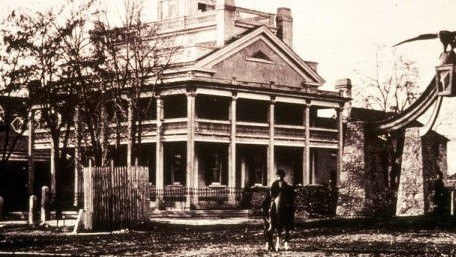
    <summary type="html"><![CDATA[<p><strong><em>“The home was undoubtedly planned in father’s mind through the happy memories of the beautiful colonial buildings in Vermont, his birthplace.”   These words were penned by Clarissa Young Spencer, a daughter of Brigham Young, as she recalled her childhood in the Beehive House. The house served as Brigham Young’s primary residence following its completion in 1854 until his death.</em></strong></p><img src="https://www.intermountainhistories.org/files/fullsize/984716657eaee063d17107e9c8504e3a.jpg" alt="Beehive House of Brigham Young" /><br/><p>Built in 1854 in Salt Lake City, Utah the Beehive house was home to Brigham Young, the 2nd president of the Church of Jesus Christ Latter-day Saints. It was designed in the Greek Revival style of architecture by Truman O. Angell. The original adobe walls were painted in a soft yellow, with green shutters over the windows, and a large front door with a silver door-knob.  Spencer recalled how the house was used to entertain many guests.  Such entertainments took place in what was called the “long hall.” The Utah State Historical Society records that the home welcomed visitors including “President Ulysses S. Grant, Emperor Dom Pedro of Brazil, General William T. Sherman, Ralph Waldo Emerson, Mark Twain, Jay Gould, Horace Greeley, and even the midget Tom Thumb and his tiny wife.”  Young lived there with his wife Mary Ann Angell, who moved back to the White House, a separate property owned by Brigham Young in Salt Lake City “about a block east of the Lion House.”  Lucy Ann Decker and her children moved into the house in 1860 and Lucy remained there until the end of Brigham’s life.  The house was also home to men who worked on the Young estate as well as immigrant girls who had nowhere to go. Spencer recalled “Mother always used to say that everyone who didn’t have any other place to go was sent to her.” </p><p>Other features of the house included an attic, two parlors, Brigham Young’s room, a cellar, and a porch which Spencer recalls as a young woman was “a most convenient place to set out onto” to listen to serenading young men.  A family store was also added at the back of the house where there had originally been a barn.  The store was stocked to provide goods for the families of Young’s various wives. Brigham Young is known to have had at least 56 plural wives, as confirmed by the LDS Family History Archives. Only one wife and her children ever lived at the Beehive house at a time. Others lived in other homes owned by Young, many lived at the nearby Lion House. Spencer recorded that “there were usually about twelve families living in the Lion House.” </p><p>When Brigham Young died in 1877 Lucy Ann Decker was given the house in the estate settlement, and in 1888 she sold it to a son of Mary Ann Angell, John W. Young. In 1889, he began to remodel the house, which included a large Victorian addition in the back. However, he was a businessman, and when he suffered financial troubles, the house was foreclosed by the bank and sold at an auction to John Beck, who also eventually suffered financial troubles. The house was then purchased by the LDS church in 1899.  Since that time it has served as the home of LDS Presidents Lorenzo Snow and Joseph F. Smith, then in 1920 it was given to the LDS Young Ladies Mutual Improvement Society to be run as a home for young women who came to the city for work or school. In 1959 it was converted into a museum. </p><p><em><strong><a href="https://www.intermountainhistories.org/items/show/47">For more (including 3 images) view the original article</a></strong></em></p>]]></summary>
    <published>2017-05-22T21:45:35+00:00</published>
    <updated>2026-04-17T19:31:58+00:00</updated>
    <link rel="alternate" type="text/html" href="https://www.intermountainhistories.org/items/show/47"/>
    <id>https://www.intermountainhistories.org/items/show/47</id>
    <author>
      <name>Devin Hart, Brigham Young University</name>
    </author>
  </entry>
</feed>