<?xml version="1.0" encoding="UTF-8"?>
<feed xmlns="http://www.w3.org/2005/Atom">
  <title type="text">Intermountain Histories</title>
  <updated>2026-04-17T19:32:21+00:00</updated>
  <generator uri="http://framework.zend.com" version="1.12.20">Zend_Feed_Writer</generator>
  <link rel="alternate" type="text/html" href="https://www.intermountainhistories.org/"/>
  <link rel="self" type="application/atom+xml" href="https://www.intermountainhistories.org/items/browse?output=rss2"/>
  <id>https://www.intermountainhistories.org/</id>
  <author>
    <name>Intermountain Histories</name>
    <uri>https://www.intermountainhistories.org</uri>
  </author>
  <link rel="hub" href="https://pubsubhubbub.appspot.com/"/>
  <entry>
    <title type="html"><![CDATA[London Bridge in Arizona]]></title>
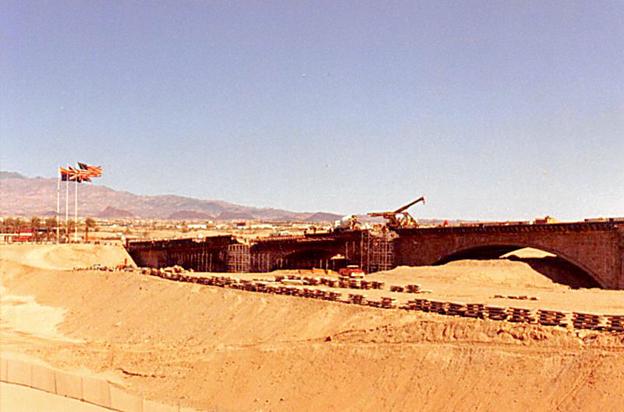
    <summary type="html"><![CDATA[<p><strong><em>While traveling the highways and rural paths of the American Southwest, it’s common to run into historical markers or monuments. In Lake Havasu City, Arizona, you can walk and drive along one that surprisingly originates from Great Britain.</em></strong></p><img src="https://www.intermountainhistories.org/files/fullsize/eb4a00dec8faaa2863b7452eb68fb4ca.jpg" alt="Construction of the London Bridge before a man-made canal was run along under it, Lake Havasu City, Arizona." /><br/><p>In 1958, entrepreneur and city planner Robert P. McCulloch envisioned a city in Western Arizona that would attract retirees and tourists. He purchased several thousand acres of land on the east side of Lake Havasu, a reservoir behind the Parker Dam along the Colorado River. The recreational aspect for his city was set, a dazzling blue and green lake set in contrast with the hot and red desert was sure to attract retirees. However, further appeal was needed to attract tourists and full time residents who would call the city home. A prospective attraction appeared in 1967, when it was found that one of the historic “London Bridges” along the Thames River in London, England was not structurally stable and would need to be replaced.
John Rennie of Scotland was the designer of the bridge, and completed its construction in August of 1831, replacing the original bridge constructed in 1209. When the officials found it structurally unsound in 1967, instead of demolishing it, they tried selling it. McCulloch’s oil company brokered a deal and bought the bridge’s exterior masonry for 2.46 million dollars at the end of 1967 (a sum worth almost 23 million dollars today when adjusted for inflation). Local newspaper <em>The Arizona Republic</em> reported the sale on April 19, 1968, writing that the bridge would “<em>serve as a centerpiece for the city’s leisure industry and an attraction to entice travelers to Lake Havasu City from transcontinental highways.”</em> The bridge that now exists only contains this exterior masonry. When shipment and construction began in 1968, they used a base concrete skeleton on which the veneer of the original stone masonwork was placed. The five arched bridge was built over a dip in the sandy earth of a peninsula jutting into Lake Havasu, through which a man-made canal was created. This made it so that the structure bridged together the newly created ‘Pittsburgh Point Island’ and mainland Lake Havasu City.
The bridge opened up with much fanfare and excitement in 1971. The opening ceremony featured a parade of flag-bearing boy scouts, fireworks, and the mayor of London who placed the foundation stone in 1968. Following construction, Lake Havasu City grew steadily because of efforts from McCulloch. He would fly in potential homebuyers, build hotels and stores on his own dime, plant palm trees to add greenery, and yes, even construct one of London’s famous bridges in the middle of the desert. What started as a dream in the desert has since turned into a city of over 57,000 people. Whether the London Bridge serves as a monument to foreign lands or a tourist trap is dependent on the visitor. But for those that live in this desert city, the bridge is one of the many attributes that makes them call Lake Havasu City home.</p><p><em><strong><a href="https://www.intermountainhistories.org/items/show/939">For more (including 5 images) view the original article</a></strong></em></p>]]></summary>
    <published>2026-02-02T17:22:18+00:00</published>
    <updated>2026-04-17T19:32:21+00:00</updated>
    <link rel="alternate" type="text/html" href="https://www.intermountainhistories.org/items/show/939"/>
    <id>https://www.intermountainhistories.org/items/show/939</id>
    <author>
      <name>Samuel Watson, Brigham Young University</name>
    </author>
  </entry>
  <entry>
    <title type="html"><![CDATA[The CCC &amp; Arches National Monument and Park]]></title>
    <summary type="html"><![CDATA[<p><strong><em>Between the years 1938-1942 the Civilian Conservation Corps (CCC) completed an impressive amount of work building bridges, trails, and roads in Arches National Monument.</em></strong></p><img src="https://www.intermountainhistories.org/files/fullsize/4d4bd60d7e1db17da38aa27f1a6dbf34.jpg" alt="Moab Canyon Wash Culvert" /><br/><p>The area which is now Arches National Park first came to the attention of the government in the early part of the 20th century. In 1929, President Herbert Hoover designated 4,500 acres of the region a National Monument and in 1938 President Franklin Roosevelt enlarged it substantially to 33,000 acres. This was the size of the area when the CCC worked there, making it a challenge to create roads, trails, bridges, and other infrastructure projects over such a vast area. In 1969, President Richard Nixon granted the area National Park status.</p><p>In nearby Moab, Utah, the government created CCC camp NP-7 in 1940 with the aim of improving the infrastructure of Arches National Monument. The men of the CCC were the first people to attempt projects such as trail building in this remote area. Their efforts in the 1940’s helped the area to become more accessible when tourism boomed during the post-World War II period. This growth, caused predominantly by increased leisure time and money along with access to automobiles, has continued to this day with Arches National Park becoming an increasingly popular choice for tourists of all types visiting the Southwest. </p><p>Those in the NP-7 camp, one of the last CCC camps in America to close down, had completed an impressive amount of work when it closed in 1942. One of the most distinctive CCC projects to look for in the park is an impressive red sandstone building near the visitor center. Other remnants include many of the trails leading to key attractions in the park, including the ones leading to Delicate Arch and Landscape Arch. In addition to this the CCC completed work on the headquarters buildings, drainage culverts and a scenic park road. </p><p>Today Arches National Park is popular with all types of tourists, from avid mountain bike enthusiasts attracted by the surrounding region's trails to curious sightseers simply wishing to take in the stunning natural beauty of the park. </p><p><em><strong><a href="https://www.intermountainhistories.org/items/show/72">For more (including 3 images) view the original article</a></strong></em></p>]]></summary>
    <published>2017-06-12T22:22:32+00:00</published>
    <updated>2026-04-17T19:31:59+00:00</updated>
    <link rel="alternate" type="text/html" href="https://www.intermountainhistories.org/items/show/72"/>
    <id>https://www.intermountainhistories.org/items/show/72</id>
    <author>
      <name>Sarah Birt, Northern Arizona University and Hull University </name>
    </author>
  </entry>
</feed>
