<?xml version="1.0" encoding="UTF-8"?>
<feed xmlns="http://www.w3.org/2005/Atom">
  <title type="text">Intermountain Histories</title>
  <updated>2026-04-17T19:32:18+00:00</updated>
  <generator uri="http://framework.zend.com" version="1.12.20">Zend_Feed_Writer</generator>
  <link rel="alternate" type="text/html" href="https://www.intermountainhistories.org/"/>
  <link rel="self" type="application/atom+xml" href="https://www.intermountainhistories.org/items/browse?output=rss2"/>
  <id>https://www.intermountainhistories.org/</id>
  <author>
    <name>Intermountain Histories</name>
    <uri>https://www.intermountainhistories.org</uri>
  </author>
  <link rel="hub" href="https://pubsubhubbub.appspot.com/"/>
  <entry>
    <title type="html"><![CDATA[The &quot;Ghost Streetcar&quot; of South Boise Station, Idaho]]></title>
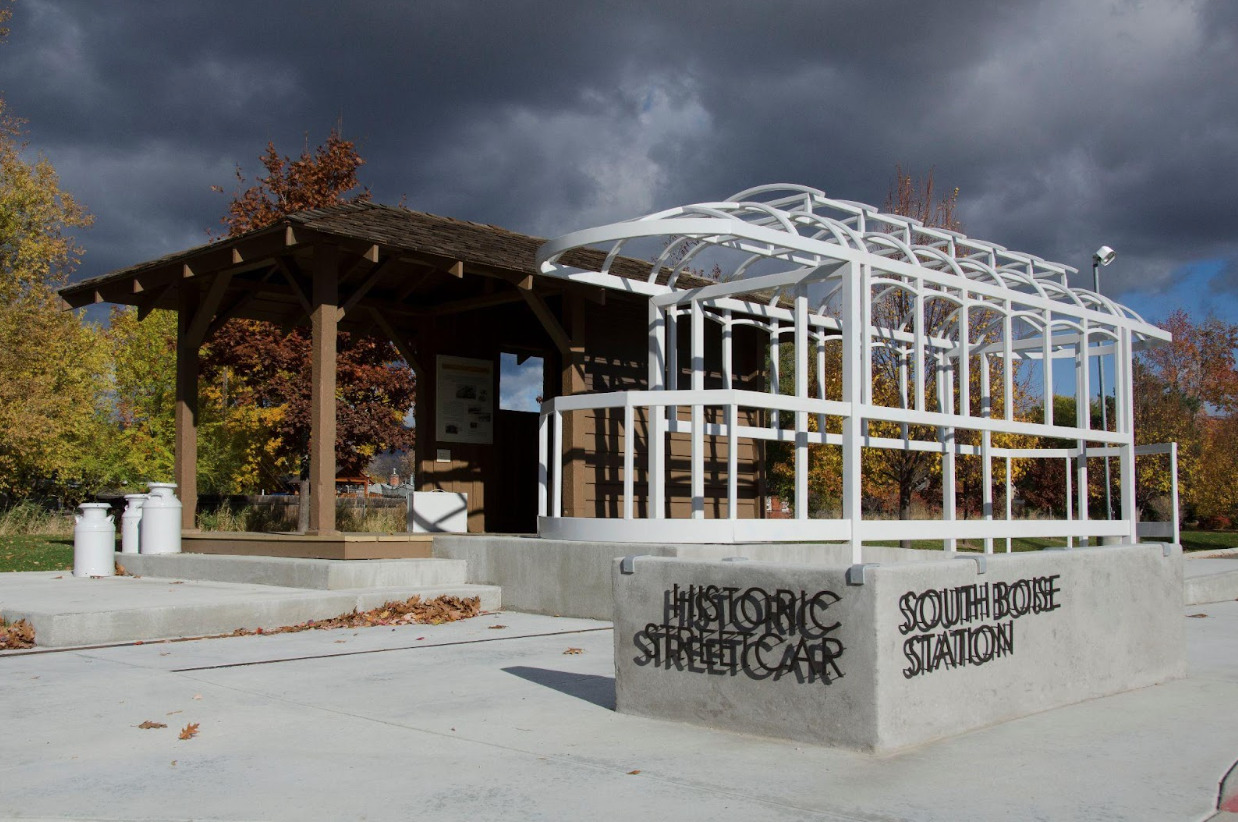
    <summary type="html"><![CDATA[<p><strong><em>Once a trolley shelter on the verge of demolition, the South Boise Streetcar Station features a “ghost streetcar,” a skeletal sculpture designed to commemorate Boise’s trolley history.</em></strong></p><img src="https://www.intermountainhistories.org/files/fullsize/0074d4188c04497c1d8f70aa728da031.jpg" alt="Historic South Boise Streetcar Station Plaza. 2013" /><br/><p><span style="font-weight:400;">Amidst the green grasses of Ivywild Park, a large recreational space in the southern end of Boise, Idaho, stands a bleached, skeletal phantom of a trolley car. This “ghost streetcar” is a to-scale installation sculpture designed by the Byron Folwell firm in 2012, and it features prominently as part of Ivywild Park’s South Boise Trolley Station Plaza, a refurbished trolley shelter that stands as one of the only remnants of the Boise Interurban.</span>
<span style="font-weight:400;">Boise’s streetcar history began in 1891, a year after Idaho achieved statehood, when the Boise City Rapid Transit Company opened an electric rail line along Main Street. From there, Boise’s streetcar network underwent enormous growth; as new communities sprang up, a slew of private companies sought to build more lines and provide service to neighborhoods across the rapidly developing city. The exponential growth of Boise’s communities was intricately intertwined with the proliferation of the streetcar, an early example of what planners now call “transit-oriented development.”</span>
<span style="font-weight:400;">Individual trolleys served communities throughout the Treasure Valley, including Boise and Caldwell, but there was a growing desire among Valley residents and investors alike to connect these disparate streetcar systems into one interurban network. The effort to create an interurban loop from these piecemeal trolleys began with Walter E. Pierce’s Boise Interurban Railway, which initiated construction of a link northward from Boise and Caldwell in 1905, with service beginning in 1907. Meanwhile, Donald Ustick and Robert Noble’s Boise Valley Railway extended southward to Nampa. The northern and southern interurban lines remained disconnected until 1912, when the Idaho Railway Light & Power Company purchased both companies and completed the Boise Valley Interurban Loop, operating streetcars along it as the Idaho Traction Company. Nearby hydroelectric dams supplied much of the power to this new interconnected trolley system.</span>
<span style="font-weight:400;">A wide variety of people relied on the Interurban’s service for their needs, from students riding to the College of Idaho campus in Caldwell to farmers taking their produce to railroad stations. At its peak in 1920, the trolley cars had carried over two and a half million passengers. The trolley had been so foundational to building community in the Valley that local community boosters nicknamed the region’s semi-professional intercity baseball club the “Trolley League.” Despite this, however, the growing popularity of automobiles heralded the end of the Boise streetcar’s profitability. Gradually, buses replaced trolley lines, and the Idaho Power Company ceased all streetcar service from Boise to nearby cities in May of 1928.</span>
<span style="font-weight:400;">The trolley shelter that had once housed streetcars in South Boise remained untouched for almost a century, the city letting it fall into disrepair and dilapidation. The shelter faced the prospect of demolition until 2012,  when three Boise city organizations - the Southeast Boise Neighborhood Association, the City of Boise Department of Arts & History, and the Boise Department of Parks and Recreation - endeavored to save the location from its grim fate. Employing the Byron Folwell design firm to create a life-size skeletal sculpture of a streetcar, the three organizations revitalized the shelter as a public historical attraction and community art piece, a monument to the streetcar history of Boise.</span></p><p><em><strong><a href="https://www.intermountainhistories.org/items/show/818">For more (including 4 images) view the original article</a></strong></em></p>]]></summary>
    <published>2024-05-21T05:33:45+00:00</published>
    <updated>2026-04-17T19:32:18+00:00</updated>
    <link rel="alternate" type="text/html" href="https://www.intermountainhistories.org/items/show/818"/>
    <id>https://www.intermountainhistories.org/items/show/818</id>
    <author>
      <name>Liam Craddock, Northern Arizona University </name>
    </author>
  </entry>
  <entry>
    <title type="html"><![CDATA[A Large KKK Parade and Initiation Ceremony in Boise, Idaho]]></title>
    <summary type="html"><![CDATA[<p><strong><em><span style="font-weight:400;">A large Ku Klux Klan parade marched through downtown Boise in 1924. The parade had floats and pyrotechnics. The procession ended at the fairgrounds where Klan initiation ceremonies took place. </span></em></strong></p><img src="https://www.intermountainhistories.org/files/fullsize/49066b000484ae4fe8e361ce7330a383.jpg" alt="Group of Klansmen photographed without masks" /><br/><p><span style="font-weight:400;">On September 8</span><span style="font-weight:400;">th</span><span style="font-weight:400;">, 1924, 350 Knights of the Ku Klux Klan marched through downtown Boise, Idaho. The parade—representing Klan chapters from all over Idaho—was a large spectacle and reminiscent of a traditional Fourth of July celebration. The parade contained floats, pyrotechnics, and a band blaring “Rally ‘Round the Flag”—an old Civil War tune. They marched through downtown before eventually ending at the fairground where Klan initiation ceremonies and speeches took place in front of an audience of 3000.</span></p><p><span style="font-weight:400;">Most remarkable about the Klan’s presence on that day was how they chose to represent themselves. Following backlash concerning its violent and clandestine nature in previous years, Klansmen presented themselves unhooded and orderly to emphasize their grandeur and image as proper Americans. Many members felt proud to display their allegiance, and twenty even chose to pose unmasked for an </span><i><span style="font-weight:400;">Idaho Statesman</span></i><span style="font-weight:400;"> photograph.  Their use of expensive pyrotechnics and floats is also notable because it not only shows a desire for attention but demonstrates the Klan was organized and wealthy enough to produce such a parade. Furthermore, when the procession reached the fairgrounds, Klansman concluded speeches with special bombs exploding in the air. When the bombs exploded, American flags and three “K” flags were produced in the air and gradually floated back to the ground. </span>
<span style="font-weight:400;">Two floats present in the parade represented Klan political beliefs/tactics during this period. One float was titled “Little Red Schoolhouse” but instead of a traditional red schoolhouse the Klan had draped the schoolhouse in white and added a banner proclaiming “one flag, one county, one school.” Another float followed, also covered in white, with a banner stating, “America First.” According to the Boise paper the </span><i><span style="font-weight:400;">Idaho Statesman,</span></i><span style="font-weight:400;"> this float represented the women of the Klan. Together these floats show the Klan desired to be represented as model Protestant Americans.</span>
<span style="font-weight:400;">The </span><i><span style="font-weight:400;">Statesman</span></i><span style="font-weight:400;"> and others had criticized the Klan inflicting violence against minorities and the Klan used the parade to quell the fears of the citizens. When they reached the fairgrounds, J.H Harmon, a Klansman, stated “we have demonstrated in Boise today that we are a law and order organization…It should prove to you that we do not commit violence.”  Another Klansman, W.M Cortner, stated in a speech “The Knights of the Ku Klux Klan are standing for nothing that is not just, right and honorable. It is not anti-one church, race, creed, or people. The reason why a Catholic, a Jew, or a negro cannot belong to the Klan Is because they have their own organizations.”  </span>
<span style="font-weight:400;">The Boise parade and speeches represent the Klan’s desire to use grandeur and spectacle to alter its image from violence and racism to a softer one of proper American Protestants and white supremacists. </span></p><p><em><strong><a href="https://www.intermountainhistories.org/items/show/813">For more (including 3 images) view the original article</a></strong></em></p>]]></summary>
    <published>2024-05-21T01:01:51+00:00</published>
    <updated>2026-04-17T19:32:18+00:00</updated>
    <link rel="alternate" type="text/html" href="https://www.intermountainhistories.org/items/show/813"/>
    <id>https://www.intermountainhistories.org/items/show/813</id>
    <author>
      <name>Aidan Capristo, Northern Arizona University</name>
    </author>
  </entry>
  <entry>
    <title type="html"><![CDATA[City National Bank of Boise]]></title>
    <summary type="html"><![CDATA[<p><strong><em>Opened in 1886, the Boise City National Bank quickly became one of the largest financial houses in Idaho and the Pacific Northwest, operating for a total of forty-six years.</em></strong></p><img src="https://www.intermountainhistories.org/files/fullsize/b717659bdc02604d2951ecfeaba1dac4.jpg" alt="Boise City National Bank" /><br/><p><span style="font-weight:400;">In 1886 Boise had a single national bank and Idaho’s growing mining and agricultural production offered conditions for another financial house. Alfred Eoff, a freelance economic agent operating across the American West since the 1860s, took advantage of this opportunity. Encouraged by Wells Fargo & Company treasurer Henry Wadsworth to seize the opportunity, Eoff established Boise City National Bank in 1886. Situated near Main Street and Capitol Boulevard, it was established as a competitor to the First National Bank of Idaho. Wadsworth acted as City National’s president while Eoff became its cashier, becoming part of Wells Fargo’s growing presence in the American West.</span>
<span style="font-weight:400;">Wadsworth’s recommendations proved sound. By 1890, City National Bank’s portfolio included over $620,000 in financial assets, with $65,000 held in securities alone. Idaho’s population boom increased City National’s business, requiring a larger building as the initial bank became too small to house its customers and resources, including cash, deeds, or precious metals. This led City National Bank’s board to construct a three-story building designed by local architect James King that could house both the bank and rentable commercial and office space. This new structure housed not only the bank but also the United States Marshals’ and Surveyor’s Offices as well as Idaho’s federal district court after its completion in 1892.</span>
<span style="font-weight:400;">Despite the 1890s economic downturn, City National’s portfolio continually increased, with total assets totaling $870,000 by 1900. Continued growth led to the addition of a fourth story commercial club in 1904 and renovations in 1913, all designed by John Tourtellotte & Company who also planned Idaho’s State Capitol. The commercial club catered to its patrons, who likely consisted of influential stockmen, farmers, and investors, offering amenities such as a dining district, billiards parlor, cardroom, lounge, writing room, and a library. </span>
<span style="font-weight:400;">By 1905, Wadsworth retired and Frank R. Coffin became City National’s new president. Coffin, previously lured west from Indiana, first settled in California as a tinsmith and later became a gold miner in Idaho’s 1860 gold strike. He served as Idaho’s first state treasurer from 1891-93, treasurer of the Artesian Hot and Cold Power Company, one of the state's leading utility corporations, and president of the Boise Clearinghouse Association, a local financial institution. Serving as president until he died in 1920, Coffin further expanded City National’s reach until it became Idaho's second-largest national bank, with $1.6 million in total assets.</span>
<span style="font-weight:400;">By 1932, during the strain of the Great Depression, City National voluntarily closed, citing depleted reserves. It argued that closure was the best option for depositors, with the remaining $2.5 million in accounts distributed among its clients. After its closure, various owners occupied the bank building, including the Idaho Building and Loan Association and the J. R. Simplot Company, one of Idaho’s largest corporations. Today it is owned by Rocky Mountain Management, and houses many offices and commercial businesses.</span></p><p><em><strong><a href="https://www.intermountainhistories.org/items/show/796">For more (including 7 images) view the original article</a></strong></em></p>]]></summary>
    <published>2024-03-20T19:44:45+00:00</published>
    <updated>2026-04-17T19:32:17+00:00</updated>
    <link rel="alternate" type="text/html" href="https://www.intermountainhistories.org/items/show/796"/>
    <id>https://www.intermountainhistories.org/items/show/796</id>
    <author>
      <name>William R. Batson, Northern Arizona University</name>
    </author>
  </entry>
  <entry>
    <title type="html"><![CDATA[Chinden Boulevard: Remembering Chinese Contributions to Boise]]></title>
    <summary type="html"><![CDATA[<p><strong><em>Many residents of Idaho’s capital know the name “Boise” comes from the French word for “wooded,” but will those who call “The City of Trees” home recognize another familiar name in the valley that recalls Idaho’s storied past as a culturally diverse frontier territory?</p></strong></p><img src="https://www.intermountainhistories.org/files/fullsize/a9f4450a4cbf7c33cbfa46eac170c193.jpg" alt="A Festival on Chinden" /><br/><p><span style="font-weight:400;">“Chinden Boulevard,” or US Highway 20/26 is a vital East-West artery of the Boise metropolitan area which connects suburban homes to the workplaces, restaurants, and entertainment centers of the capital city’s quaint downtown. Many commuters on this road, or those pleasure-seekers out for a night on the town, are, perhaps, unaware that the road’s name bears the memory of the Chinese immigrants who came to the region decades before Idaho achieved statehood. Instead of the tattoo parlors and used car lots lining the road today, near the end of the 19th century, the road passed acres of beautiful vegetable gardens planted and cared for by Chinese immigrants, thus earning the name “China-garden,” or “Chinden.”</span>
<span style="font-weight:400;">The discovery of gold in Southern Idaho in 1862 marked the beginning of a mass migration into the region that extended over the course of multiple decades and paved the way to statehood. Though united in their search for fortune and opportunity, the early prospectors and adventurers who braved this new frontier came from diverse cultural and ethnic backgrounds. One early resident of Idaho expressed his first impression of Boise in these words: “In the courtyard of the Overland Hotel I saw, the morning of my arrival in Boise, an Irishman, a Spaniard, a Frenchman, two Chinamen, a Canadian, an Englishman—and not an American.”</span>
<span style="font-weight:400;">Early Idaho was diverse and one prominent group in the cultural patchwork of the region was Chinese immigrants. In fact, in a population of about 20,600 in the territory of Idaho in 1869, 4,274 were Chinese. Though many Chinese came to the region in search of gold, over time they took up other pursuits. Indeed, it could be said that in the Idaho Gold Rush the Chinese abided by the idiom, “during a gold rush, sell shovels.” Instead of mining, many began shop keeping, cleaning laundry, raising pigs, and growing and selling vegetables to mining communities. Initially, the produce from these Chinese gardens was intended for Chinese miners, but—due to the quality and availability of the vegetables—the market quickly expanded outside Chinese circles to entire communities. The produce attracted such praise that one newspaper commented that, “most of their productions surpass in size and excellence the imported articles.” With Boise as the main supply center of the region and many Chinese looking to sell their goods and services to miner customers, many Chinese gravitated to the city, becoming a crucial part of both the city and territorial economy. In 1871, a newspaper noted that “The China population are planting gardens here pretty extensively. They are so patient and puttering that they do well.” These “patient and puttering” gardeners were known to group together to lease land for their various crops. Each took part in planting, harvesting, and selling their produce.</span>
<span style="font-weight:400;">During the growing season, work in the fields would begin before dawn. By sun-up, their carts would be loaded and ready for making deliveries to homes or selling vegetables in the streets. Another newspaper report illustrates a typical interaction between a Chinese vegetable peddler and their client: “John Chinaman makes his appearance at our door bright and early every morning, with the traditional pole and baskets, the latter filled with every variety of fresh plucked and cool vegetables.” Clearly, the Chinese presence in Boise was prominent as they filled a variety of needs for a variety of customers on a regular basis.</span>
<span style="font-weight:400;">While newspapers at times praised the industry of Chinese workers, their often patronizing tone is indicative of both the underlying and overt racism and persecution the Chinese in Idaho endured. Indeed, as far removed as the territory was, it was not far enough to escape the waves of anti-Asian legislation that spread in the wake of the Chinese Exclusion Act of 1882. After only a few decades, many Chinese left Idaho, and the once vibrant Chinese community became a shadow of what it once was. Today, Chinden Boulevard still passes through Garden City, the lowlands west of Boise’s downtown where scores of Chinese immigrants cultivated gardens to build themselves better lives. Though their exodus out of Idaho left a vacancy in Boise’s Chinese population that has not been filled since, the memory of their resolve in the face of adversity can continue to inspire generations of Idahoans as they travel along the old China-gardens road.</span></p><p><em><strong><a href="https://www.intermountainhistories.org/items/show/739">For more (including 3 images) view the original article</a></strong></em></p>]]></summary>
    <published>2023-04-07T18:08:21+00:00</published>
    <updated>2026-04-17T19:32:16+00:00</updated>
    <link rel="alternate" type="text/html" href="https://www.intermountainhistories.org/items/show/739"/>
    <id>https://www.intermountainhistories.org/items/show/739</id>
    <author>
      <name>Jacob Johnson, Brigham Young University</name>
    </author>
  </entry>
  <entry>
    <title type="html"><![CDATA[The Old Idaho State Penitentiary]]></title>
    <summary type="html"><![CDATA[<p><strong><em>The Old Idaho Penitentiary operated for over 100 years as the first prison in Boise, Idaho. Over the years it has housed over 13,000 inmates, hosted 36 wardens, and was the site of numerous escapes, riots, and executions. Today, it stands as one of only four territorial prisons open to the public and has been converted to a museum detailing the prison’s history.</em></strong></p><img src="https://www.intermountainhistories.org/files/fullsize/a2d30f007de6a7615d40500011f92655.jpg" alt="Women&#039;s Ward" /><br/><p><span style="font-weight:400;">Located between the heart of downtown Boise and the Boise Foothills, the Old Idaho Penitentiary serves as a reminder of Idaho’s territorial past. Inmates quarried the distinctive sandstone that makes up the prison’s buildings and walls from the nearby Table Rock area, a well-known Boise landmark. The penitentiary first opened in 1872 and was originally known as the Territorial Prison. It was later renamed the Idaho State Penitentiary when Idaho achieved statehood in 1890.</span>
<span style="font-weight:400;">The prison was constructed in the Second Empire architectural style with guard turrets and thick walls reminiscent of a castle or fortress. Architects intended the construction to evoke a “somber, dark environment deemed appropriate for prisoners.” Wardens and guards encouraged inmates to work to reduce idleness and the penitentiary became almost entirely self-sufficient. Inmate labor carried the added benefit of reducing construction fees, costs, and wages significantly, saving the state hundreds of thousands of dollars. However, the prison lacked modern amenities, a problem that would cause discontent and riots in later years.</span>
<span style="font-weight:400;">As the number of inmates increased, the compound expanded significantly. The inmates quarried sandstone and constructed most of the buildings themselves. By 1973, the penitentiary’s walls had housed multiple cell blocks, several administrative buildings, the warden’s house, a dining hall, library, commissary, blacksmith and carpenter shop, shirt and license plate factory, women’s ward, an apiary, a garden, and a steam plant. The prison also contained several isolation and punishment cells, known as the “Dungeon,” “Cooler,” and “Siberia,” as well as a gallows that was used to execute ten prisoners. Additionally, the penitentiary owned several ranches and farms that utilized inmate labor to produce the prison’s food.</span>
<span style="font-weight:400;">Harry Orchard was the penitentiary’s most infamous prisoner. He had assassinated Frank Steunenberg, the former governor of Idaho, with a bomb as revenge for the government’s role in the 1890 mining conflicts in Coeur d'Alene. Although he confessed to killing at least 17 men, Orchard remained a model prisoner. Other prisoners were not, and the penitentiary experienced over 500 escape attempts. Prisoners escaped by running away from work assignments, digging tunnels, climbing walls, or lowering themselves down makeshift ropes. Some succeeded, but the majority were caught soon after their escape. </span>
<span style="font-weight:400;">There were also several riots in the later years of the penitentiary's history, reflecting inmate discontent with outdated prison conditions. One of the most notable riots occurred in 1952, when nearly 250 inmates seized the Multipurpose Building and severely damaged it. In 1971, two prisoners were stabbed, inmates set fire to several buildings, and others raided the commissary and hospital. A similar riot occurred in 1973 and caused significant fire damage. </span><span style="font-weight:400;">The riots were all put down, some using tear gas, but the increasing frequency worried prison officials. </span>
<span style="font-weight:400;">The riots, outdated facilities, and lack of space for expansion led to the construction of a new correctional facility in 1972. This facility was built near Kuna, Idaho, and officials gradually transferred inmates there. By 1974, the recently renamed Old Idaho Penitentiary earned a spot in the National Register of Historic Places. Today, it has been converted into a museum run by the Idaho State Historical Society. Boise residents refer to it as the “Old Pen,” and local legend claims it is haunted by the ghosts of former guards and executed inmates.</span></p><p><em><strong><a href="https://www.intermountainhistories.org/items/show/734">For more (including 6 images) view the original article</a></strong></em></p>]]></summary>
    <published>2023-04-05T20:08:12+00:00</published>
    <updated>2026-04-17T19:32:16+00:00</updated>
    <link rel="alternate" type="text/html" href="https://www.intermountainhistories.org/items/show/734"/>
    <id>https://www.intermountainhistories.org/items/show/734</id>
    <author>
      <name>Madison Sommer, Brigham Young University</name>
    </author>
  </entry>
  <entry>
    <title type="html"><![CDATA[Ahavath Beth Israel in Boise, Idaho]]></title>
    <summary type="html"><![CDATA[<p><strong><em>Ahavath Beth Israel (Hebrew for "Love of the House of Israel") is the oldest synagogue in continuous use west of the Mississippi River. Founded in part by the first Jewish governor in United States history, it represents over 125 years of Jewish life in Idaho. </em></strong></p><img src="https://www.intermountainhistories.org/files/fullsize/47a512e31e6ea673617a2392d1569f9c.jpg" alt="Temple Beth Israel" /><br/><p><span style="font-weight:400;">Among the first immigrants to Idaho were Jews who came from Germany and Central Europe beginning in the 1860s. They arrived soon after Congress declared Idaho a territory and primarily worked in mercantile or farming operations. They worshipped in private homes and rented halls until they amassed the resources for a synagogue. In 1895, five years after statehood, community leaders organized an official congregation and elected successful Boise merchants Moses Alexander and David Falk as leaders. They led the congregation to purchase three lots a few blocks from the state capitol and hired an architectural firm to begin construction on the Temple Beth Israel. Records later surfaced that nationally known companies such as Marshall Field and Levi Strauss contributed to its construction. </span>
<span style="font-weight:400;">Local architects Chestney and Schroeder completed the synagogue in 1896, and its architecture reflects Rundbogenstil and Moorish Revival styles. Rundbogenstil was popular in Germany and its diaspora, reflecting the recent waves of German immigration. It incorporates Byzantine, Romanesque, and Renaissance styles commonly used in synagogue architecture of this period. It can be seen in the tall, arched window framing the synagogue, and the arched windows along the sides. Such windows, intricate detailing, and interior vaulted arches also reflect Moorish Revival style, a mainstay of nineteenth-century synagogues due to its association with Judaism’s Middle Eastern origins. The architects designed Temple Beth Israel with a white and reddish pink Boise sandstone base and cedar-shingled exterior that imitates stonework. They used Cathedral glass to make stained glass windows and adorned the building with a handmade Star of David. Its crowning feature is a large, circular rose window. Ornate yet small, the Boise congregation constructed it to hold only 150 people. </span>
<span style="font-weight:400;">The synagogue founders were major figures in Boise life. David Falk, the congregation president, owned dry goods stores and assisted in establishing the Boise-Winnemucca Railroad. Moses Alexander, vice president, became a prominent statesman. His fellow citizens elected him mayor of Boise in 1897 and 1901, and then governor of Idaho in 1914, becoming the first practicing Jewish governor in the United States. The community remained small throughout the twentieth century. In 1972, the Jewish citizenry successfully petitioned to have the synagogue placed on the National Register of Historic Places. A federal grant and other raised monies then facilitated a building renovation in 1981, which restored the windows, siding, and handmade Star of David—which they delayed placement of until an Aryan Nations Conference had left the area. Soon after, a new congregation of Jews who had moved from Poland after World War II merged with Temple Beth Israel, formally becoming Congregation Ahavath Beth Israel in 1986.</span>
<span style="font-weight:400;">The new congregation continued to grow, and, in 1994, added Daniel Fink as Idaho’s first full-time rabbi. They also needed more space, so they hired Cole & Associates to relocate the building in October of 2003. Of the additions, they added an education building. Today, the synagogue continues to support Boise’s Jewish population from its location on Latah Street. </span></p><p><em><strong><a href="https://www.intermountainhistories.org/items/show/718">For more (including 5 images) view the original article</a></strong></em></p>]]></summary>
    <published>2023-03-01T19:42:44+00:00</published>
    <updated>2026-04-17T19:32:15+00:00</updated>
    <link rel="alternate" type="text/html" href="https://www.intermountainhistories.org/items/show/718"/>
    <id>https://www.intermountainhistories.org/items/show/718</id>
    <author>
      <name>Katie Scholler, Northern Arizona University </name>
    </author>
  </entry>
  <entry>
    <title type="html"><![CDATA[Idaho’s Territorial Capital Dispute]]></title>
    <summary type="html"><![CDATA[<p><strong><em>Lewiston was Idaho's first territorial capital, but the title was short-lived. Many disputes over moving the capital down to Boise ensued between the people of Lewiston and the people of Boise, contributing to a longstanding divide between northern and southern Idaho.</em></strong></p><img src="https://www.intermountainhistories.org/files/fullsize/acc53b1a3c757d53c6ac8a90857a5ee8.jpg" alt="First" /><br/><p>A nineteenth-century dispute over where to place the state capital dispute helped create a regional divide that persists in Idaho to this day. It all started when westward settlers found gold in 1860, leading many to migrate to the Rocky Mountains in hopes of striking it rich. Settlers found gold in the Clearwater River, in northern Idaho, and some formed mining camps, one of which was Lewiston. As the settler population grew, many in the area called for establishing a seat of United States government closer than Olympia, Washington. In response, in March 1863, territorial governor William H. Wallace pronounced Lewiston the capital of Idaho. Wallace chose this location because in addition to the gold, there was already an established transportation and communication system that linked northern Idaho to other U.S. states and territories.
After the discovery of gold in 1862 in the Boise Basin, however, eager settlers rushed to the southern part of the territory. At the same time, gold had depleted up north in Lewiston, even further accelerating the southward migration. With most of the settler population now residing in the south, moving the capital seemed logical, especially since mountainous terrain made traveling between Boise and Lewiston difficult.
This turned out to be easier said than done, however. The territorial legislature, primarily made up of representatives from northern Idaho, failed the first initiative to change Idaho’s capital. However, in 1864 Idaho’s number of legislative representatives changed to accommodate the difference in population, leaving three representatives for the north and four for the south. This change in political power—plus pressure from H. C. Riggs, one of Bosise’s founders—convinced acting governor Caleb Lyon to move the capital to Boise. On November 23, 1864, Riggs introduced a bill to make Boise the capital. It passed six days later, and Lyon signed it into law.
Rather than fix the problem, this may have only made it worse. Governor Lyon fled to nearby Walla Walla, Washington, and sent a trusted official to retrieve the official documents from the acting secretary of Lewiston. After a stalemate over who had rights to the papers, and where the capital would officially reside, President Lincoln’s territorial secretary C. DeWitt Smith went to serve as acting governor of Idaho. With help from Fort Lapwai soldiers, Smith obtained the documents and traveled to Boise, where he put the new law into effect.
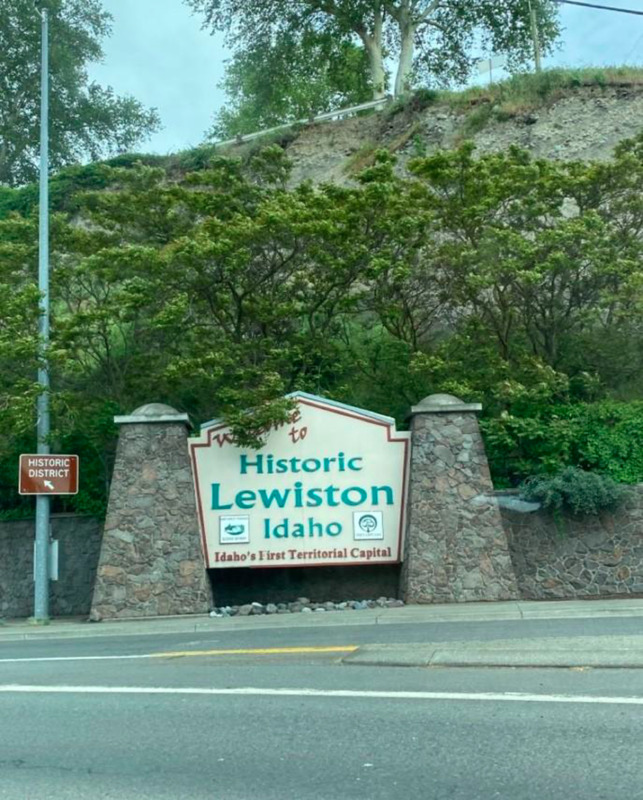
In the end, moving the capitol from Lewiston to southern Idaho left its residents with a sense of lost pride. This sparked a cultural divide between northern and southern Idaho that continues to this day. To this day, downtown Lewiston hosts a sign proclaiming the city “Idaho's First Territorial Capital,” demonstrating that the residents remember their city’s history and will not let people forget Idaho’s original territorial capital.</p><p><em><strong><a href="https://www.intermountainhistories.org/items/show/628">For more (including 3 images) view the original article</a></strong></em></p>]]></summary>
    <published>2022-06-30T20:51:21+00:00</published>
    <updated>2026-04-17T19:32:13+00:00</updated>
    <link rel="alternate" type="text/html" href="https://www.intermountainhistories.org/items/show/628"/>
    <id>https://www.intermountainhistories.org/items/show/628</id>
    <author>
      <name>Dawson Packwood, College of Idaho</name>
    </author>
  </entry>
  <entry>
    <title type="html"><![CDATA[Queen Aggie: Boise’s Black Madam]]></title>
    <summary type="html"><![CDATA[<p><strong><em>Levy’s Alley was Boise’s most notorious restricted district. After Davis Levy’s death, Agnes Bush became one of its most famous proprietors.</em></strong></p><img src="https://www.intermountainhistories.org/files/fullsize/0cad4d80950205d12f20127cfaf8287c.jpg" alt="Parlor" /><br/><p>Named for Davis Levy, the original owner of many of the cribs that lined the alley in the 1880s, Levy’s Alley ran behind the 600 block of Main Street in downtown Boise. While the alley was not the only restricted district in the city, it was the most notorious, and the majority of Boise’s most famous madams and sex workers lived and worked there. One such person was Agnes Bush, also known as “Queen Aggie,” a Black woman who operated multiple cribs and parlor houses in Boise.
Bush was one of Levy’s prior tenants, and after he died, she acquired some of the property for herself and expanded a pleasure business of her own. Bush soon ran multiple rooms in the district, by then nicknamed “Levy’s Alley” after Davis, which she rented out by individual women known as “crib girls.” She was known not only as a successful businesswoman but also as a prominent citizen, and the <em>Idaho Daily Statesman</em> frequently wrote about her charitable acts for the poor and children in need. Bush also made important donations to the city and formed long-standing financial and “friendly” ties with the press and local law enforcement. These relationships were supplemented by expensive gifts such as a diamond-encrusted badge she gave to Boise police chief B. F. Francis and a $250 diamond ring to local journalist C. Miles. These gifts and activities both ensured and announced Bush’s prominent role in Boise, for which she earned the nickname “Queen Aggie.”
Agnes Bush stands out because she was a Black woman. As a prominent figure in the Boise community with ties to law enforcement, as well as significant property holdings and wealth, she stands as a curious anomaly in the history of the Treasure Valley and the broader region. Though there was white supremacist activity in the area given Boise’s proximity to Oregon (which white residents established officially as a white-only state in its 1859 constitution), Bush was a major player in her community. Indeed, local government and law enforcement typically tolerated sex workers in Boise until 1909, when national sentiments turned against the traditional practice of relegating sex workers to restricted districts in favor of completely expelling such para-legal practices in the name of public health. That year, Congress passed the Mann Act, and local Boise officials began targeting their city’s sex workers for fear of federal intervention.
After being run out of the city, Bush moved to Portland, Oregon to live with one of her sons while she suffered from partial paralysis. In 1910, the <em>Statesman</em> reported her death in Portland and revealed her “real name,” Frances Richardson. Despite how her story ended, Bush’s success and her ties to the community suggest the rich tapestry of people that comprised the state of Idaho’s early years and reflect the fascinating and dynamic time in which she lived.</p><p><em><strong><a href="https://www.intermountainhistories.org/items/show/624">For more (including 3 images) view the original article</a></strong></em></p>]]></summary>
    <published>2022-06-25T23:56:23+00:00</published>
    <updated>2026-04-17T19:32:13+00:00</updated>
    <link rel="alternate" type="text/html" href="https://www.intermountainhistories.org/items/show/624"/>
    <id>https://www.intermountainhistories.org/items/show/624</id>
    <author>
      <name>Gabriel Herring, College of Idaho</name>
    </author>
  </entry>
  <entry>
    <title type="html"><![CDATA[Idaho State Capitol in Boise]]></title>
    <summary type="html"><![CDATA[<p><strong><em>The Capitol building in downtown Boise houses the bicameral Legislature of the State of Idaho as well as several offices of the executive branch. It is an impressive building which speaks to the history of the state.</em></strong></p><img src="https://www.intermountainhistories.org/files/fullsize/f06979ab23734dfbc6f456e70ce3331c.jpg" alt="Chamber of the Idaho House of Representatives" /><br/><p>The land that would become Idaho was originally Native land. Today these Native tribes include the Coeur dAlene, Kootenai, Shoshone-Bannock, and Nez Perce. White settlers had been passing through along the Oregon trail earlier in the nineteenth century but became more established in the wake of gold rushes starting in 1860. Many more white immigrants arrived to farm in the 1890s and, along with the U.S. government, forced Native peoples onto reservations.
Idaho was formed largely by agricultural boosterism. White settlers who had envisioned a farming paradise were soon confronted by the difficulty of the land and the unpredictable Snake River. Many persevered, however, and helped Idaho grow. Boosterism even gave the state its name. The name is often taken as a Native word meaning “gem of the mountain” or similar, but it actually traces back to a white man named George Willing, who suggested it as a name of what became Colorado territory. Although the name was pulled as a candidate for Colorado after the truth was discovered, it remained popular and was applied to the Idaho Territory by territorial officials when Congress separated it from Washington Territory. It was established as a territory by Abraham Lincoln on March 4, 1863 with Boise decided as its capitol the following year. Benjamin Harrison signed Idaho into statehood on July 3rd, 1890, though it took fifteen years for the old Territorial Capitol building to be replaced by the new State Capitol building.
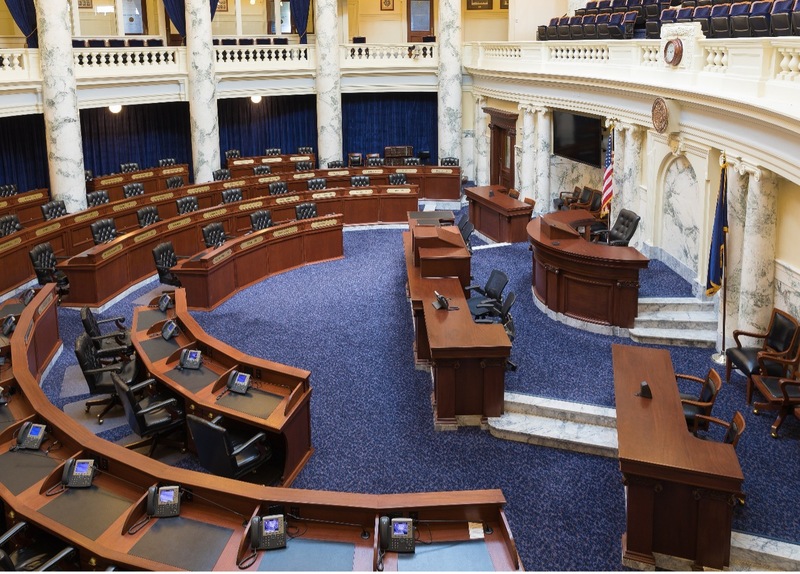
Construction of the Capitol took place in two distinct phases. Builders constructed the central dome and north wing from 1905–1912, after which it began to operate as the seat of government. In 1919, the legislature secured additional funds to build the east and west wings, completing them the next year. The Legislature tapped J.E. Tourtellotte and Charles Hummel to design the initial structure and chose native sandstone for the building’s superstructure. The state used convict labor to transport the blocks from a nearby quarry but employed craftsmen to finish the fine multicolored foreign marble of the building’s interior. Since its completion, the Capitol has been updated for comfort, safety, and technology to preserve it as a working seat of government.
While facing the front of the Capitol from beyond Jefferson Sreet, visitors can see a statue of Abraham Lincoln; behind that a memorial for Governor Frank Steunenberg, who was assassinated in 1905; and behind that a replica of the Liberty Bell, donated by the U.S. Treasury department in 1950. A Pioneer Monument to the east of the entrance honors the travelers of the Oregon Trail, and to the west stands an 1840 Confederate seacoast gun and the Grand Army of the Republic Monument dedicated to soldiers of the Union Army. A relic from the old Idaho Territorial Capitol stands on the fourth floor: a gilded pinewood statue of George Washington carved in 1869 by Charles L. Ostner. These objects and the building itself stand as a reminder of Idaho’s place in U.S. history.</p><p><em><strong><a href="https://www.intermountainhistories.org/items/show/507">For more (including 3 images) view the original article</a></strong></em></p>]]></summary>
    <published>2021-10-09T22:39:59+00:00</published>
    <updated>2026-04-17T19:32:10+00:00</updated>
    <link rel="alternate" type="text/html" href="https://www.intermountainhistories.org/items/show/507"/>
    <id>https://www.intermountainhistories.org/items/show/507</id>
    <author>
      <name>David Cady, Northern Arizona University</name>
    </author>
  </entry>
  <entry>
    <title type="html"><![CDATA[Fort Boise&#039;s Historic Transitions]]></title>
    <summary type="html"><![CDATA[<p><strong><em>During the nineteenth century, the Boise Basin hosted an abundance of natural resources. These resources, specifically furs and gold, attracted settlers from the East, triggering a massive migration out West. Settlers, miners, and fur traders traveled the nearby Oregon Trail. A series of fort locations were employed starting in 1834 near the confluence of the Boise and Snake Rivers to provide support and stimulate economic growth by enabling settlers to trade goods with each other and nearby Native tribes. </em></strong></p><img src="https://www.intermountainhistories.org/files/fullsize/62d23d4b423fe9a0d3055e24e29e6bdf.jpg" alt="Fort Boise 2" /><br/><p>Snake Fort, founded in 1834 by Thomas McKay of the Hudson Bay Fur Trading Company, was originally located at the confluence of the Snake and Boise River near present-day Parma, Idaho, at the Oregon border. Later renamed Fort Boise, the fur trading post directly competed with Fort Hall, established by Nathaniel Wyeth, upriver in what is now present-day Pocatello, Idaho. The adobe style structure was highly susceptible to flooding, and Fort Boise was relocated several times within the general vicinity to reduce flooding risk. Within a few years, regional fur trading sharply declined, and the economy of Fort Boise transitioned to salmon fisheries. The great flood of 1853, along with escalating conflicts among settlers and Native Americans in 1854, contributed to its demise. The old fort was abandoned in 1855. </p><p>The new Fort Boise, situated in the heart of downtown Boise, Idaho, was established as a military post by the U.S. government in 1863 under the guidance of Major Pinkney Lugenbeel. Gold mining prevailed in the Boise Basin, and the military post provided a protective buffer to settlers and miners, reducing conflicts between them and surrounding tribes. Inspiration for the design came from brick buildings in Walla Walla, Washington, where Major Lugenbeel stopped on his way to the Boise Basin. Charles May, the builder responsible for the construction of the brick buildings, was hired to assist in the construction of Fort Boise. He used strong materials that consisted of brick and sandstone quarried from the nearby foothills and Table Rock.</p><p>In 1879, Fort Boise was renamed the Boise Barracks and served as a military base and a community center by hosting numerous social events such as theatrical performances, religious services, concerts, balls, tea and dinner parties, dancing, and tennis matches. The fort played a vital role in establishing the city and providing a center for diverse activities, meeting the needs of military and civilian. In the early twentieth century, the decision by the U.S. War Department to reduce small military bases and forts resulted in the fort’s second abandonment. Following several years of vacancy, Governor D.W. Davis loaned the property to the U.S. Public Health Service, enabling World War I veterans to receive treatments from postwar injuries. Passed in 1922, the Hospital Bill qualified veterans to receive medical treatments regardless of active status. The Public Health Service later turned the hospital over to the Veterans Bureau and in 1930 to the Veterans Administration. </p><p>Despite its many shortcomings, Fort Boise became a fundamental component to the development of the current city. Initially facilitating economic growth and prosperity in the region through the trade of natural capital, the fort later transitioned to a protective force, a location for social interaction among settlers and finally a place of healing for the wounded.</p><p><em><strong><a href="https://www.intermountainhistories.org/items/show/174">For more (including 8 images) view the original article</a></strong></em></p>]]></summary>
    <published>2018-05-17T00:07:10+00:00</published>
    <updated>2026-04-17T19:32:02+00:00</updated>
    <link rel="alternate" type="text/html" href="https://www.intermountainhistories.org/items/show/174"/>
    <id>https://www.intermountainhistories.org/items/show/174</id>
    <author>
      <name>Zachary A. Sanchez, University of Idaho</name>
    </author>
  </entry>
  <entry>
    <title type="html"><![CDATA[Boise’s Table Rock Cross]]></title>
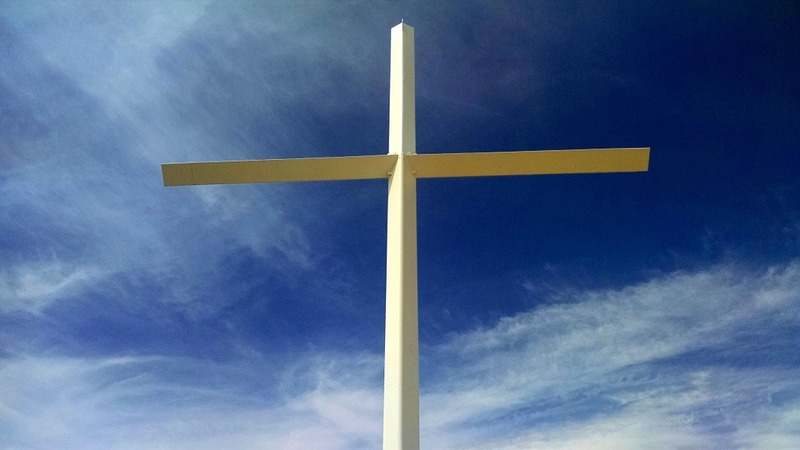
    <summary type="html"><![CDATA[<p><strong><em>The Table Rock Cross has been the center of the longest separation-of-church-and-state debate in Idaho. </em></strong></p><img src="https://www.intermountainhistories.org/files/fullsize/6996d6b0b4fb21cca67d5be525d10eb1.jpg" alt="Cross, Table Rock, Boise" /><br/><p>Table Rock is a popular hiking destination for residents in Boise, Idaho. It is part of a diverse four-mile hiking loop that lets hikers make their own trails without the worry of motorized vehicles running into them. Atop of the hiking trail you will see a 60-foot white cross put up by the Jaycees Club of Boise in 1956. The cross was built on government land, meaning the Jaycees Club did not own the cross or land until 1972. Even then, the cross met with controversy. </p><p>On July 19, 1970, the Jaycees Club asked to buy the land around the cross from the Board of Correction. On June 25, 1971, the Correction Board declared the parcel surplus and gave it to the Idaho Department of Lands. The Idaho Board of Lands feared a lawsuit as a similar cross in Eugene, Oregon was ruled to be violating the separation of church and state in the 1970s. The Land Board declared a public auction to sell the land around the cross and the Jaycees Club bought it for $100 and made it private land.  In 1999, Rob Sherman, a Chicago talk-radio host and atheist, argued that the transaction of land was rigged in favor of the Jaycees Club and wanted the cross to be removed. This led to a march of around 10,000 people on Capitol Boulevard protesting that the cross should stay. Many notable Idaho politicians showed their support for the cross like future Governor Butch Otter who thought it was private property.</p><p>The cross continues to look over the Boise area today. It has become a reminder of the longest separation-of-church-and-state debate in Idaho. Though some have brought up the question whether the cross would even exist if the majority of Boise residents were not Christians, there have also been arguments that the cross brings harm to other non-Christian groups in Boise. For many Boise residents, however, the cross is a symbol of how peaceful and welcoming the Boise community can be.</p><p><em><strong><a href="https://www.intermountainhistories.org/items/show/170">For more (including 3 images) view the original article</a></strong></em></p>]]></summary>
    <published>2018-05-15T01:38:18+00:00</published>
    <updated>2026-04-17T19:32:02+00:00</updated>
    <link rel="alternate" type="text/html" href="https://www.intermountainhistories.org/items/show/170"/>
    <id>https://www.intermountainhistories.org/items/show/170</id>
    <author>
      <name>Tristin Hafer, University of Idaho</name>
    </author>
  </entry>
  <entry>
    <title type="html"><![CDATA[Basque Culture in Boise]]></title>
    <summary type="html"><![CDATA[<p><strong><em>The Boise Basque Block is an entire city block dedicated to the culture and heritage of Basque in Boise and across the United States. Located along the entire length of Grove Street, this area features museums, restaurants, music events, and annual festivals. The historic block is home to one of the largest Basque communities in the United States with an estimated 16,000 residents. </em></strong></p><img src="https://www.intermountainhistories.org/files/fullsize/a36978dc31ec6c0002d8a71f3c169930.jpg" alt="Boise Basque Center" /><br/><p>Drawn to the United States by the gold rush of 1848, waves of Basque people arrived in the U.S. and settled around Los Angeles. After becoming established in southern California, their populations expanded and followed the discovery of gold to northern California and Nevada. By 1890 the Basques had moved into Oregon and southern Idaho, and by 1910 they had spread throughout the West.</p><p>Basque peoples focused their efforts on establishing themselves in the region through various economic endeavors, such as sheep herding. The Basque style of sheep herding is one of solitude in which the shepherd is out alone with only the animals that he cares for. These grazing practices helped shape the ecological landscape of the regions that were used. Furthermore, it drove the Basques to the regions and industries that they are currently in today. This is shown through their large populations in areas such as Fruitland, Idaho and Ontario, Oregon. These cities have long histories of Basque culture and deep ties to the traditions that they hold dear. </p><p>After months of this lonely schedule, men commonly rented rooms at Basque boarding houses that housed their fellow countrymen. These would be places to relax, court potential wives, and reconnect with their culture. A boarding house was the key factor in establishing what is today the Boise Basque Block. The Cyrus Jacobs/Uberuaga House served as a Basque boarding house in Boise from 1910 until 1968.   Today it stands in the center of the block and is a museum dedicated to the Basque community. </p><p>With such an established Basque community in Boise centered around the Cyrus Jacobs/Uberuaga House, it was decided in 1949 to build the Basque center right next door. This place served as a location for gatherings and events as well as a location to preserve the heritage of the Basque people. Their influence began to spread throughout Boise as their population grew and various businesses and restaurants came up throughout the city. </p><p>The Boise Basque Block became such an influence on the community that in 1987 the festival of Jaialdi was held there. Jaialdi celebrates the patron saint San Ignacio of Loyola and is in an effort to educate the public of the Basque culture and be part of Basque activities.  This is a festival that is held the last weekend in July every five years with an average attendance of 40,000 people. It has become a highlight for all of Basque people in the Pacific Northwest.</p><p><em><strong><a href="https://www.intermountainhistories.org/items/show/168">For more (including 3 images) view the original article</a></strong></em></p>]]></summary>
    <published>2018-05-15T00:30:09+00:00</published>
    <updated>2026-04-17T19:32:02+00:00</updated>
    <link rel="alternate" type="text/html" href="https://www.intermountainhistories.org/items/show/168"/>
    <id>https://www.intermountainhistories.org/items/show/168</id>
    <author>
      <name>John Fisk, University of Idaho</name>
    </author>
  </entry>
  <entry>
    <title type="html"><![CDATA[Boise&#039;s Chinatown]]></title>
    <summary type="html"><![CDATA[<p><strong><em>Walking around Boise today, there is little evidence of a bustling Chinatown—no markers, signs, or old buildings. In fact, most people would be surprised to learn that a large population of Chinese people once lived in Boise.  In fact, the Chinese community was strong and active in the early years of the city’s history</em></strong></p><img src="https://www.intermountainhistories.org/files/fullsize/f098af98c1e67d4e82ded64443854cf3.jpg" alt="Chinese New Year Parade" /><br/><p>Similar to the rest of Idaho, Boise was home to many Chinese immigrants in the mid to late 1800s. Integral to Boise’s history, Boise’s first Chinatown was first located in the middle of downtown Boise, on Idaho Street. Attracted to the Boise Basin area for its gold mines, many Chinese immigrants arrived to earn funds to return home to their families in China. Thousands of Chinese arrived at Boise and its surrounding area in the 1860s. However, by 1920, fewer than 600 remained. Despite the brevity of this period, Chinese immigrants left an impact on Boise that is often forgotten. </p><p>Cultural celebrations and parades in Boise's Chinatown were a key factor in raising its prominence in the broader community. Chinese parades fascinated the locals, and many residents of Boises took to the streets to watch the strange and colorful parades. Government officials, invited by Chinese associations, would also attend. During an era where Chinese were often discriminated against, the festivals provided Chinese immigrants a chance to celebrate their heritage. Moreover, these celebrations helped Chinese immigrants feel at home in a foreign land, and provided a way for them pass on Chinese cultural traditions to their children. </p><p>Despite the popularity of such events, all was not well in the community. Boise’s early Chinatown was often a violent place. First, Chinese immigrants faced violence from locals, such as Billy Haug robbing laundryman Wong Hong—and being acquitted for the act. Anti-Chinese sentiments grew from cultural, social, and economic rifts. There was also internal conflict. Belonging to different “tongs” or organizations, there was constant friction between the different groups of Chinese. Newspapers constantly reported on the various skirmishes between the tongs. Local Chinese leaders tried to control the violence by signing peace agreements. </p><p>Today, there are no historical markers to indicate Boise’s long-ago Chinese presence. Boise’s Chinatown is not a ghost town, but a town that has been completely subsumed by Boise’s cityscape. The last original Chinese building was removed in 1970 to make way for renovations. The presence and contributions of early Chinese immigrants to Boise merit remembrance.</p><p><em><strong><a href="https://www.intermountainhistories.org/items/show/126">For more (including 5 images) view the original article</a></strong></em></p>]]></summary>
    <published>2018-02-01T18:42:28+00:00</published>
    <updated>2026-04-17T19:32:00+00:00</updated>
    <link rel="alternate" type="text/html" href="https://www.intermountainhistories.org/items/show/126"/>
    <id>https://www.intermountainhistories.org/items/show/126</id>
    <author>
      <name>Dani Carmack, Brigham Young University</name>
    </author>
  </entry>
</feed>