<?xml version="1.0" encoding="UTF-8"?>
<feed xmlns="http://www.w3.org/2005/Atom">
  <title type="text">Intermountain Histories</title>
  <updated>2026-04-17T19:32:13+00:00</updated>
  <generator uri="http://framework.zend.com" version="1.12.20">Zend_Feed_Writer</generator>
  <link rel="alternate" type="text/html" href="https://www.intermountainhistories.org/"/>
  <link rel="self" type="application/atom+xml" href="https://www.intermountainhistories.org/items/browse?output=rss2"/>
  <id>https://www.intermountainhistories.org/</id>
  <author>
    <name>Intermountain Histories</name>
    <uri>https://www.intermountainhistories.org</uri>
  </author>
  <link rel="hub" href="https://pubsubhubbub.appspot.com/"/>
  <entry>
    <title type="html"><![CDATA[Battle of Diamond Fork]]></title>
    <summary type="html"><![CDATA[<p><strong><em>A raid in Maple Canyon turned into a short battle. This battle, leaving eight dead, is representative of the character of the Black Hawk War in Utah County.</em></strong></p><img src="https://www.intermountainhistories.org/files/fullsize/85c8e01e353c7e050a8d9157aa8ffb59.jpg" alt="Battlefield" /><br/><p>Before daybreak on June 26, 1866, a party of Timpanogos and Utes—led by Mountain, a Colorado Ute chief—seized around fifty animals, a mix of cattle and horses, from Mapleton, Utah. It was in the middle of Black Hawk’s War, and the Native American party hoped they had achieved a meaningful victory. After driving the animals through a canyon to Little Diamond Creek and feeling they had made a clean getaway, the Native American group took a break in a clear, open field near the convergence of the Little Diamond and Diamond Fork rivers to graze their horses.
However, while the horses were grazing, militiamen roused from Springville surprised the indigenous group and cut off their escape route. Knowing they had no other way to escape, the Timpanogos retaliated, and the militiamen took cover in a grove of trees and fired on the Timpanogos. Both sides fired on each other to little avail for a few hours, and Mountain taunted the militiamen, calling out Albert Dimmick specifically as a “coward and a squaw.” Dimmick furiously stood up, out of his cover, and a Native American immediately got a hit on him. Injured, Dimmick died a few hours later.
Reinforcements from Spanish Fork came to support the Springville militiamen, further pinning the Timpanogos raiders in the brush. Both the Native Americans and the militiamen tried to spread out and surround the other, but only the settlers succeeded. Pinned between two groups of enemies, the Native Americans stopped fighting—until a leader, most likely Mountain, raised a crest above them and urged them to fight on. At his appearance, the militiamen fired until he slumped in his horse and rode away. As their leader retreated, so did the rest of the Timpanogos and Utes, heading up the steep sides of the canyon and abandoning the captured animals to save their lives.
Later, the militiamen found out from Native American contacts that they had killed five or six Utes in the battle. A second militiaman, this one from Spanish Fork, a hotheaded youth of eighteen years, Jonathan Edmiston, had also been killed when he rushed into the middle of the Timpanogos to try to reach the Springville militia’s captain. His fellow soldiers had lost track of him in the brush, and after the raiding party retreated with their wounded and dead, they searched unsuccessfully for his body. The following day, a search party returned to the battleground and found Edmiston’s scalped corpse. This exchange is demonstrative of the scattered battles of the Black Hawk War in Utah.</p><p><em><strong><a href="https://www.intermountainhistories.org/items/show/630">For more (including 3 images) view the original article</a></strong></em></p>]]></summary>
    <published>2022-06-30T23:20:52+00:00</published>
    <updated>2026-04-17T19:32:13+00:00</updated>
    <link rel="alternate" type="text/html" href="https://www.intermountainhistories.org/items/show/630"/>
    <id>https://www.intermountainhistories.org/items/show/630</id>
    <author>
      <name>Will Anderson, Brigham Young University</name>
    </author>
  </entry>
  <entry>
    <title type="html"><![CDATA[The Circleville Massacre]]></title>
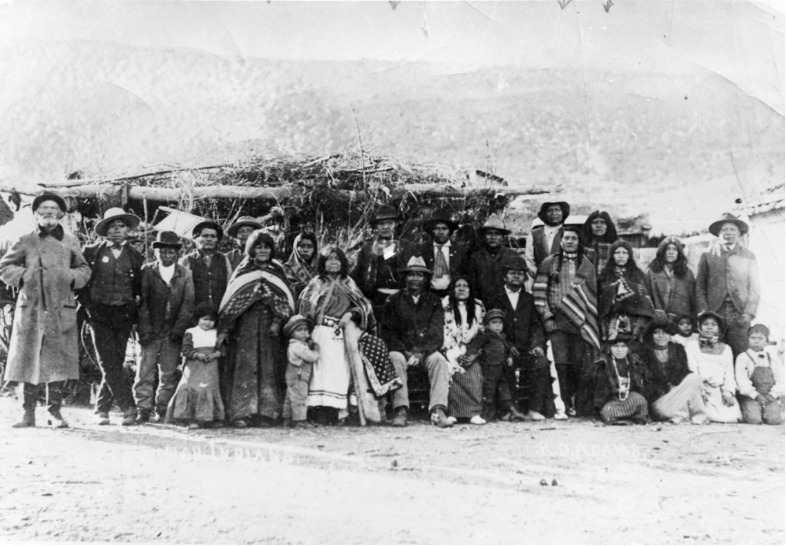
    <summary type="html"><![CDATA[<p><strong><em>In the midst of Utah’s Black Hawk War between the Latter-day Saints and local Indian tribes, a brutal massacre happened in the settlement of Circleville, resulting in the tragic deaths of men, women, and children of the Koosharem Band of Paiutes.</em></strong></p><img src="https://www.intermountainhistories.org/files/fullsize/82b7857c58d88b127610d63f624be8a3.jpg" alt="Local Koosharem Band several decades after the massacre" /><br/><p>In 1864, Brigham Young called fifty families to move into Paiute territory in Circle Valley, southern Utah. Initially, the settlement of Circleville boomed, and by 1865, nearly 100 families lived in Circleville. One inhabitant, Oluf Larsen, described relations with neighboring Paiutes as friendly. “There was a small tribe of friendly Indians living in the valley which we furnished with bread stuff and treated kindly. They in turn brought us venison and beaver meat.” Despite the seemingly mutually beneficial relationship, Larsen added, “we dared not attach too much confidence to them and watched their every move with suspicion.”
The settlers’ suspicions of the local Paiutes grew after one of Chief Black Hawk’s lieutenants, Tamartiz, led a raid on Circleville on November 25<sup>th</sup>, 1865. Although the Paiutes had nothing to do with the attack, the settlers were afraid of being attacked again and began acting more aggressively toward all American Indians. Violence increased in the area, with nearby settlements being raided and settlers killing Indians even suspected to be guilty of any crime against the settlers.
Growing tensions between local Indians and settlers increased and reached a climax in April of 1866. On April 22, Paiutes formerly viewed as friendly were spotted, allegedly behaving suspiciously, near Fort Sanford, 15 miles away from Circleville. A skirmish broke out between soldiers at the fort and the Indians, leaving one of the Paiutes dead and a soldier wounded.
When the Circleville settlers heard that previously peaceful Paiutes were involved in the skirmish, they grew suspicious that the Paiutes near them were involved with Black Hawk and were planning to attack the settlement. To prevent any potential attacks, the militia of Circleville, led by Major James T.S. Allred, went to the local Koosharem Band of Paiutes and convinced them to gather their people together and come to Circleville for a meeting, promising peace between the groups. A group of roughly 20 Paiutes gathered, and the men were led to the meetinghouse and tied together while the women and children were placed in a nearby cellar.      </p><p>The Circleville settlers then sent a message to Colonel W.H. Dame and hoped to receive instructions on what to do with the imprisoned Paiutes. Erastus Snow, religious leader over Southern Utah, was with Colonel Dame when he received the message, and Snow told Dame to ensure the prisoners were treated kindly. </p><p>Unfortunately, the message was not received in time. When several Paiute men attempted to escape, they, along with all the other male prisoners, were immediately shot. Fearing survivors would report the violence to Black Hawk and return with reinforcements, the Circleville guards proceeded to slit the throats of all the Paiute women and children who were old enough to remember the horrific event, sparing only a few children. A total of 15 to 18 Paiutes were killed.
Although the Circleville inhabitants claimed they acted in self-defense, today the event is remembered as a tragic massacre of innocent Paiutes. In honor of those murdered, on April 22, 2016, a monument with inscriptions written by the Paiute Tribe was dedicated in Circleville and includes the Paiute oral history of the event. The Tribe wrote: “None of us can ever hope to describe the emotions that these people might have felt. All we can do is honor their existence as human beings.”</p><p><em><strong><a href="https://www.intermountainhistories.org/items/show/477">For more (including 3 images) view the original article</a></strong></em></p>]]></summary>
    <published>2021-09-11T07:51:15+00:00</published>
    <updated>2026-04-17T19:32:10+00:00</updated>
    <link rel="alternate" type="text/html" href="https://www.intermountainhistories.org/items/show/477"/>
    <id>https://www.intermountainhistories.org/items/show/477</id>
    <author>
      <name>Bethany Erickson, Brigham Young University</name>
    </author>
  </entry>
  <entry>
    <title type="html"><![CDATA[Black Hawk Burial Site]]></title>
    <summary type="html"><![CDATA[<p><strong><em>Brigham Young said in 1870 that Black Hawk was "the most formidable foe amongst the red men that the Saints have had to encounter.” Black Hawk experienced both support and hostility from Utah settlers, and his final resting place is marked by a thoughtful memorial that reflects his goal to care for his homeland.</em></strong></p><img src="https://www.intermountainhistories.org/files/fullsize/9057516a6f9102a0c6af54a56f807fca.jpg" alt="Blackhawk memorial" /><br/><p>Antonguer, or Black Hawk, is one of the most iconic and controversial figures in early territorial Utah history. He led the 1865-1867 Black Hawk War. </p><p>Mormon settlers who arrived in Ute lands in 1847 called Black Hawk “a friendly Indian” in his youth, however, conflict emerged between the settlers and natives. Historians theorize that Black Hawk was the only male survivor of the Creek Canyon Battle in March 1849. “The bloodiest week of Indian killing in Utah history” occurred on February 8, 1850 at the battle at Fort Utah when a group of Utes awaited refuge at the fort – Black Hawk and his family among them – but found themselves caught in the middle of violence. Black Hawk helped the Mormons during the battle. For the next fifteen years, despite continued conflicts and starvation, Black Hawk tried to maintain relatively peaceful relations with the settlers. However, some historians believe that what he witnessed during that battle lingered and motivated him to break his loyalty with the Mormon settlers and start the Black Hawk War on April 9, 1865. The majority of violence occurred 1865-1867, but intermittent conflicts continued until 1872. </p><p>Though a “dozen men in Utah claim the honor of killing Black Hawk,” he actually died of tuberculosis and an old wound. In 1869, just prior to his death, Black Hawk declared a “mission of peace” as he visited every “village from Cedar City on the South to Payson” that lost human lives or property, and asked forgiveness from the Mormon pioneers. While Black Hawk experienced both support and hostility from the settlers, his final resting place is marked by a thoughtful memorial, one that reflects his aim to care for his people and homeland.</p><p>In the decades following his 1870 death and burial near Spring Lake Villa, Utah, the controversial identity of Black Hawk resurfaced. In 1911, miners unearthed and displayed Black Hawk’s bones and personal objects, which eventually were placed in a museum in Salt Lake City. After additional relocations, Shane Armstrong and Charmaine Thompson conducted a project in 1995 to locate Black Hawk’s remains and found them at the BYU Museum of Peoples and Cultures. On May 4 the following year, Black Hawk’s family and tribe received these remains and reburied him at a memorial close to the original 1870 burial site. The Salt Lake Tribune reported that “more than 2,000 non-Utes” attended the ceremony. The official dedication for the current permanent marker took place on September 27, 1997. </p><p><em><strong><a href="https://www.intermountainhistories.org/items/show/395">For more (including 5 images) view the original article</a></strong></em></p>]]></summary>
    <published>2020-03-02T23:28:27+00:00</published>
    <updated>2026-04-17T19:32:07+00:00</updated>
    <link rel="alternate" type="text/html" href="https://www.intermountainhistories.org/items/show/395"/>
    <id>https://www.intermountainhistories.org/items/show/395</id>
    <author>
      <name>Carolina Corrales, Brigham Young University</name>
    </author>
  </entry>
</feed>