<?xml version="1.0" encoding="UTF-8"?>
<feed xmlns="http://www.w3.org/2005/Atom">
  <title type="text">Intermountain Histories</title>
  <updated>2026-04-17T19:32:20+00:00</updated>
  <generator uri="http://framework.zend.com" version="1.12.20">Zend_Feed_Writer</generator>
  <link rel="alternate" type="text/html" href="https://www.intermountainhistories.org/"/>
  <link rel="self" type="application/atom+xml" href="https://www.intermountainhistories.org/items/browse?output=rss2"/>
  <id>https://www.intermountainhistories.org/</id>
  <author>
    <name>Intermountain Histories</name>
    <uri>https://www.intermountainhistories.org</uri>
  </author>
  <link rel="hub" href="https://pubsubhubbub.appspot.com/"/>
  <entry>
    <title type="html"><![CDATA[Hornaday Bison Exhibit]]></title>
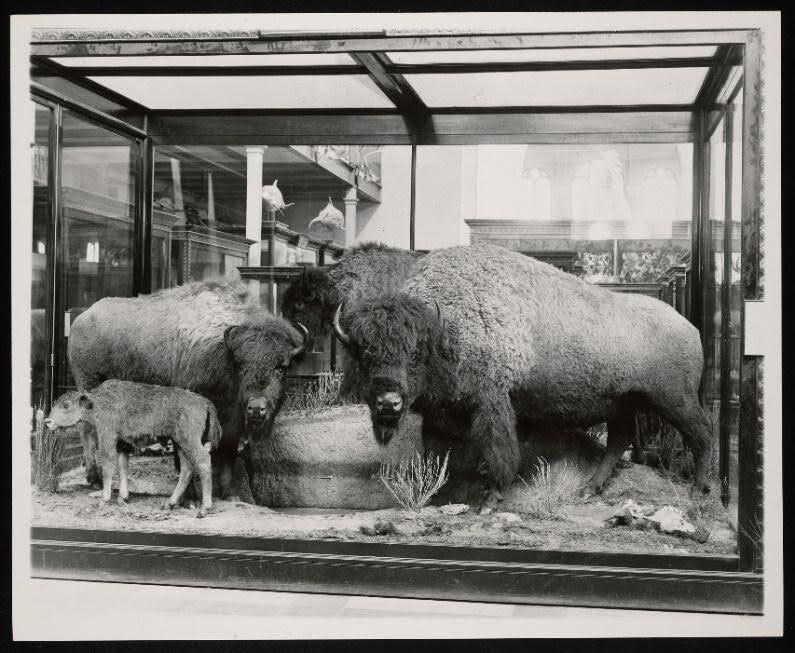
    <summary type="html"><![CDATA[<p><strong><em><span style="font-weight:400;">In 1886, there was genuine concern that the American bison (</span><i><span style="font-weight:400;">Bison bison</span></i><span style="font-weight:400;">) was on the brink of extinction. William Hornaday set out to gather a group of these animals to ensure the preservation of this iconic and once-abundant species. This effort resulted in a collection of six bison, forming one of the most significant representations of this American symbol in the United States.</span></em></strong></p><img src="https://www.intermountainhistories.org/files/fullsize/a329348b27c8e30eb86e7c0d3cd6bf29.jpg" alt="Mammals Exhibit, South Hall, United States National Museum" /><br/><p><span style="font-weight:400;">William Temple Hornaday (1854-1937) was among the first and most notable individuals in the fight to protect the American bison. In his </span><i><span style="font-weight:400;">The Extermination of the American Bison, </span></i><span style="font-weight:400;">Hornaday noted the decimation of the bison and called for the animals’ protection by state and national governments. By 1886, concerns about the potential extinction of the bison loomed, so Hornaday, as Chief Taxidermist at the Smithsonian Institution, traveled to Montana to collect specimens. These bison were some of the last from the wild herds found between the Yellowstone and the Missouri rivers, an area that had witnessed the last Blackfeet buffalo hunt in 1879. </span>
<span style="font-weight:400;">Hornaday killed and conducted the taxidermy on these six bison specimens and exhibited them at the Smithsonian in 1887. They remained there on permanent exhibit until 1955. The Smithsonian decided to dismantle the display and returned them to Montana. The group of bison were split up and put into storage, lost for years. Eventually, Doug Coffman (who studied the history of the bison at the Smithsonian) set out to find them in the 1980s. After being found and restored, the bison were put back on public display in 1996. Today, these six bison can be seen at the Hornaday Smithsonian Buffalo and Dean & Donna Strand Western Art Gallery, located within the Fort Benton Museum & Heritage Complex in Fort Benton, Montana. </span>
<span style="font-weight:400;">The bison are exhibited in the same arrangement in which they originally appeared at the Smithsonian. Notably, the large bull in the collection has served as a model for various national symbols and government designs, including coins, paper currency, postage stamps, and the Great Seal of the Department of the Interior, cementing its place as a symbol of American heritage. In 2016, President Barack Obama signed a bill into law naming the bison as America’s mammal.</span></p><p><em><strong><a href="https://www.intermountainhistories.org/items/show/879">For more (including 3 images) view the original article</a></strong></em></p>]]></summary>
    <published>2025-01-27T03:52:17+00:00</published>
    <updated>2026-04-17T19:32:20+00:00</updated>
    <link rel="alternate" type="text/html" href="https://www.intermountainhistories.org/items/show/879"/>
    <id>https://www.intermountainhistories.org/items/show/879</id>
    <author>
      <name>Dawson Muranaka, Brigham Young University</name>
    </author>
  </entry>
</feed>
