<?xml version="1.0" encoding="UTF-8"?>
<feed xmlns="http://www.w3.org/2005/Atom">
  <title type="text">Intermountain Histories</title>
  <updated>2026-04-17T19:32:16+00:00</updated>
  <generator uri="http://framework.zend.com" version="1.12.20">Zend_Feed_Writer</generator>
  <link rel="alternate" type="text/html" href="https://www.intermountainhistories.org/"/>
  <link rel="self" type="application/atom+xml" href="https://www.intermountainhistories.org/items/browse?output=rss2"/>
  <id>https://www.intermountainhistories.org/</id>
  <author>
    <name>Intermountain Histories</name>
    <uri>https://www.intermountainhistories.org</uri>
  </author>
  <link rel="hub" href="https://pubsubhubbub.appspot.com/"/>
  <entry>
    <title type="html"><![CDATA[Battle Creek Canyon Massacre]]></title>
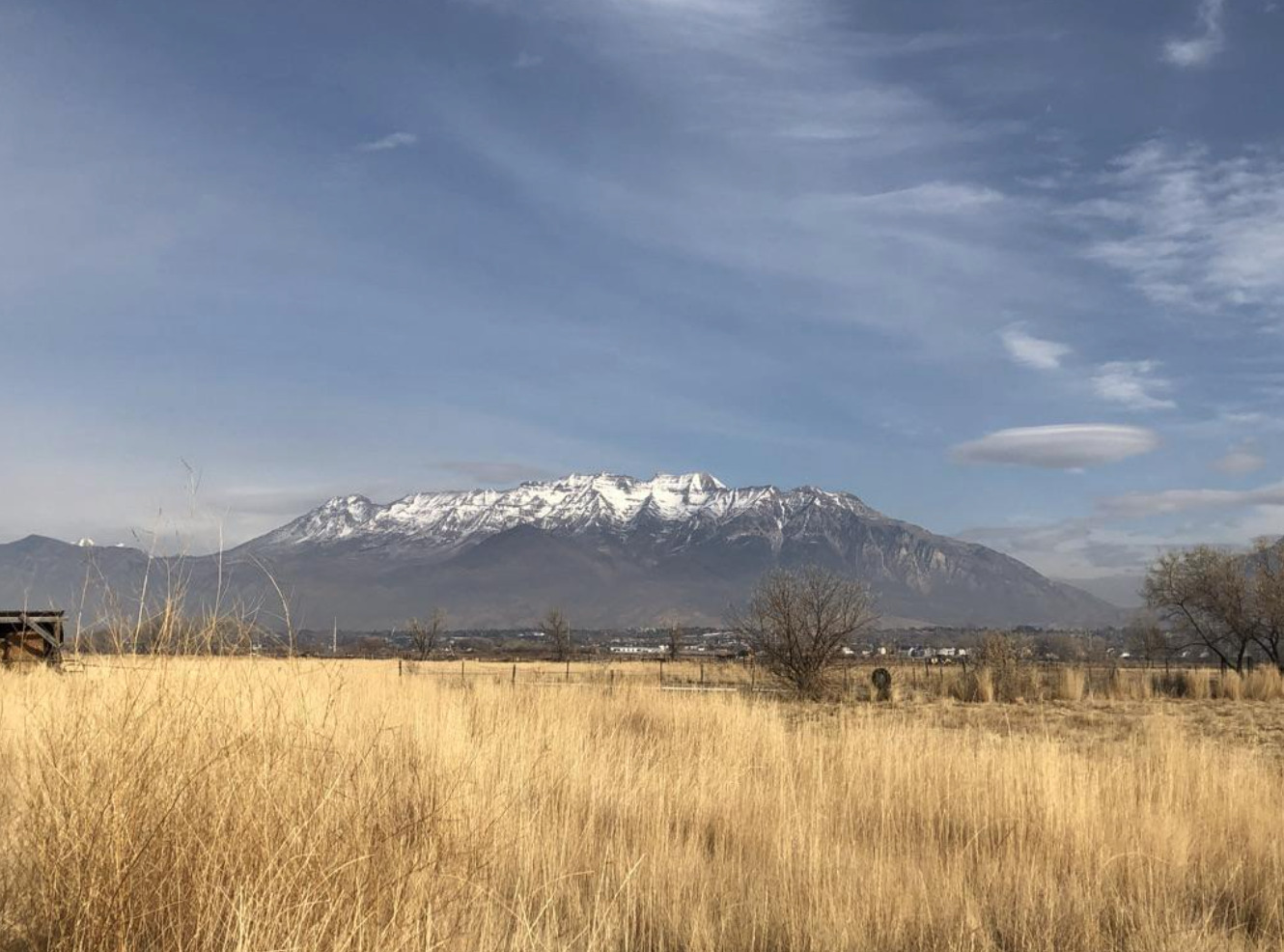
    <summary type="html"><![CDATA[<p><strong><em>Battle Creek Canyon's name originates from Utah's first major skirmish between the Utes and the Mormon militia. </em></strong></p><img src="https://www.intermountainhistories.org/files/fullsize/54eea90162a257c6e9cd4299408aea71.jpg" alt="Kade Dallin, Purple Mountain Majesties, 2020.
" /><br/><p><span style="font-weight:400;">When the pioneers of the Church of Jesus Christ of Latter-day Saints entered the Salt Lake Valley, they generally settled in what is now Salt Lake County on the Wasatch Front. The area was largely a desert and many, including some mountain men, suggested that the people settle further south in the freshwater valley that now comprises the bulk of Utah County. Brigham Young immediately sent out people to found colonies, cities, and towns throughout modern Utah, Arizona, Nevada, California, and Mexico. Yet, the pioneers balked at the initial thought of settlement in Utah Valley because of the native tribes who already lived there. Various bands of the Ute and Timpanogos tribes lived throughout the valley and had a reputation of being warlike and aggressive as a way to defend their land and livelihood. </p>
<span style="font-weight:400;">The pioneers especially resented the Ute practice of poaching the settler’s cattle. Roman Nose, a prominent Ute, was particularly troublesome. He led a band that repeatedly raided the farms and ranches near the valley border, and was even accused of stealing several of Brigham Young’s personal horses. After Brigham Young heard of the theft, he ordered Captain John Scott to lead a posse against the Utes in hopes of apprehending Roman Nose and his band. Their orders were to find the band of thieves and to “take such measures as would put a final end to their depredations in the future.” In 1849, they began raiding the Ute bands they deemed responsible for the loss of the livestock. However, Brigham Young soon discovered that the Utes had been mistakenly blamed: his horses had simply been moved to different pastures. He ordered Scott and the posse to stand down, but they refused. </p>
<span style="font-weight:400;">On the morning of March 5, 1849, the relationship between Mormon settlers and the local band of Timpanogos Indians deteriorated into brutal hostility in what is now Pleasant Grove, Utah. Scott’s rogue posse of 44 men soon arrived where they found the Ute camp which they thought participated in the raids. The group surrounded the sleeping camp and opened fire in a reign of terror. The members of the posse then hunted down many of the Utes who managed to escape the initial shootout. In total, they killed seventeen men, women, and children, including Roman Nose. </p>
<span style="font-weight:400;">After seeing the massacre, the chief of the Native American tribe, Little-Chief was distraught. Although he reportedly agreed that the killing of the supposed thieves was justified, he understood that this would cause a rift to form between white settlers and local tribes. This event, among many other skirmishes, led to heightened tension between the two groups and permanently damaged the already delicate relationship between the Native American tribes and the Mormon settlers. After this event, the area became known as Battle Creek Canyon and is today memorialized by the Battle Creek Marker. </span>


</p><p><em><strong><a href="https://www.intermountainhistories.org/items/show/757">For more (including 2 images) view the original article</a></strong></em></p>]]></summary>
    <published>2023-10-22T05:05:29+00:00</published>
    <updated>2026-04-17T19:32:16+00:00</updated>
    <link rel="alternate" type="text/html" href="https://www.intermountainhistories.org/items/show/757"/>
    <id>https://www.intermountainhistories.org/items/show/757</id>
    <author>
      <name>Kade Dallin, Brigham Young University&amp;#32;&amp;amp;&amp;#32;Bryce Revelli, Brigham Young University</name>
    </author>
  </entry>
  <entry>
    <title type="html"><![CDATA[The Paiute War of 1860]]></title>
    <summary type="html"><![CDATA[<p><strong><em>The silver and gold rush in the mid-1800s brought many settlers into Nevada, specifically the Pyramid Lake area in western Nevada. With miners encroaching on the land, the availability of natural resources caused tensions between the Paiutes and the newcomers. At the same time, the Pony Express built several stations along Paiute territory causing more conflicts with the natives. The Williams Station Massacre sparked the Paiute War of 1860, also known as the Pyramid Lake War.</em></strong></p><img src="https://www.intermountainhistories.org/files/fullsize/9f8b564d49f8cead9ca7d8cb45477029.jpg" alt="Sarah Winnemucca (daughter), Chief Winnemucca, Natchez (son), and Captain Jim." /><br/><p>In 1859, several prospectors struck it rich when they found silver at the head of Gold Canyon in western Nevada. Hundreds of people soon came to mine for these minerals. As the population rapidly increased, they established Silver City, Virginia City, and Gold Hill. The following year, thousands more arrived, transforming the area into a hub for underground mining. Though many consider this discovery the beginning of civilization in the western United States, the indigenous people experienced a degrading impact on their lifestyle. </p><p>With a growing settler population came a significant loss of resources for the Paiute Indians. Many settlers brought their own livestock but would feed their animals on Paiute territory, which led to range wars, overgrazing, and exploiting the land of its mineral wealth. These conflicts stimulated further tension among the settlers and Paiutes. Additionally, the Pony Express gained physical traction and interrupted Paiute land with numerous stations along the trail between California and Missouri.</p><p>In a series of disagreements, some Paiutes murdered two white men, resulting in a response of blackmail and fraud from the settlers. A tribal chief named Winnemucca counseled with his people whether or not they should fight. What further spurred this decision was the kidnapping of two Paiute girls who were later found alive at the Williams Station near Carson River. When the two girls told their people of the abuses the Williams’ brothers had enacted on them, several Paiute warriors went to the station, captured two of the brothers and a traveler, and burned the building, killing those inside. The nephew of Winnemucca, named Young Winnemucca or Numaga, heard of the retaliation and knew the settlers would come back. He thereby created a plan to prepare his people for their arrival.</p><p>After hearing of the so-called Williams Station Massacre, nearby settler towns took up arms and assembled an attack force. Low in numbers and weapons, men from different towns gathered together and proceeded to the ruins of Williams Station. On May 9, 1860, the volunteer group spotted a few Paiute men and began to chase them into a nearby ravine in the Truckee River banks. As they approached the ravine, about one hundred Paiute warriors attacked in an ambush. The Paiutes then chased the survivors twenty miles south of their original entry point. Almost eighty men died from the volunteer group in comparison to a few Paiute casualties.</p><p>A month later, Colonel John Hays led a battalion of five hundred men to Pyramid Lake after hearing rumors concerning the result of the ambush. This time the attack did not end well for the Paiutes; about 160 Paiutes died. Small skirmishes and raids continued for the next few months until August, when both sides called for a ceasefire. The site of this battle has been preserved and is located on the Pyramid Lake Indian Reservation.</p><p><em><strong><a href="https://www.intermountainhistories.org/items/show/406">For more (including 3 images) view the original article</a></strong></em></p>]]></summary>
    <published>2020-03-15T06:05:37+00:00</published>
    <updated>2026-04-17T19:32:08+00:00</updated>
    <link rel="alternate" type="text/html" href="https://www.intermountainhistories.org/items/show/406"/>
    <id>https://www.intermountainhistories.org/items/show/406</id>
    <author>
      <name>Dion Tapahe, Brigham Young University</name>
    </author>
  </entry>
  <entry>
    <title type="html"><![CDATA[Rosebud Battlefield State Park and General Crook]]></title>
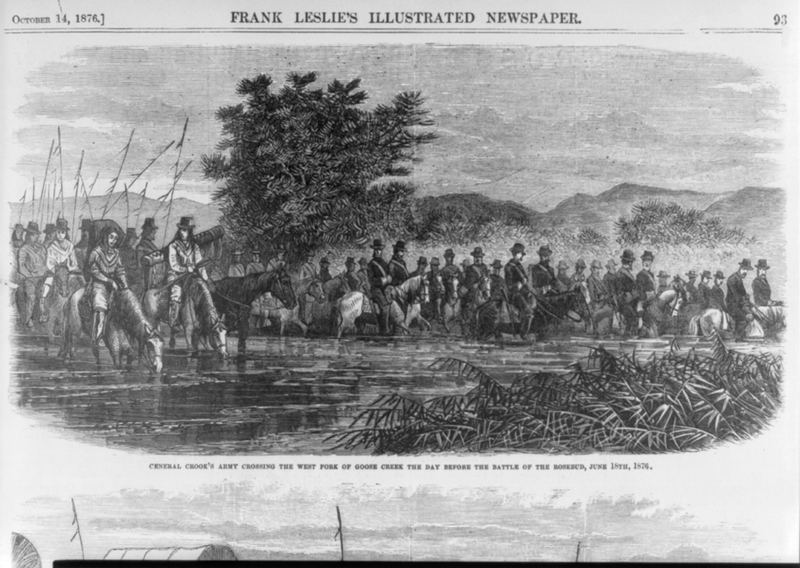
    <summary type="html"><![CDATA[<p><strong><em>At Rosebud Creek, Montana, Northern Cheyenne and Sioux warriors attacked Brigadier General George R. Crook's forces in June 1876. Crook's complex philosophical differences with General Philip Sheridan, and his sympathetic sentiments toward the plight of his Indian adversaries, influenced his cautious, tactical decisions in the days following the battle.</em></strong></p><img src="https://www.intermountainhistories.org/files/fullsize/baff63751c5ff6ce3544c63a1971fbcd.jpg" alt="General Crook&#039;s Army before the Battle of Rosebud" /><br/><p>In January, 1876, the Sioux failed to report to the reservation at Standing Rock, Dakota Territory, after being driven off their homeland by the United States' attempt to accommodate the Black Hills gold rush.  General George Crook's forces deployed from Fort Fetterman in May 1876 in pursuit of the Sioux and their Northern Cheyenne allies. The expedition consisted of over 1,000 soldiers and civilians. Among the latter were teamsters, packers, and five journalists. On June 17, 1876, Sioux and Northern Cheyenne warriors, led by Crazy Horse and Two Moon attacked Crook's first Yellowstone Expedition.       </p><p>In response, Crook deployed his cavalry to control high ground to the North and East of Rosebud Creek. “They were from two or three miles distant, coming at full speed towards us, cheering,” Captain Anson Mills recounted. The infantry formed an inner defensive perimeter, while the packers remained in a fracas behind a rocky outcropping known today as 'Packers Rocks'. The following six hours consisted of a cacophony of gunfire, yelling, dust, smoke, stench, and screams. During the melee, a Cheyenne warrior, Comes In Sight, had his horse shot out from under him. A young Cheyenne woman rode out to his rescue. The Northern Cheyenne say she was Buffalo Calf Road Woman, the sister of Comes In Sight. The Cheyenne remember the conflict as 'Where the girl saved her brother'. At approximately 2pm, Crook ordered his men to disengage, fearing a greater ambush from the North.                                             </p><p>The Army's official casualty report was ten killed in action with thirty wounded.  The Department of Interior revised the number to include fifty seven wounded.  Crazy Horse and Two Moon had reported their losses at twenty seven killed and sixty three wounded.. General Anson Mills recalled, “We then all realized for the first time that while we were lucky not to have been entirely vanquished, we had been most humiliatingly defeated.”  After the battle, a dejected General Crook responded to counter attack orders from General Philip Sheridan, “I wish Sheridan would come here himself and show us how to do it. It is rather difficult to surround three Indians with one soldier.” </p><p>Eight days following the engagement at Rosebud Creek, the Sioux and Northern Cheyenne annihilated five companies of the 7th Cavalry under the command of Lieutenant Colonel George A. Custer, less than fifty miles north at Little Big Horn Creek. This fact has led many historians to criticize Crook's decision to withdraw from the battle and return the Yellowstone Expedition to Fort Fetterman and Camp Cloud Peak to re-supply and rest.  They have also critiqued Crook's reluctance to counter attack as being a contributing factor to the defeat at the Battle of the Little Bighorn.</p><p>The secluded 3,052 acres of Rosebud Battlefield State Park were in ranch lands until acquired by the state of Montana in 1978. Thirty years later, the National Park Service designated this scenic valley as a National Historic Landmark.</p><p><em><strong><a href="https://www.intermountainhistories.org/items/show/338">For more (including 4 images) view the original article</a></strong></em></p>]]></summary>
    <published>2019-09-18T04:05:54+00:00</published>
    <updated>2026-04-17T19:32:06+00:00</updated>
    <link rel="alternate" type="text/html" href="https://www.intermountainhistories.org/items/show/338"/>
    <id>https://www.intermountainhistories.org/items/show/338</id>
    <author>
      <name>Robert M. Estrada, Northern Arizona University</name>
    </author>
  </entry>
  <entry>
    <title type="html"><![CDATA[The Battle of the Little Bighorn]]></title>
    <summary type="html"><![CDATA[<p><strong><em>At the Battle of the Little Bighorn (or Battle of Greasy Grass) Lakota, Northern Cheyenne, and Arapahos defeated U.S. Army General George Armstrong Custer. Though they won the battle, the Natives eventually surrendered to relocation and reservation confinement.</em></strong></p><img src="https://www.intermountainhistories.org/files/fullsize/da952bfc060ae3d8448a8814e5394d7b.jpg" alt="Custer&#039;s Last Stand" /><br/><p>Lakota Sioux have lived in the present-day South Dakota area for centuries. The first reservation treaty between the Lakota and the United States was signed in 1851 when Europeans on the Oregon Trail started to cross the southern part of Lakota lands in large numbers. There were several clashes between whites and Lakotas after that, but the biggest and the most famous conflict happened in 1876 when several hundred U.S. soldiers were killed by Lakota, Northern Cheyenne, and Arapaho forces at the Battle of the Little Bighorn.</p><p>By the 1870s, many Plains Natives had moved onto government agencies in Nebraska and South Dakota. However, in 1875, after discovering gold in the Black Hills on Lakota land, and anxious to civilize the buffalo-chasing nomads, the United States ordered the rest of the tribe to move or be punished. Move was something Sitting Bull, a well-known Lakota chief, could not do. For the previous ten years, Sitting Bull had pushed his people to reject the restrictions of agency life, which fought against Lakota religion, language, and tribal organization. In 1876, he started gathering Lakota, as well as their Cheyenne allies, into a huge moving village in southeast Montana far away from the agencies.</p><p>Angry at Sitting Bull’s defiance, President Ulysses Grant sent an army led by General Terry to march to Sitting Bull’s camp and force him to obey. Terry decided to split his army in half: the half led by him would attack from downriver with the help of a riverboat while the half led by General Custer would attack from upriver. Custer was impatient, started his attack early, and was overpowered by the superior numbers and fighting experience of the Lakota and Cheyenne warriors in the village. Of the 650 soldiers in Custer’s army, 268 of them were killed, including all of the soldiers who were fighting beside Custer at the time. The survivors managed to hide in a thrown-together fort until they were saved two days later by Terry’s army (who saw no action). The mission was a complete failure.</p><p>For the US, the battle was a terrible shock and Custer was turned into an American hero, like Abraham Lincoln or George Patten. For the Lakota, it was the happy fulfillment of Sitting Bull’s vision of a strong Lakota nation, free from American laws and land grabs. Over the next winter, however, bad weather exhausted the Lakota, and in 1877 they gave up the fight and moved to Nebraska. General Custer kept his hero status until the 1960s and 70s when Native American culture and history started to become more accepted and Custer was seen more and more as a villain who oppressed a nature-loving society. Today, the Battle of the Little Bighorn is still alive in the memories of both natives and non-natives as the moment in history when Indians proved that, despite what most whites believed, they were still very much a force to be reckoned with.</p><p><em><strong><a href="https://www.intermountainhistories.org/items/show/186">For more (including 3 images) view the original article</a></strong></em></p>]]></summary>
    <published>2018-05-28T16:48:13+00:00</published>
    <updated>2026-04-17T19:32:02+00:00</updated>
    <link rel="alternate" type="text/html" href="https://www.intermountainhistories.org/items/show/186"/>
    <id>https://www.intermountainhistories.org/items/show/186</id>
    <author>
      <name>Jonathan Reil, Brigham Young University</name>
    </author>
  </entry>
</feed>