<?xml version="1.0" encoding="UTF-8"?>
<feed xmlns="http://www.w3.org/2005/Atom">
  <title type="text">Intermountain Histories</title>
  <updated>2026-04-17T19:32:11+00:00</updated>
  <generator uri="http://framework.zend.com" version="1.12.20">Zend_Feed_Writer</generator>
  <link rel="alternate" type="text/html" href="https://www.intermountainhistories.org/"/>
  <link rel="self" type="application/atom+xml" href="https://www.intermountainhistories.org/items/browse?output=rss2"/>
  <id>https://www.intermountainhistories.org/</id>
  <author>
    <name>Intermountain Histories</name>
    <uri>https://www.intermountainhistories.org</uri>
  </author>
  <link rel="hub" href="https://pubsubhubbub.appspot.com/"/>
  <entry>
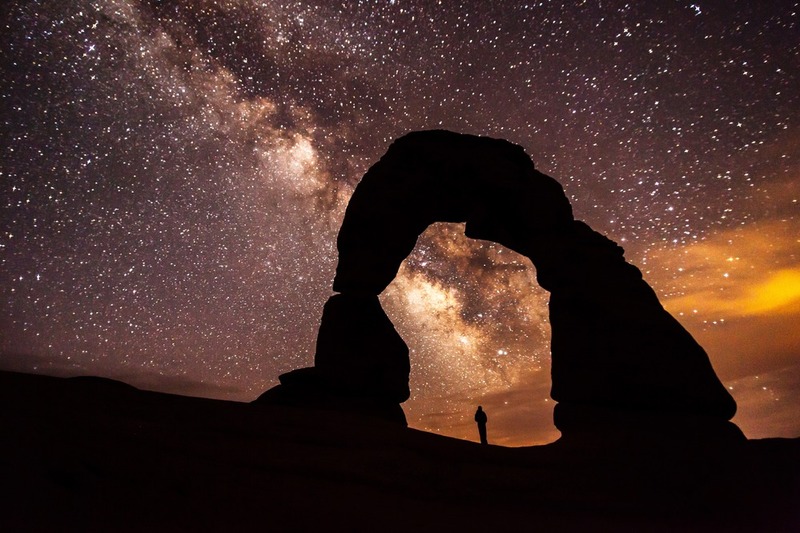
    <title type="html"><![CDATA[Dark Sky over Arches National Park]]></title>
    <summary type="html"><![CDATA[<p><strong><em>Home to over 2,000 natural sandstone arches in Utah, Arches National Park applied for recognition from the International Dark-Sky Association and received the association’s “Silver Tier” designation in 2019 thanks to its commitment to preserving the natural sky and educating the public about the benefits of reducing light pollution.</em></strong></p><img src="https://www.intermountainhistories.org/files/fullsize/94128d7b834b011c0b21f969610c1bc6.jpg" alt="Milky Way over Arches" /><br/><p>First designated a national monument in 1929, Congress declared Arches a national park on November 12, 1971. Arches National Park is one of the “Mighty 5” national parks of Utah, and in 2019, the International Dark-Sky Associated recognized the park’s work toward reducing light pollution within and outside of the park with its Silver Tier designation. (The Silver Tier is given when light glow is present along the horizon to a degree that wildlife and astronomy are impacted, but the Milky Way Galaxy can still be seen in summer and winter with over six thousand stars visible to the naked eye.)
In 1999, a study of 376 parks discovered that half of all National Parks, 189 in total, were threatened by light pollution from encroaching cities. The National Park Service responded by forming the Night Sky Team to document the negative effects of light pollution with 104 photos taken in a short duration. Every photo was stitched together to form a wider picture, and then the Night Sky Team erased the light generated by stars to focus on how artificial lighting impacted the park. Arches National Park in 2003 had significant light pollution from Moab, Utah, and Grand Junction, Colorado, so the park created outdoor lighting codes with training workshops to reduce light pollution, intending to keep visitors safe while minimizing harm to wildlife.
Arches National Park’s lighting codes implement several strategies for reducing light pollution and preserving a clear night sky as a culture heritage. First, Arches’ lights use motion sensors to provide visitors with light when they need it without leaving any running constantly. Second, Arches’ outdoor light fixtures are shielded with hoods and point toward the ground. Third, Arches National Park uses warm-colored light, as blue-colored light negatively impacts insects while amber lighting minimizes sky brightness while still providing visibility to guests. Fourth, Arches encourages nearby cities and households to plan outdoor lighting efficiently and use high quality lights. This includes striving to minimize nighttime lighting and only using what is strictly necessary for public safety.  Close to 100% of all exterior lights throughout the 119-square-mile park are night-sky friendly in accordance with Arches’ principles.
The value Arches National Park places on its dark skies is not limited to lighting codes and stargazing within the park. Educational outreach programs have been created, like the Night Sky Ranger booklet that teaches children about astronomy and light pollution through stargazing and moon phase observation activities. Preservation can maintain the dark skies, but education about the value of dark skies is what will break through the night blindness created by brightly lit societies.</p><p><em><strong><a href="https://www.intermountainhistories.org/items/show/541">For more (including 5 images) view the original article</a></strong></em></p>]]></summary>
    <published>2021-11-14T03:31:12+00:00</published>
    <updated>2026-04-17T19:32:11+00:00</updated>
    <link rel="alternate" type="text/html" href="https://www.intermountainhistories.org/items/show/541"/>
    <id>https://www.intermountainhistories.org/items/show/541</id>
    <author>
      <name>Emma Svenson, Northern Arizona University</name>
    </author>
  </entry>
  <entry>
    <title type="html"><![CDATA[Charles Steen’s Former Hilltop Mansion<br />
]]></title>
    <summary type="html"><![CDATA[<p><strong><em>After climbing, camping in, or hiking through the National Parks that surround Moab, visitors might want to eat at a family-owned restaurant—The Sunset Grill. Before its transformation into a restaurant, this complex was the mansion of multi-millionaire uranium miner Charles Steen, a visionary prospector whose rags to riches (and back to rags) story still resonates with those who have seen the best and worst of times.</p></strong></p><img src="https://www.intermountainhistories.org/files/fullsize/1c696df5a134bb4118b5bc82e7ea351f.jpg" alt="The Steen family, from left to right: M.L., Butch, Charles, Jr., Mark, Charlie, Andy, and Johnny.
" /><br/><p>Each year, over 1.5 million outdoor enthusiasts visit Arches National Park, a mountain biker, hiker, and rock climber paradise, located outside of Moab. One popular restaurant where adrenaline junkies and nature lovers can refill is Sunset Grill, currently owned by a former aerospace engineer and a nightclub manager from Pennsylvania who moved to Moab in 1993. But before it was a restaurant, the site was the hilltop mansion built and owned by Charles Steen, a “rags to riches uranium boom king” who made his fortune in the 1950s.</p><p>In the early 1940s, Steen studied geology at the Texas College of Mines and Metallurgy (today the University of Texas at El Paso). After working in South America as a petroleum geologist and then in Texas for Standard Oil Company, Steen was fired for insubordination and blacklisted by the industry. In the December 1949 issue of the The Engineering and Mining Journal, he learned that the Atomic Energy Commission, desperate to supply uranium for the government’s nuclear weapons program, “established minimum prices, guaranteed the rates for ten years, and added a $10,000 bonus for each separate discovery . . . of high-grade uranium from new deposits.” Steen headed west. He, his wife, and four sons moved around in trailers and backcountry, tarpaper shacks for almost two years. Finally, on 6 July 1952, Steen struck big at Mi Visa Mine near Moab, which shipped a million dollars’ worth of ore in its first six months. Before then, he had been sustaining his family on a “diet of potato chips and bananas.” His son recalls that they had been “living in a $15 a month shack, unencumbered with running water or electricity.” But Steen’s willpower paid off. Moab, a sleepy town, became home to a millionaire.</p><p>He quickly built a $250,000 hilltop mansion in Moab, replete with a swimming pool, greenhouse, and even servants’ quarters. Steen also lived lavishly by purchasing a private plane, which he flew to Salt Lake City for weekly dancing lessons. Although he spent much of his money lavishly, Steen was known as a friendly man who gave to the community. Every year, he invited the entire population of Moab to annual parties and donated $50,000 toward a local hospital. His discovery put Moab on the map as the “Uranium Capital of the World” and created hundreds of jobs. He was elected to the Utah State Senate in 1958, but when the country had obtained enough ore and stopped supporting his prices, he suffered heavy financial losses. After he declared bankruptcy in 1968, the IRS seized his assets. Although he went from rags to riches, then lost his riches, Steen’s mansion, now a restaurant, is still open for business, overlooking the town like he once did.</p><p><em><strong><a href="https://www.intermountainhistories.org/items/show/214">For more (including 3 images) view the original article</a></strong></em></p>]]></summary>
    <published>2018-06-11T22:31:24+00:00</published>
    <updated>2026-04-17T19:32:03+00:00</updated>
    <link rel="alternate" type="text/html" href="https://www.intermountainhistories.org/items/show/214"/>
    <id>https://www.intermountainhistories.org/items/show/214</id>
    <author>
      <name>Marc Jonathan Wein, Brigham Young University</name>
    </author>
  </entry>
  <entry>
    <title type="html"><![CDATA[The Wolfe Homestead]]></title>
    <summary type="html"><![CDATA[<p><strong><em> John Wesley Wolfe, a Civil War veteran, left his family in Ohio to find relief from his wounds in a drier climate. He and his oldest son established a cattle ranch and trading stop for Indians. In their last years on the ranch, John’s daughter Flora and her family kept him company and contributed to the ranch.</em></strong></p><img src="https://www.intermountainhistories.org/files/fullsize/af938743024b683a80bf043ceb5c95ce.jpg" alt="Arches National Park" /><br/><p>John Wesley Wolfe was born on February 17, 1829 in Tennessee. When the Civil War broke out in 1861, John joined the Union even though his home state joined the Confederacy. He fought in several major battles as a member of the 17th Ohio Battery. At the Siege of Vicksburg, John injured his leg lifting a cannon out of the mire and was given a disability discharge. He never walked without the aid of a crutch again, and this injury eventually prompted him to move to Utah.</p><p>In 1898, at the age of sixty-nine, John decided to heed his doctor’s advice and move to a drier climate. He hoped the desert air would alleviate the pain in his leg and stop the infection from spreading. He only managed to convince his son Fred to go with him to southern Utah. John’s wife and their three other children stayed behind in Ohio. John and Fred erected a simple cabin and set to work creating their “Bar DX” ranch. Though it’s not visible today, there was abundant native grass in the area that allowed over 1,000 cattle to graze on the Wolfe’s ranch. </p><p>In 1906, John’s daughter Flora and her family came to live on the ranch. She, her husband Ed Stanley, and their children Esther and Ferol brought new life to the remote homestead. Fred and Ed built a new cabin with wood floors and a window to make Flora and the children more comfortable. The men hauled timber from the Colorado River to use for the walls. They built the roof out of a frame of small logs and a large center beam. Fred and Ed laid bark from juniper trees and dirt from the surrounding hills over the top of the frame. The children helped stuff clay into the cracks between logs for insulation. This cabin is visible from the trail that leads to Delicate Arch in Arches National Park today. </p><p>Despite living in such a remote area, the Wolfes and Stanleys ate well. John irrigated a garden by plugging the creek that ran nearby with a simple dirt dam. He grew squash, corn, pumpkins, and a few extra melons to trade with the Indians who passed through. Few things made John as angry as when a rainstorm flushed out the dam. The family ate rabbit, venison, and chicken until butchering season came each fall and they had fresh beef. John supplanted their diet with groceries like canned milk that he picked up at Thompson Springs. Ed missed fresh milk so much that he once tried to milk a wild cow. The rest of the family watched as the cow kicked both hind feet and Ed quickly learned to be content with canned milk. </p><p>After two years, the Stanleys moved to Moab so their children could receive a formal education. In 1910, John sold the ranch to Tommy Larson and moved back to Ohio. John died in October of 1913 at age eighty-four. In 1914, Marvin Turnbow, the first custodian of Arches National Monument, bought the ranch from Larson. His family used the cabin occasionally until they sold it to Emmit Elizondo, who eventually sold the property to the U.S. government for inclusion in Arches National Monument.</p><p><em><strong><a href="https://www.intermountainhistories.org/items/show/200">For more (including 3 images) view the original article</a></strong></em></p>]]></summary>
    <published>2018-06-07T01:18:25+00:00</published>
    <updated>2026-04-17T19:32:02+00:00</updated>
    <link rel="alternate" type="text/html" href="https://www.intermountainhistories.org/items/show/200"/>
    <id>https://www.intermountainhistories.org/items/show/200</id>
    <author>
      <name>Samuel Hauber, Brigham Young University</name>
    </author>
  </entry>
</feed>
