<?xml version="1.0" encoding="UTF-8"?>
<feed xmlns="http://www.w3.org/2005/Atom">
  <title type="text">Intermountain Histories</title>
  <updated>2026-04-17T19:32:20+00:00</updated>
  <generator uri="http://framework.zend.com" version="1.12.20">Zend_Feed_Writer</generator>
  <link rel="alternate" type="text/html" href="https://www.intermountainhistories.org/"/>
  <link rel="self" type="application/atom+xml" href="https://www.intermountainhistories.org/items/browse?output=rss2"/>
  <id>https://www.intermountainhistories.org/</id>
  <author>
    <name>Intermountain Histories</name>
    <uri>https://www.intermountainhistories.org</uri>
  </author>
  <link rel="hub" href="https://pubsubhubbub.appspot.com/"/>
  <entry>
    <title type="html"><![CDATA[United States Air Force Academy Chapel, Colorado Springs, CO]]></title>
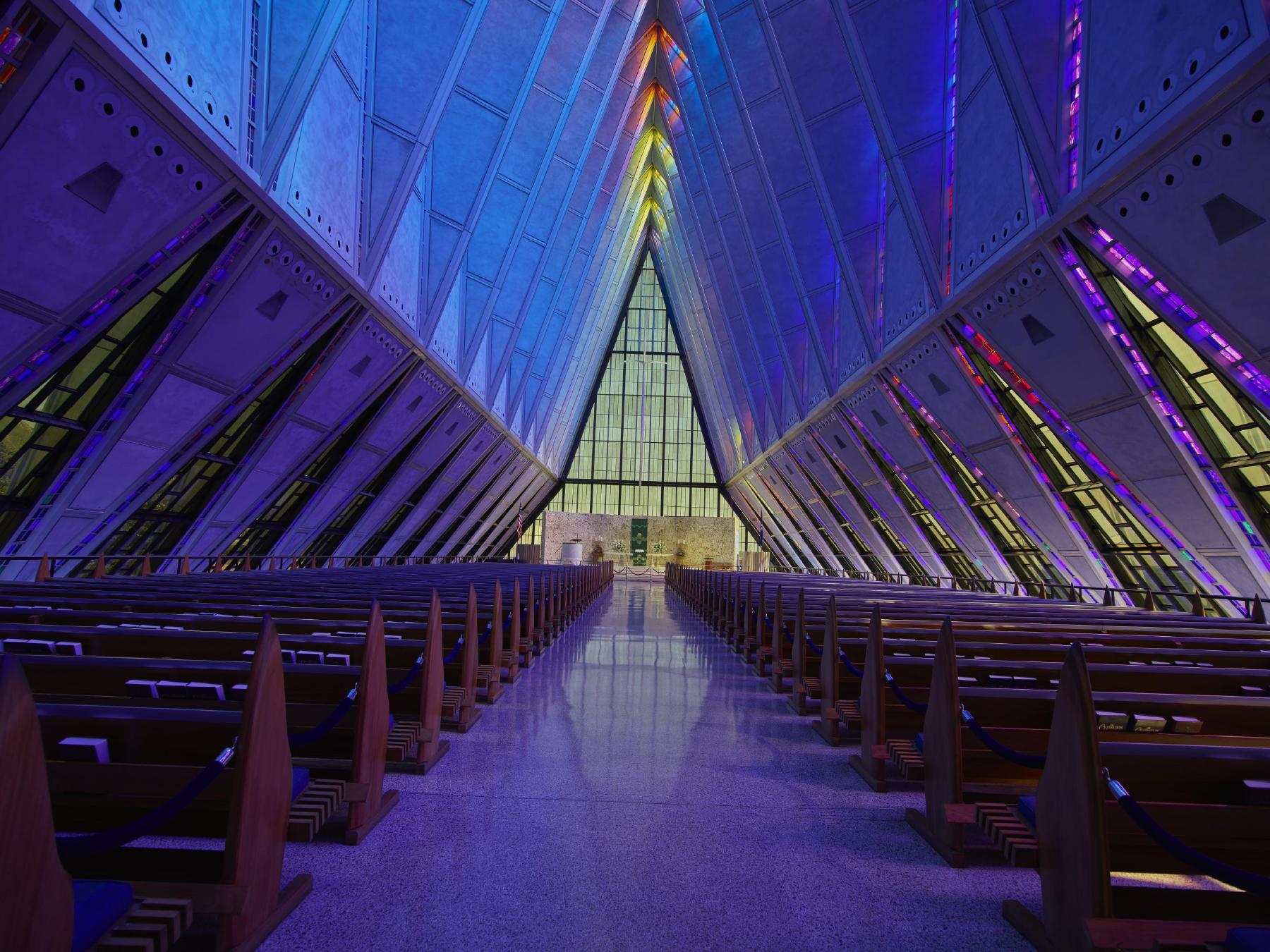
    <summary type="html"><![CDATA[<p><strong><em>An architectural triumph, the United States Air Force Academy Chapel in Colorado Springs is a futuristic vision of spirituality and light.</em></strong></p><img src="https://www.intermountainhistories.org/files/fullsize/6fa877fa8a8572d3d403698d65fbe97e.jpg" alt="Interior of the main atrium in the Cadet Chapel" /><br/><p>     Outside of Colorado Springs on the front Rampart Range of the Rocky Mountains the soaring spires of the United States Air Force Academy Chapel stand as a shining example of modernist architecture. Composed of seventeen spires that rise 150 feet into the air, the profile of the chapel mimics the mountains behind it. Each individual spire is is made up of 100 polygon shapes with the crisp edges giving the chapel a strikingly futuristic feel. The main floor houses the nine-hundred seat Protestant service area directly underneath the striking spires. Between the spires are one-foot-wide panels of colored glass, arrayed with cubes of every color of the rainbow. The panels bounce light off the faceted interior of the chapel during the day as the sun streams in. At night, interior illumination sends their color pouring over the outside of the aluminum spires, highlighting the materials reflective qualities. Underneath the main level is the area devoted to holding Catholic services. This level is demarcated by low sweeping stonework and large mosaic of stone angels behind the altar. Also on the terrace level is the Jewish service section. A circular screen of Israeli cypress panels ensconces the prayer area and the floor is made of Jerusalem Brownstone tiling donated by the Israeli Defense force in 1960.
     It was these three faiths that architect Walter Netsch was tasked with designing the building around in 1954 when the firm Skidmore Owings & Merrill received the contract to design the Air Force Academy Campus. The rest of the campus is made up of lower profile, modernist structures that seem to hover above the earth. The Cadet Chapel has remained the crown gem of the campus since its completion in 1962.
     The sub-genre of googie architecture experienced peak popularity in the mid-century and left its largest marks upon commercial structures in the West. Diners and motels are the most common manifestations of this style. However, while many googie structures are commercial that is not a requirement for the classification. Perhaps the most important aspect of googie architecture is that the structures appear to exist out of time. Materials like aluminum, neon, and concrete are utilized to give the buildings a futuristic and industrial touch, as if they were designed in the 22<sup>nd</sup> century instead of the 21<sup>st.</sup>. The Cadet Chapel epitomizes the idealistic futurism of the googie genre, brought out of the realm of the commercial and into the spiritual.
     In 2019 renovations began with the initial goal of fixing water leakage problems that had been persistent since the building was completed. Restoration has been ongoing due to the delicate nature of the historic structure and is projected to be completed in 2027. In 2012, fifty years after the completion of the Cadet Chapel, SOM returned to the campus to create a new event center called Polaris Hall. The glass prism tower of Polaris Hall is a testament to the lasting appeal of strikingly modernist architecture like that of the Cadet Chapel that inspired it.</p><p><em><strong><a href="https://www.intermountainhistories.org/items/show/901">For more (including 3 images) view the original article</a></strong></em></p>]]></summary>
    <published>2025-09-23T15:36:00+00:00</published>
    <updated>2026-04-17T19:32:20+00:00</updated>
    <link rel="alternate" type="text/html" href="https://www.intermountainhistories.org/items/show/901"/>
    <id>https://www.intermountainhistories.org/items/show/901</id>
    <author>
      <name>Emily MacDonell, Northern Arizona University</name>
    </author>
  </entry>
  <entry>
    <title type="html"><![CDATA[The Plane of the People]]></title>
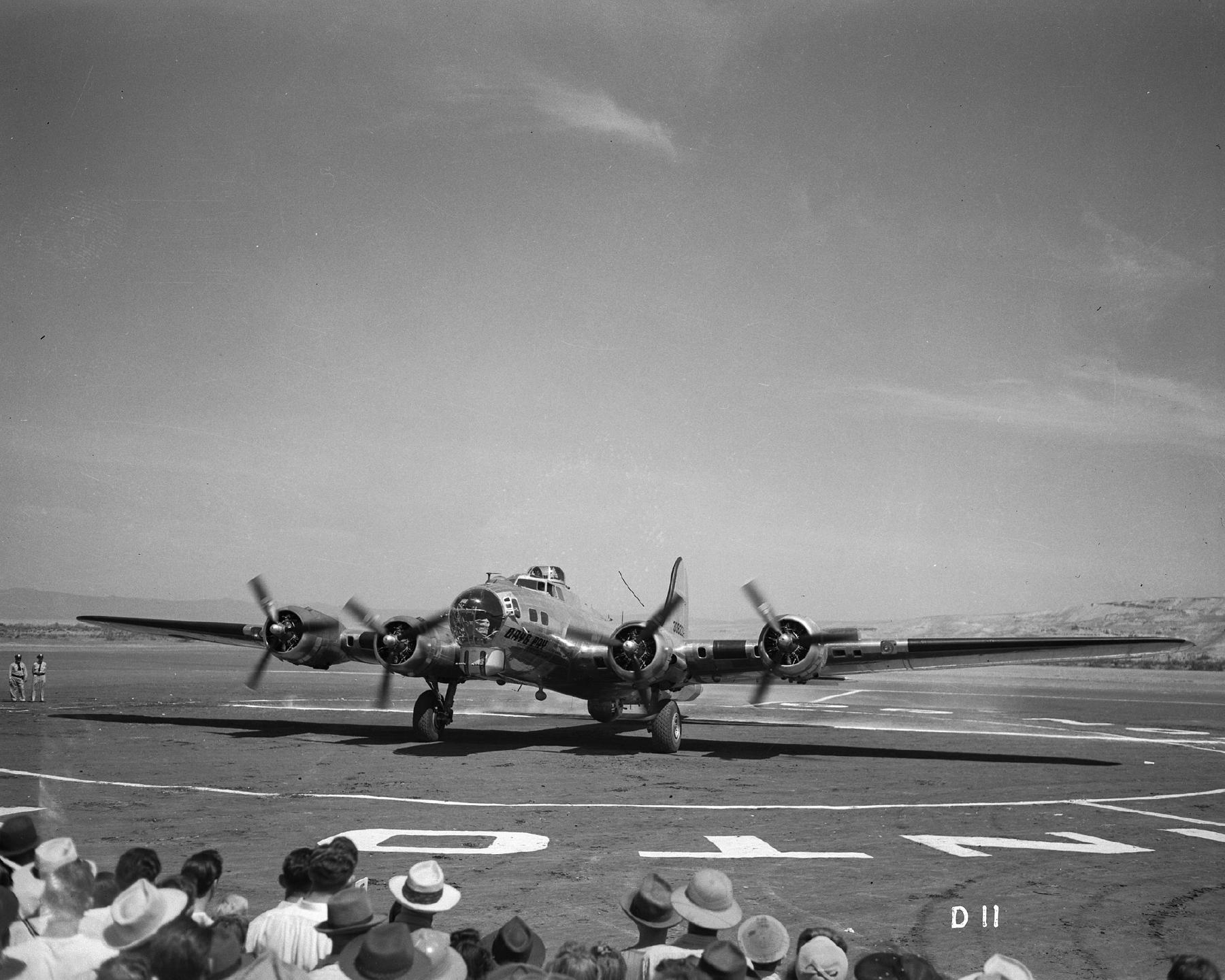
    <summary type="html"><![CDATA[<p><strong><em>During World War II the people of the Hanford Site came together to buy a bomber to support the war effort. The “Give a Bomber” campaign created a legacy that continues to bind a town together.</em></strong></p><img src="https://www.intermountainhistories.org/files/fullsize/5cc1c2fd94c0b5b7485b37b7f3d037e9.jpg" alt="The Day’s Pay B-17 Bomber at the celebration" /><br/><p><span style="font-weight:400;">Would you give up a day's pay to help your country? The workers of Hanford, Washington, where the plutonium was made for the Manhattan Project, decided to contribute their wages to buy a bomber to send overseas. Demonstrating their enthusiasm, 51,000 employees gave up a day’s pay for a certificate acknowledging their “share” of the bomber. The campaign’s slogan “Give a day’s pay and send a bomber on its way,” influenced the name of the plane as “Days Pay” was the overwhelming winner when the “Give a Bomber” committee held a contest to pick a name for th</span><span style="font-weight:400;">e plane. The workers asked the Army Air Force what type of plane it needed. The answer came back asking for the B-17 Flying Fortress, with the cost of the bomber being approximately $300,000 in 1944 (costing $5,257,107.95 in 2024).</span>
<span style="font-weight:400;">On July 23, 1944, workers christened the new plane and dedicated it to Colonel David Wade, along with Mrs. Katie Belle Harris, whose son had been lost in action. The Day’s Pay then became a part of the 8th Army Air Force in England, where it flew more than 60 missions in Germany. The plane was hit to the point of critical condition multiple times, but, what was very rare for the time was that every man on that bomber returned home safely and unharmed, which made the Day’s Pay a lucky plane.</span>
<span style="font-weight:400;">The employees who bought Day’s Pay continued to keep track of it as it flew missions, with the employee newspaper, the </span><i><span style="font-weight:400;">Sage Sentinel,</span></i><span style="font-weight:400;"> reporting on its mission progress. The paper also published a list of the plane’s crew, which allowed the employees to send Christmas cards and care packages to “their” boys overseas as well as check in on “our” plane. Unfortunately after the war, on December 4, 1947, it was taken to Kingman Field, Arizona, and reduced to scrap. </span>
<span style="font-weight:400;">But the legacy of the Day’s Pay lives on in the Richland police department’s badge, the name of a local microbrewery, and other businesses. The largest showing of the Day’s Pay comes from Richland High School, where a mural of the Day’s Pay covers one side of the gymnasium and the football team wears a simplified B-17 bomber sticker on the backs of their helmets. The Richland High School class of 2021 raised money to have a B-17 bomber fly over for graduation, demonstrating that the Day’s Pay is alive and instills community pride to this day.</span></p><p><em><strong><a href="https://www.intermountainhistories.org/items/show/870">For more (including 5 images) view the original article</a></strong></em></p>]]></summary>
    <published>2024-10-22T21:07:24+00:00</published>
    <updated>2026-04-17T19:32:19+00:00</updated>
    <link rel="alternate" type="text/html" href="https://www.intermountainhistories.org/items/show/870"/>
    <id>https://www.intermountainhistories.org/items/show/870</id>
    <author>
      <name>Mason Williamson, Rocky Mountain College</name>
    </author>
  </entry>
</feed>