<?xml version="1.0" encoding="UTF-8"?>
<feed xmlns="http://www.w3.org/2005/Atom">
  <title type="text">Intermountain Histories</title>
  <updated>2026-04-17T19:32:19+00:00</updated>
  <generator uri="http://framework.zend.com" version="1.12.20">Zend_Feed_Writer</generator>
  <link rel="alternate" type="text/html" href="https://www.intermountainhistories.org/"/>
  <link rel="self" type="application/atom+xml" href="https://www.intermountainhistories.org/items/browse?output=rss2"/>
  <id>https://www.intermountainhistories.org/</id>
  <author>
    <name>Intermountain Histories</name>
    <uri>https://www.intermountainhistories.org</uri>
  </author>
  <link rel="hub" href="https://pubsubhubbub.appspot.com/"/>
  <entry>
    <title type="html"><![CDATA[Hazel Hunkins-Hallinan: Silent Sentinel Suffragist ]]></title>
    <summary type="html"><![CDATA[<p><strong><em>Billings native Hazel Hunkins-Hallinan, alongside other members of the National Women’s Party, peacefully picketed the White House fence from 1917-1919 to advocate for a federal amendment for women’s right to vote. Known as the “Silent Sentinels,” they proved to be a continual reminder to President Woodrow Wilson of the issue of suffrage.</em></strong></p><img src="https://www.intermountainhistories.org/files/fullsize/bffa4510a4cca3ac68232b815d975d58.jpg" alt="[Untitled]" /><br/><p><span style="font-weight:400;">Hazel Hunkins grew up in Billings, Montana, and as a young girl, she was seen as “different” because she wanted to do what boys could do from climbing trees to becoming a doctor. After graduating valedictorian from Billings High School, Hunkins obtained her chemistry degree from Vassar College. However, when she applied to chemistry labs across the country they all replied that although she was qualified, they “don’t hire women.” </span>
<span style="font-weight:400;">This response sparked a fire in her, and when she met Anne Louise Rowe of the National Women’s Party (NWP), Hunkins realized that she “was one of millions who had been shoved aside because of my sex” and she had to do something about the exclusion of women. Within six months of joining the NWP, she became the Montana State Chairman. When the NWP began their constant picketing of the White House in 1917, Hunkins participated in the demonstrations. The pickets were peaceful—holding purple, gold, and white suffrage banners and signs like “Mr. President, how long must women wait for liberty?” </span>
<span style="font-weight:400;">Hunkins led a protest at Lafayette Square, carrying the American flag and leading the way to the Park. Once at the statue, she made the simple statement: “Here, at the statue of Lafayette, who fought for the liberty of this country, and under the American flag, I am asking for the enfranchisement of American Women.” She was immediately arrested. Other women followed Hunkins’ lead, each suffragist making her own statement until 47 women were arrested.</span>
<span style="font-weight:400;">Lafayette Square confirmed the NWP efforts were unpopular; however, once World War started, they were scrutinized even more, as people thought the women needed to support the war effort rather than picket a wartime president. The NWP, instead of wavering in their resolve, started new demonstrations like the watchfires of freedom—where President Wilson’s speeches about democracy in Europe were read aloud and burned because American women did not have democracy at home.</span>
<span style="font-weight:400;">The arrests of NWP women continued, often being charged with newly fabricated crimes like “obstruction of a public sidewalk.” Rather than paying fines, they chose jail because as Hunkins stated, “Women cannot be law-breakers until they are law-makers.” The prison conditions were awful—cold, damp areas, without proper clothing, blankets, and food—so the suffragists would often go on hunger strikes to protest these conditions, and in some cases, they would be force-fed. After one such hunger strike, Hunkins left the prison hardly able to walk. </span>
<span style="font-weight:400;">Despite all of the challenges they faced fighting public opinion and police officers’ efforts to stop their protests, in 1920 the 19th Amendment was finally ratified, giving American women the right to vote. After this triumph, Hazel Hunkins continued to push for women’s rights. When she moved to London with her husband, Charles Thomas Hallinan, she joined the British feminist Six Point Group. At age 87, Hunkins-Hallinan returned to America to participate in the March for Equal Rights. There she stated what she fought her whole life for, “Equal Rights is so clear cut; it’s fundamental—a basic change… For half a cent I would stay here and campaign.” </span></p><p><em><strong><a href="https://www.intermountainhistories.org/items/show/866">For more (including 4 images) view the original article</a></strong></em></p>]]></summary>
    <published>2024-10-21T17:33:32+00:00</published>
    <updated>2026-04-17T19:32:19+00:00</updated>
    <link rel="alternate" type="text/html" href="https://www.intermountainhistories.org/items/show/866"/>
    <id>https://www.intermountainhistories.org/items/show/866</id>
    <author>
      <name>Rosalyn Visser, Rocky Mountain College</name>
    </author>
  </entry>
  <entry>
    <title type="html"><![CDATA[The Logan Pride House]]></title>
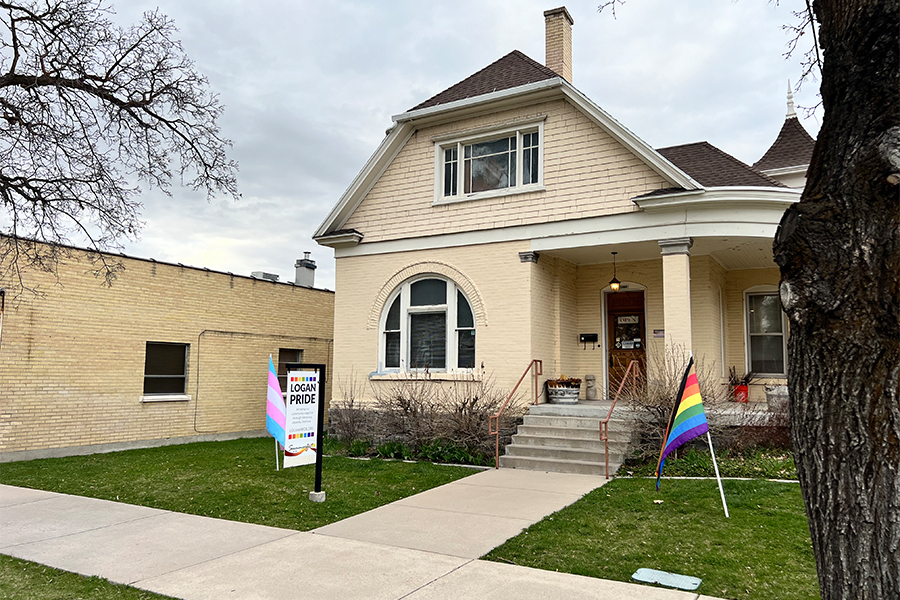
    <summary type="html"><![CDATA[<p><strong><em>Logan Pride serves as a resource and safe space for LGBTQ+ individuals in Cache, Box Elder, and Rich counties. Logan Pride operates out of a pride house in Downtown Logan, UT.</em></strong></p><img src="https://www.intermountainhistories.org/files/fullsize/5ca0800f25493c527cc973cb2f94eb22.jpg" alt="The Logan Pride House" /><br/><p><span style="font-weight:400;">The Logan Pride House is the home of Logan Pride–a foundation focused on serving adults in Cache, Box Elder, and Rich counties. Logan Pride is a safe space for LGBTQ+ individuals and allies located in downtown Logan, UT.</span>
<span style="font-weight:400;">Logan Pride operates off a board of volunteers who are passionate about fostering a safe, queer space in Cache Valley. The organization holds events almost every day. These events range from coffee and cocoa to support groups for various sexuality and gender identities. Logan Pride strives to serve as a safe space for queer people and allies to gather and become friends. Logan Pride also has shelves upon shelves of queer literature, both fiction and non-fiction that is available for community members to borrow and read.</span>
<span style="font-weight:400;">Not only does Logan Pride do activities several nights a week, they also host the annual Logan Pride Festival. The event has been running since 2016 and has grown bigger and bigger each year. In 2023, the pride festival had over 3,000 attendees and more than 85 vendors. It started as a way to show community and raise awareness that there is a space for queer people in Cache Valley. The Logan Pride festival is only possible because of the donations and volunteer hours given to Logan Pride. </span>
<span style="font-weight:400;">President of the Logan Pride Foundation, Mel Payne, stated “Whenever I hear these sad stories in the house, majority of the time it is because they haven’t had anybody show up for them… They haven’t had anybody reach out a hand when they’re feeling a certain way.” Logan Pride stands to be a support system for these individuals the most. Individuals who need friends that have similar experiences. Logan Pride serves as a safe space for people to be their authentic selves. </span>
<span style="font-weight:400;">For more information about Logan Pride, and a schedule of their events – visit their website: </span><a href="https://www.loganpride.org/"><span style="font-weight:400;">https://www.loganpride.org/</span></a><span style="font-weight:400;">. </span></p><p><em><strong><a href="https://www.intermountainhistories.org/items/show/859">For more (including 3 images) view the original article</a></strong></em></p>]]></summary>
    <published>2024-10-16T20:50:54+00:00</published>
    <updated>2026-04-17T19:32:19+00:00</updated>
    <link rel="alternate" type="text/html" href="https://www.intermountainhistories.org/items/show/859"/>
    <id>https://www.intermountainhistories.org/items/show/859</id>
    <author>
      <name>Cooper Sanders, Utah State University</name>
    </author>
  </entry>
  <entry>
    <title type="html"><![CDATA[The &quot;Most Important Event on Campus&quot;: 1974 Chicano Conference at BYU]]></title>
    <summary type="html"><![CDATA[<p><strong><em>In 1974, Brigham Young University hosted a symposium on Chicanos. From coast to coast, law enforcement, social and government workers, educators, healthcare workers, and others interested in the Spanish-American population attended in order to understand and address the problems facing Spanish-speaking Americans. </em></strong></p><img src="https://www.intermountainhistories.org/files/fullsize/01fd33b1d3bd410bfc117f5ed59fa188.jpg" alt="Armando Morales at the Chicano Conference" /><br/><p>In 1974, the United States was home to over 11 million Spanish-speaking people. The Chicano Conference was organized in order to “understand and confront the challenges facing Spanish-speaking people in their struggle for education and for finding their proper place in American society.” These problems varied, but included an unemployment rate that was two to three times the national level, disease, and cultural barriers. </p><p>The basis of the conference included workshops, speakers, and lessons. Leaders of this conference included a wide array of professors and leaders of the Chicano movement, as well as leaders in The Church of Jesus Christ of Latter-day Saints. Organizers highlighted non-stereotypical problems and people of the Spanish-speaking community in order to bring awareness to the disservice that such stereotypes were causing Spanish-speaking people. </p><p>One of these “non-stereotypical” scenarios was originally told by Dr. Clark Knowlton and was included in the opening statement. In a neighborhood in El Paso, Texas, gang members rallied together to raise enough money to give a college scholarship to one of their own. When that member failed his first quarter, fellow gang members woke him up at four in the morning to study, escorted him to and from class, and made sure that he completed his homework. That member passed his second quarter and went on to complete a law degree. Such a story emphasized one of the overarching messages of the conference: Spanish-speaking Americans were fighting battles that were important to the whole country and were not exclusively their own. </p><p>The symposium’s keynote speaker, Utah Governor Calvin Rampton, ended the conference by expressing his desire for greater action and initiative on behalf of Spanish-speakers within the state. He mentioned the involvement of the Spanish Speaking Organization for Community, Integrity, and Opportunity in creating government councils, as well as a 20-hour training on the culture of Spanish-speakers for law enforcement.</p><p>The Chicano Conference of 1974 was a part of the larger Chicano Movement which began in the 1960s. The movement itself was multifaceted and evolved overtime, but it originated in Mexican Americans rejecting previous efforts to assimilate into white American identity and instead embracing their heritage. The Chicano Conference—the “most important event on campus” at the time—followed previous conferences in Utah, such as the Chicano Conference in 1971 sponsored by Chicanas Unidas and the Chicano Conference in 1973 sponsored by La Raza; both groups were coalitions of Chicanos in the state. The Conference of 1974 joined previous efforts to alleviate pressure of assimilation as well as increase understanding of the needs of Hispanics in Utah.</p><p><em><strong><a href="https://www.intermountainhistories.org/items/show/641">For more (including 2 images) view the original article</a></strong></em></p>]]></summary>
    <published>2022-09-09T00:37:20+00:00</published>
    <updated>2026-04-17T19:32:14+00:00</updated>
    <link rel="alternate" type="text/html" href="https://www.intermountainhistories.org/items/show/641"/>
    <id>https://www.intermountainhistories.org/items/show/641</id>
    <author>
      <name>Lindsey Meza, Brigham Young University </name>
    </author>
  </entry>
  <entry>
    <title type="html"><![CDATA[SOCIO: Advocating for Hispanics in Utah ]]></title>
    <summary type="html"><![CDATA[<p><strong><em>As the Hispanic population in Utah continued to develop during the course of the 20th century, so did the growing community’s efforts to secure equal opportunities for education, representation, and economic welfare. The Spanish-speaking Organization for Community, Integrity, and Opportunity (SOCIO) was a grassroots organization which for over 20 years helped develop reforms aimed at improving educational, economic, social, and political circumstances for the Hispanic population of Utah. </em></strong></p><img src="https://www.intermountainhistories.org/files/fullsize/e9b161375213b85f06121b5fc9b4c60c.jpg" alt="Float for SOCIO in Utah Parade" /><br/><p>At a December 1967 meeting held in the Guadalupe Center, over 150 people—including Father Jerald H. Merrill from the “Our Lady of Guadalupe” Mission and Bishop Orlando Rivera from the Lucero Spanish Ward of the Church of Jesus Christ of Latter-day Saints (LDS, or Mormon)—came together to discuss the possibility of forming a grassroots organization aimed at advocating for the welfare of Hispanics in Utah. The name of this operation would be the Spanish-speaking Organization for Community, Integrity, and Opportunity (SOCIO). On March 21, 1968 SOCIO formally began operations on behalf of the over 50,000 Hispanics residing in Utah. </p><p>SOCIO started as a grassroots organization seeking to ensure the civil rights of Hispanics in Utah. For decades, Hispanics had faced varying levels of racism and discrimination. In the mid-1960s, many struggled to thrive in Utah’s growing economy. Discrimination was persistent in new private-sector job markets, and many lacked the skills and training for the new jobs and industries. These issues were at the forefront of SOCIO concerns. </p><p>Several other organizations shared SOCIO’s goals and concerns and focused on helping Hispanics, mainly Mexicans, navigate financial and social problems in Utah. However, SOCIO differed from other Chicano Civil Rights efforts in the Southwest in its approach to protecting and edifying the Spanish-speaking population. They made it a point to avoid confrontational methods of protest and activism and instead worked with the systems already in place in order to include Hispanics in leadership and fix the rules and regulations that were negatively affecting them. In this sense, they focused on rectifying the causes of challenges rather than alleviating negative outcomes as previous Hispanic rights organizations in Utah had. </p><p>SOCIO focused its attention on creating representation in both governmental and professional markets. They created several skill training programs aimed at increasing Hispanic self-sufficiency and included clerical skills, math and grammar skills, construction training, and even the Minority Women Employment Program which worked to train Hispanic women for occupations such as plumbing. Furthermore, SOCIO helped implement permanent offices in the Utah government such as the Governor's Advisory Council on Hispanic Affairs whose specific aim was to serve as the voice of Utah’s Spanish-speaking population at a bureaucratic level. They also proposed the formation of a Utah Migrant Council, whose task would be to care for migrants who came each year for agricultural labor. Efforts such as these helped to create an expectation within the Hispanic community of representation on the bureaucratic level. </p><p>However, by 1981, funding became a growing problem for SOCIO with no plausible solution. Previous efforts to rally funding from church organizations, businesses, and the government—along with a membership fee—proved insufficient. By 1990, SOCIO stopped operating, but not without making a lasting impact on both the educational, social, and economic systems in Utah as seen through the continuation of changes such as the Office of Hispanic Affairs.</p><p><em><strong><a href="https://www.intermountainhistories.org/items/show/638">For more (including 3 images) view the original article</a></strong></em></p>]]></summary>
    <published>2022-09-07T18:31:34+00:00</published>
    <updated>2026-04-17T19:32:14+00:00</updated>
    <link rel="alternate" type="text/html" href="https://www.intermountainhistories.org/items/show/638"/>
    <id>https://www.intermountainhistories.org/items/show/638</id>
    <author>
      <name>Lindsey Meza, Brigham Young University</name>
    </author>
  </entry>
  <entry>
    <title type="html"><![CDATA[Aryan Nations in Coeur d’Alene, Idaho: Is the state “Too Great for Hate?”]]></title>
    <summary type="html"><![CDATA[<p><strong><em>Coeur d’Alene is the largest city in Northern Idaho, nestled among the Rocky Mountains and a picturesque lake. It was also home to a major compound of the Aryan Nations.</em></strong></p><img src="https://www.intermountainhistories.org/files/fullsize/2da7685c12ed5a2ea90e86e36e9487ae.jpg" alt="Founder of the Aryan Nations" /><br/><p>From the early-1970s arrival of Aryan Nations leader Richard Butler, to the March 2020 Idaho House’s failed vote for a “Too Great for Hate” specialty license plate, the state of Idaho has in recent years struggled over both the presence and meaning of modern white supremacy within its borders. Shortly after moving to Idaho, Butler established an Aryan Nations headquarters in rural Kootenai County on a twenty-acre site just north of Coeur d’Alene. Butler used funding he had saved and donations from fellow worshippers to begin holding services for his own congregation of the Church of Jesus Christ-Christian, a group founded in the 1940s that promulgated white supremacy and antisemitism. Butler’s compound included an adjoined print shop for publishing books, fliers, posters, and pamphlets filled with racist propaganda and antisemitic caricatures. The group led parades that gathered large crowds of youths in downtown Coeur d’Alene alongside annual summits at the compound. In the mid-1990s, the Aryan Nations began running its own website, one of the first dedicated sites for recruiting white supremacists. The religious tenor of Butler’s compound was a major draw for many who saw him as a prophetic individual, and he claimed a religious freedom right to spread his message of hate. From this headquarters, Butler preached white supremacy and exclusion to his followers, making the area synonymous with white supremacy.
However, many residents of Coeur d’Alene felt distressed at Butler’s growing presence. In 1981, Butler’s followers and rivals engaged in violent conflict, and someone defaced a local Jewish restaurant with antisemitic grafitti. This brought the compound and the town to the attention of the Kootenai County Task Force on Human Relations. The brainchild of local activists Tony Stewart, Norman Gissel, and Marshall Mend, the task force rallied locals to advocate against hate by using community outreach programs to speak against white supremacy and by intervening in disputes involving Butler and his supporters.
The advocacy group finally made headway when they won a $6.3 million lawsuit against Butler’s group for violating local codes. Stewart, Gissel, and others involved in that campaign were loath to offer their strategy as a solution for other cities, but they say their approach might be one way to address white supremacy in the US and around the world. Bankrupted by the suit, the Aryan Nations lost possession of their local property. Idaho firefighters used the compound buildings for arson investigation training, eventually burning down every structure.
The Carr Foundation later purchased the land and gifted it to the North Idaho College Foundation on the condition that they redevelop it into a “peace park.” However, in 2019 NICF obtained the Carr foundation’s permission to instead sell the land in a favorable market to fund an endowment for human rights education.
The task force’s victory over the Aryan Nations does not mean the struggle against white supremacy has concluded. Coeur d’Alene remains a town of mixed emotions between those who allow racism to flourish and those who believe Idaho can be “too great for hate.”</p><p><em><strong><a href="https://www.intermountainhistories.org/items/show/622">For more (including 3 images) view the original article</a></strong></em></p>]]></summary>
    <published>2022-06-25T05:20:37+00:00</published>
    <updated>2026-04-17T19:32:13+00:00</updated>
    <link rel="alternate" type="text/html" href="https://www.intermountainhistories.org/items/show/622"/>
    <id>https://www.intermountainhistories.org/items/show/622</id>
    <author>
      <name>Omotayo Akingba, College of Idaho</name>
    </author>
  </entry>
  <entry>
    <title type="html"><![CDATA[AIM Occupation of Fairchild Plant on Navajo Reservation]]></title>
    <summary type="html"><![CDATA[<p><strong><em>Activism plays a significant role in improving employment quality and longevity, but situations like the occupation of the Fairchild Plant on the Navajo Reservation causes people to question whether or not activism is the best method to achieve such goals.</em></strong></p><img src="https://www.intermountainhistories.org/files/fullsize/f881a04cf0a41c0bb4ee8d31723f525d.jpg" alt="Ribbon cutting at Fairchild Building Dedication, 1969" /><br/><p>In the early 1960s, unemployment on the Navajo Reservation hovered around 40% and Tribal leadership desperately tried to create jobs for Diné peoples. In 1964, Tribal chairman Raymond Nakai advocated for better economic development on the reservation and – hoping to attract outside investment – opened up the Navajo Nation to outside businesses. To further entice companies, the tribe offered $1 million toward development to any company willing to relocate. Fairchild Camera and Instrument Corporation responded to the offer and decided to build a plant in Shiprock, New Mexico and provide housing for tribal members who helped with construction. After its completion, Fairchild employed more than a thousand workers (the majority being female) and provided consistent jobs for ten years. </p><p>In the early 1970s, however, the country’s economy lagged, affecting companies like Fairchild. Many of the workers in Shiprock faced reduced paychecks or even termination. According to one Navajo account, the plant manager said, “This is a business venture, not a charitable activity.” The weakened economy combined with news of the plant’s financial solution wounded the community’s morale. The American Indian Movement (AIM) – an organization founded during the Civil Rights Era that fought for indigenous communities’ rights – heard about the situation and decided to intervene. Protestors including activist Russell Means came to Shiprock and laid siege to the plant on behalf of the underpaid and dismissed workers. The protestors demanded that Fairchild rehire the workers and restore their paychecks to pre-reduction rates. However, some local Natives considered this protest against the company dangerous and unnecessary. </p><p>Fairchild refused AIM’s conditions and let the tribal government handle the matter. However, the tribal government did not help overcome the impasse and the siege ultimately shut down the plant. Fairchild executives expressed frustration over how the tribe handled the situation and withdrew from the reservation altogether, relocating their operations to Korea. Some AIM supporters perceived this result as a victory, but locals recognized the great loss of employment opportunity alongside a damaged reputation for future incoming businesses on the Navajo Reservation. Even today, these consequential outcomes continue to have a harmful effect on Navajo employment.</p><p><em><strong><a href="https://www.intermountainhistories.org/items/show/398">For more (including 3 images) view the original article</a></strong></em></p>]]></summary>
    <published>2020-03-06T23:38:51+00:00</published>
    <updated>2026-04-17T19:32:08+00:00</updated>
    <link rel="alternate" type="text/html" href="https://www.intermountainhistories.org/items/show/398"/>
    <id>https://www.intermountainhistories.org/items/show/398</id>
    <author>
      <name>Elias Gold, Brigham Young University</name>
    </author>
  </entry>
</feed>