<?xml version="1.0" encoding="UTF-8"?>
<feed xmlns="http://www.w3.org/2005/Atom">
  <title type="text">Intermountain Histories</title>
  <updated>2026-04-17T19:32:20+00:00</updated>
  <generator uri="http://framework.zend.com" version="1.12.20">Zend_Feed_Writer</generator>
  <link rel="alternate" type="text/html" href="https://www.intermountainhistories.org/"/>
  <link rel="self" type="application/atom+xml" href="https://www.intermountainhistories.org/items/browse?output=rss2"/>
  <id>https://www.intermountainhistories.org/</id>
  <author>
    <name>Intermountain Histories</name>
    <uri>https://www.intermountainhistories.org</uri>
  </author>
  <link rel="hub" href="https://pubsubhubbub.appspot.com/"/>
  <entry>
    <title type="html"><![CDATA[Waterton-Glacier International Peace Park and the International]]></title>
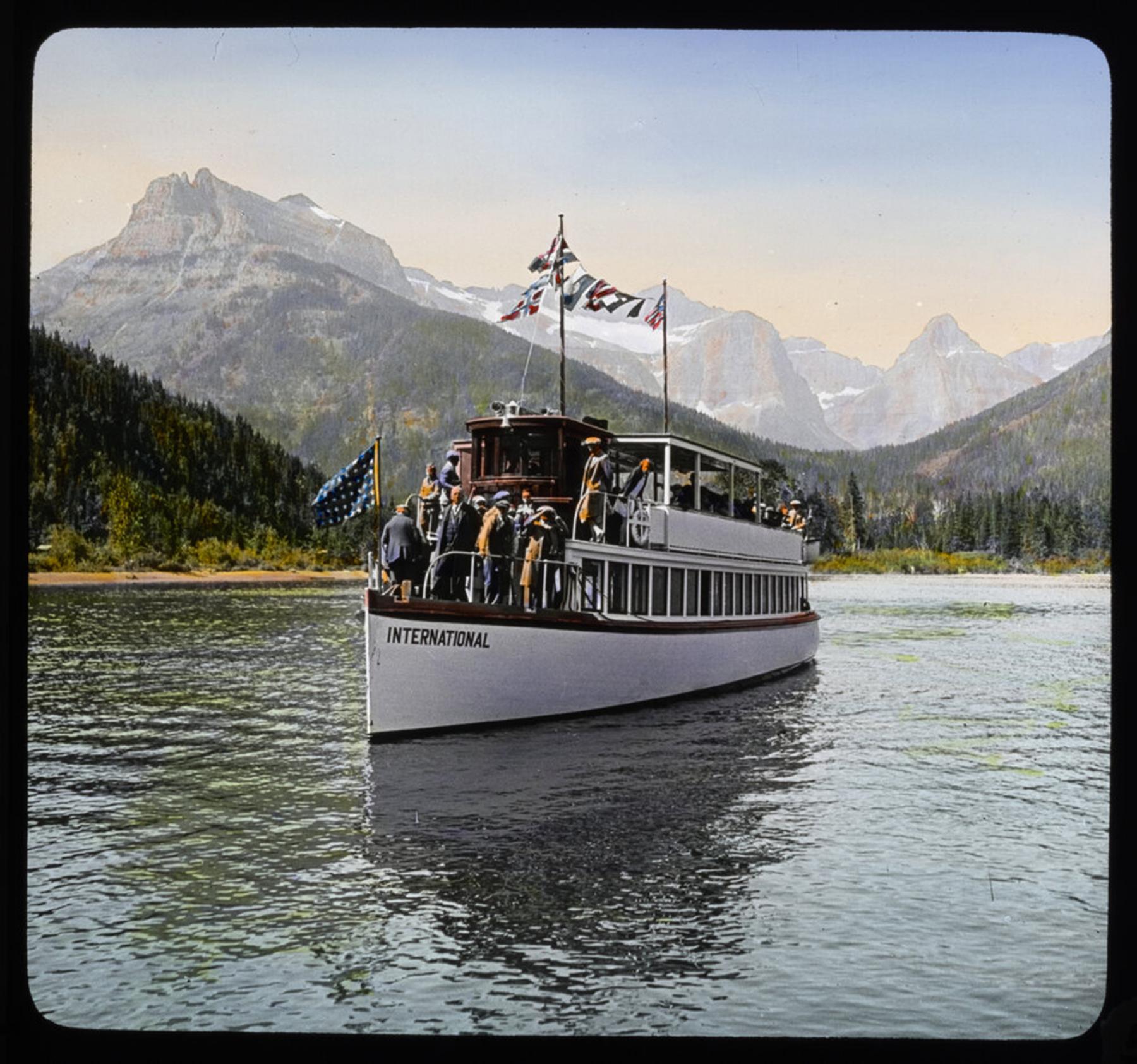
    <summary type="html"><![CDATA[<p><strong><em>Waterton-Glacier International Peace Park is a first-of-its-kind testament to the friendship between Canada and the United States. Glacial lakes, dramatic mountain faces, and abundant wildlife are just a few of the Glacier and Waterton Lakes’ shared features. The parks also feature the enduring craftsmanship of Captain J. W “Billy” Swanson, the prolific boat builder in the region.  </em></strong></p><img src="https://www.intermountainhistories.org/files/fullsize/24000f0abc2a900799c63e97227350e5.jpg" alt="The International, tinted-lantern slide, 1927" /><br/><p>In 1932, local rangers and Rotary Club members joined Glacier National Park (Montana, U.S.A.) and Waterton-Lakes National Park (Alberta, Canada) due to their contiguous landscape, similar ecosystems, and collaborative nature of their management. Though not erasing the international border, Glacier and Waterton already shared strong economic forces, like the Great Northern Railroad. The railroad’s Glacier Park Hotel Company (GPHC) built various chalets and hotels across Glacier, but its only Canadian property, the Prince of Wales Hotel, is emblematic of the international drive for nature-based tourism.
Opening in 1927, the sophisticated Prince of Wales Hotel needed travel amenities suitable for its upper-class clientele. The GPHC turned to Captain J.W. “Billy” Swanson, the prominent boat builder from Glacier National Park, to build his largest, grandest vessel: the <em>International</em>. To avoid Canadian labor and customs restrictions, the company insisted that Swanson build and register the boat on U.S. soil, even though it primarily served Canadian guests. The 250-passenger vessel was to transport guests to the remote Goat Haunt Chalet on the south side of Upper Waterton Lake. The <em>International </em>would also provide comfort and luxury to those coming from the chalet after a long trip on horseback. Though within Glacier’s borders and accessible via the park’s trail system, the backcountry chalet was easier to get to by boat from the lake’s Canadian side. However, materials were difficult to transport from Kalispell, about 150 miles away in Montana. Another boat concessionaire hauled parts for Swanson across the lake to Goat Haunt initially, but after the Captain deemed transportation prices too high, he simply built his own freighter boat. He and his small crew assembled the <em>International </em>in just two months, launching it on Upper Waterton Lake from the Prince of Wales Hotel in the summer of 1928.
Divided almost equally by the Canadian-American border, Upper Waterton Lake offers astounding views no matter which country one is in. However, some differences made the scenic trip even more sought-after from the Canadian side. The Prince of Wales Hotel initially drew Americans avoiding Prohibition laws, but by 1934, when they were repealed, Alberta still had restrictions on dancing and alcohol on Sundays. Despite the Great Depression, the vessel’s trips to the lake’s American side kept the <em>International </em>afloat. Canadians eager to escape Alberta laws hopped aboard her varnished, electrically lit deck for a good time, if only for a couple of hours.
Swanson had sold his Glacier operations by 1938 and moved on to other boat-building projects. However, as Canada entered World War Two in 1939, concession operations soon halted in the parks, though the <em>International </em>operated until 1940. The hiatus led to the neglect and eventual razing of Goat Haunt Chalet. The <em>International</em>, though, continues to transport Waterton-Glacier visitors across the lake, allowing them to experience a one-of-a-kind ride in a one-of-a-kind park.</p><p><em><strong><a href="https://www.intermountainhistories.org/items/show/891">For more (including 6 images) view the original article</a></strong></em></p>]]></summary>
    <published>2025-09-23T15:30:19+00:00</published>
    <updated>2026-04-17T19:32:20+00:00</updated>
    <link rel="alternate" type="text/html" href="https://www.intermountainhistories.org/items/show/891"/>
    <id>https://www.intermountainhistories.org/items/show/891</id>
    <author>
      <name>Anaëlle DePoint, Northern Arizona University</name>
    </author>
  </entry>
  <entry>
    <title type="html"><![CDATA[Sheepherding on Fremont Island]]></title>
    <summary type="html"><![CDATA[<p><strong><em>In 1859, two pioneer brothers from Farmington, Henry William Miller and Daniel Arnold Miller, began the first ranching operation on Salt Lake’s Fremont Island.</em></strong></p><img src="https://www.intermountainhistories.org/files/fullsize/1e4eeac398afc93856bcf40417422df4.jpg" alt="Fremont Island" /><br/><p><span style="font-weight:400;">The storied explorer John C. Fremont and his traveling companions initially documented their foray onto the Great Salt Lake with incredible optimism. While paddling arduously in their small rubber craft in 1843, they observed that, “Several large islands raised their high rocky heads out of the waves; but whether or not they were timbered, was still left to our imagination…”. When they explored one of the aforementioned “high rocky heads,”  they found  an island populated with sagebrush, bunch grass, and a surprising lack of fresh water. After a day or two, Fremont dubbed his discovery “Disappointment Island.”</span>
<span style="font-weight:400;">While surveying the Great Salt Lake for The Church of Jesus Christ of Latter-day Saints in 1850, Captain Howard Stansbury, perhaps to Fremont’s chagrin, changed the name of the formerly disappointing island to Fremont Island. Stansbury noted that the plentiful bunch grass and brackish water would be perfect for livestock. In 1859, Daniel and Henry Miller demonstrated their agreement by moving flocks of sheep and some cattle to the island, which the locals then recognized as “Miller Island.”</span>
<span style="font-weight:400;">Seymour Miller, the grandson of Daniel and Henry, recorded some of his experiences as a de facto ranch hand for the family ranching business on Fremont Island. They kept 2,000 sheep on the island and ferried themselves and their stock back and forth on the </span><i><span style="font-weight:400;">Lady of the Lake</span></i><span style="font-weight:400;">, a boat designed by Jacob Miller, Seymour’s cousin. Keeping the sheep on a relatively small island (4.60 sq. mi.) led the Millers to conclude that they did not need a full-time herder on the island. Instead, they let the sheep run wild for most of the year, confident in the confines of the island.</span>
<span style="font-weight:400;">The sheep quickly went feral and became “wild as a deer.” This provided the Millers with some market advantage because “The meat of this flock tasted more like venison than mutton and would always bring a fancy price on the market when ordinary mutton could hardly be sold.” Unfortunately, during shearing and lambing seasons, these wild qualities caused numerous problems for the island herders. They would sometimes go a full day or two during round ups without successfully driving a single sheep into the shearing pens. During one especially eventful drive, Seymour and his companions cornered some sheep on a peninsular part of the island and “Rather than be caught, several of them took off into the lake. The last I saw of them they were still going.”</span>
<span style="font-weight:400;">Unfortunately for the Millers, their ranching operation did not last past 1885, when local lawyer Uriah Wenner took an interest in living on the island and began legal procedures to oust them and their flocks. The Millers were forced to move their herds to the mainland, where they continually lost woolies due to the sheep’s feral nature that befuddled conventional herders. In his memoir, Seymour concluded that “we never got a dollar out of them.”</span>
<span style="font-weight:400;">After Wenner and his wife died, possession of the island changed hands without remarkable business or improvement until 2003. For a few years, Fremont Island underwent a small stint as a hunting ground for exotic livestock and then changed ownership until it landed in the hands of the State of Utah.</span></p><p><em><strong><a href="https://www.intermountainhistories.org/items/show/735">For more (including 3 images) view the original article</a></strong></em></p>]]></summary>
    <published>2023-04-06T16:23:06+00:00</published>
    <updated>2026-04-17T19:32:16+00:00</updated>
    <link rel="alternate" type="text/html" href="https://www.intermountainhistories.org/items/show/735"/>
    <id>https://www.intermountainhistories.org/items/show/735</id>
    <author>
      <name>Joshua Rust, Brigham Young University</name>
    </author>
  </entry>
  <entry>
    <title type="html"><![CDATA[Finnish Headstones and Saunas in Scofield<br />
]]></title>
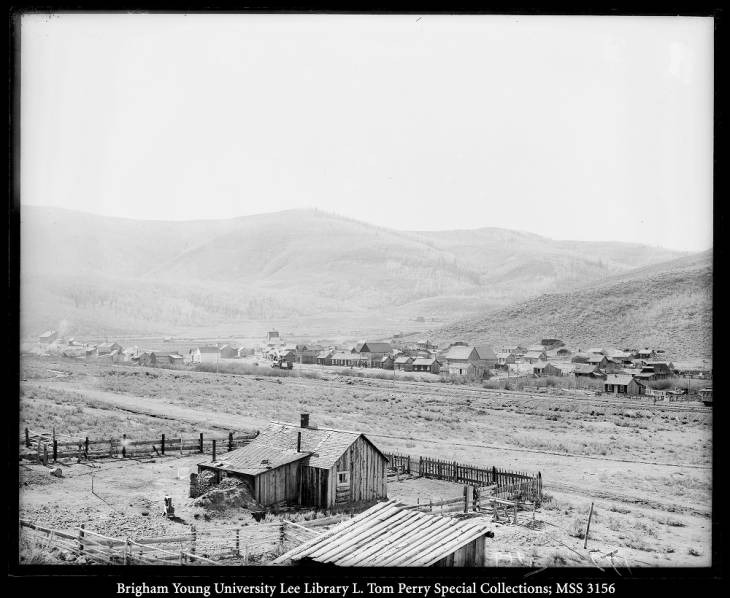
    <summary type="html"><![CDATA[<p><strong><em>Like many other mining districts, the town of Scofield went through a boom and bust cycle that effectively created a living ghost town. Despite the town’s current state, the Finnish immigrant community in Scofield left a lasting impact. Headstones and saunas are Scofield’s two most prominent visual features that tell the story of Utah’s immigrants from Finland. </p></strong></p><img src="https://www.intermountainhistories.org/files/fullsize/db01e37dc27f40411c5412b29a62a9f4.jpg" alt="The Town of Scofield, Utah at a South West Angle." /><br/><p>Although Scofield, Utah is not a booming community anymore, the town still retains remnants of immigrant life. According to the 2010 US Census, Scofield housed only 24 people. However, 120 years ago, Carbon County boasted a booming mining community. 	While most of Utah’s Scandinavian population came in the late nineteenth and early twentieth century as Mormon converts, Finland contributed only 14 people to those early groups of Mormon migrants. Instead, the year 1890 brought most of Utah’s Finnish immigrants to Utah as miners and railway workers. By the year 1900, there were over 200 Finns in Carbon County with most of them living in a small community in Winter Quarters, a suburb just outside Scofield.    </p><p>The Finns brought with them to America a desire to preserve their Finnish culture. This resulted in the building of many public and private saunas throughout Scofield. Saunas work by running water over hot stones to create steam. The saunas helped the Finns to teach their culture to the young in their company. The principle of “sisu” or internal fortitude was taught through the sauna as the Finns used the steam baths to provide both physical and spiritual cleansing. </p><p>Disaster struck Scofield’s Finnish community on May 1, 1900. An explosion in the WInter Quarters Number Four mine marked the largest mine explosion in the United States up to that point. Over 200 were numbered among the dead and many others lost that remained unaccounted for. The Finnish lost 62 of their fathers, sons, and brothers. Hit specifically hard was the Luoma family. Abe Luoma lost six sons and three grandsons in the destruction of the mine. Most of the Finns who died in the explosion were buried in the Scofield cemetery and Reverend A. Granholm, a Finnish Lutheran minister from Wyoming, came down to Scofield to dedicate the graves of the fallen Finns. </p><p>After the explosion, a majority of the Finns stayed in Scofield until the area’s mines began to cease operation in the 1920s. Even after the decline of the Scofield Finnish community, the Finns in Utah were some of the frontline advocates for greater safety for mine workers. The strikes of 1903, 1922, and 1933 featured Finns who desired to keep the period of unions alive. Despite the hardship that Finnish immigrants faced, their hearty spirit left a legacy of preserved culture and a new culture of defending and protecting their families and other immigrant workers. </p><p><em><strong><a href="https://www.intermountainhistories.org/items/show/448">For more (including 3 images) view the original article</a></strong></em></p>]]></summary>
    <published>2020-10-31T08:56:17+00:00</published>
    <updated>2026-04-17T19:32:09+00:00</updated>
    <link rel="alternate" type="text/html" href="https://www.intermountainhistories.org/items/show/448"/>
    <id>https://www.intermountainhistories.org/items/show/448</id>
    <author>
      <name>Josie Manwill, Brigham Young University </name>
    </author>
  </entry>
  <entry>
    <title type="html"><![CDATA[Lagoon’s Desegregation]]></title>
    <summary type="html"><![CDATA[<p><strong><em>Lagoon was a place of tradition turned trailblazer when its owner, Robert E. Freed, was one of the first venue owners to invite racial integration.</em></strong></p><img src="https://www.intermountainhistories.org/files/fullsize/86424cbc29d3496eff31b25048b983a3.jpg" alt="Colossus Roller Coaster" /><br/><p>Originally situated on the shores of the Great Salt Lake and later relocating to Farmington, UT, Lagoon was (and still is) a constantly evolving business. It began as Lake Park, offering a mule-drawn carousel, roller skating, and bowling, and today is a large amusement park with record-breaking multi-million-dollar steel roller coasters and over a million visitors every year. While Lagoon has evolved economically, perhaps even more significant is its demonstration of social progress. Lagoon set the stage when it officially desegregated in the 1940s, and many other public venues followed. </p><p>Unlike some of the states where the Civil Rights movement of the mid-20th century was intensely focused, Utah never had Jim Crow laws or other legislation explicitly forcing white and black people to stay separated. However, racial minorities in Utah were victim to de facto segregation (which was often due indirectly to legislation, whether intentional or not). Though Utah wasn’t on the forefront of national civil rights news, the issues were pertinent and pressing in Utah cities as well. Between 1940 and 1950, the Black population in Utah more than doubled, and tensions between the white majority and marginalized minorities continued to rise.</p><p>Without official segregation laws and few cities with more than one school, it was up to business owners to change the public’s mind about who was allowed where. After World War II, some businesses began to desegregate. One of the first was Lagoon. Lagoon had been closed during the war, and was reopened and revamped in 1946-1947. Then, Robert E. Freed, one of the owners, made the attractions at Lagoon, as well as his Rainbow Rendezvous Ballroom in Salt Lake City, available to all races. After this bold move, it didn’t take long for other businesses and city pools to open their doors to minorities as well. </p><p>Appropriately-named Robert Freed made a pivotal move when he integrated his park in the 1940s, and Utah has been working for racial equality ever since.</p><p><em><strong><a href="https://www.intermountainhistories.org/items/show/85">For more (including 5 images) view the original article</a></strong></em></p>]]></summary>
    <published>2017-08-16T21:20:56+00:00</published>
    <updated>2026-04-17T19:31:59+00:00</updated>
    <link rel="alternate" type="text/html" href="https://www.intermountainhistories.org/items/show/85"/>
    <id>https://www.intermountainhistories.org/items/show/85</id>
    <author>
      <name>Aubrey Glazier, Brigham Young University</name>
    </author>
  </entry>
</feed>