<?xml version="1.0" encoding="UTF-8"?>
<feed xmlns="http://www.w3.org/2005/Atom">
  <title type="text">Intermountain Histories</title>
  <updated>2026-04-17T19:32:00+00:00</updated>
  <generator uri="http://framework.zend.com" version="1.12.20">Zend_Feed_Writer</generator>
  <link rel="alternate" type="text/html" href="https://www.intermountainhistories.org/"/>
  <link rel="self" type="application/atom+xml" href="https://www.intermountainhistories.org/items/browse?output=rss2"/>
  <id>https://www.intermountainhistories.org/</id>
  <author>
    <name>Intermountain Histories</name>
    <uri>https://www.intermountainhistories.org</uri>
  </author>
  <link rel="hub" href="https://pubsubhubbub.appspot.com/"/>
  <entry>
    <title type="html"><![CDATA[A Thirst for Freedom in a Dry Town]]></title>
    <summary type="html"><![CDATA[<p><strong><em>A long-brewing issue, the Fort Collins, Colorado City Council voted to permit the sale of beer, wine, and liquors on April 8, 1969 and passed Ordinance No. 14. The voices of the community, including local businessmen, politicians, and the Colorado State University student population, were integral in influencing this decision.</em></strong></p><img src="https://www.intermountainhistories.org/files/fullsize/a0ecee72beabc8b0b2187f586ba3d78b.jpg" alt="Thomas Bennett" /><br/><p>The repeal of prohibition in Fort Collins was not easily completed. In 1969 a petition was circulated for the third time to end prohibition. First in 1961 and again in 1965, the petition had been defeated due to strong moral opposition from religious organizations. Yet, as Dr. Thomas Bennett, Mayor of Fort Collins from 1967 to 1968 pointed out, there were two liquor stores within city limits that held liquor licenses from Larimer County. Outside city limits, there were establishments like Ladd’s Covered Wagon. In 1961, owner Lloyd Ladd was granted a liquor license from Larimer County for his restaurant just north of Fort Collins. Fort Collins residents who wished to drink had several options to do so. </p><p>Dr. Thomas Bennett stepped down as mayor of Fort Collins in 1968 to serve as a councilman for the city and worked with others to end prohibition. Dr. Bennett felt passionately this was the moment to repeal prohibition. His primary argument was based on economics. The numerous bars and restaurants at the edge of city limits were proof of the profitability of alcohol sales. A new revenue stream, and the local jobs bars and liquor stores would generate, were appealing to the city council and the local community. Another source of pressure on the city council was the increase in student enrollment, specifically military veterans on the GI Bill, at Colorado State University (CSU). The 1968 Beer-In at CSU, referenced in the previous article, spoke volumes about the attitudes of college students towards prohibition. Two other college towns along the Front Range area were also in the process of repealing their own long-standing prohibition laws: Boulder, repealed in 1967 and Greeley in 1969. </p><p>The first legally sold drink of spirituous liquor since 1896 was sold in Fort Collins on August 8, 1969, at 5:00 pm in the Top Restaurant, located on the top floor of the Rocky Mountain Bank and Trust building. Les Ware, the owner of the Top Restaurant, had photographers on hand to commemorate the event. Red Ferrell, owner of Campus West Liquors and Larimer County liquor inspector at the time of the Fort Collins prohibition repeal, received the first license to sell packaged liquors in the city. Nancy Kavastanjian, staff writer for The Coloradoan newspaper, interviewed Ferrell in 1977 for a piece on the end of prohibition in Fort Collins. Ferrell reflected on the growth of liquor stores within Fort Collins, commenting that he “didn’t think it was healthy for a community to have that many.” </p><p>After the repeal, the number of bars and liquor stores within city limits did increase quickly.  According to Ferrell, the saturation of the market limited individual business earnings. The moral orientation of the town was still influential, limiting large-scale production and distribution of alcohol in Fort Collins for another two decades, when once again, it was the economic appeal of new businesses and new jobs that presented themselves in the form of beer production and breweries. </p><p><em><strong><a href="https://www.intermountainhistories.org/items/show/134">For more (including 5 images) view the original article</a></strong></em></p>]]></summary>
    <published>2018-02-01T20:00:10+00:00</published>
    <updated>2026-04-17T19:32:00+00:00</updated>
    <link rel="alternate" type="text/html" href="https://www.intermountainhistories.org/items/show/134"/>
    <id>https://www.intermountainhistories.org/items/show/134</id>
    <author>
      <name>Rose Gorrell, Colton Morton, and Keanu Squire, Colorado State University</name>
    </author>
  </entry>
  <entry>
    <title type="html"><![CDATA[Bootlegging, Immigrants, and Crime in Prohibition-Era Fort Collins]]></title>
    <summary type="html"><![CDATA[<p><strong><em>By 1896, the Temperance Movement in Fort Collins celebrated the issuance of Ordinance No. 8 prohibiting the purchase, sale, and gifting of alcohol. The ordinance paved the way for years of crime, illicit trade, and legal conflict as bootleggers worked to meet Fort Collin's continuing demand for alcohol.</em></strong></p><img src="https://www.intermountainhistories.org/files/fullsize/3ab0e6698166c5e00fccc4a98c981820.jpg" alt="Moonshiner Still" /><br/><p>As a result of city-wide prohibition starting in 1896, crime rates in Fort Collins increased. Skirmishes between law enforcement and drunken residents were a common sight, and cases of illegal intoxication often resulted in incarceration into the town’s local “Drunk Tank” or “calaboose." Frequent distillery raids led to additional arrests.  According to an account from Larimer County Sheriff’s officer Orville Pollock Kelly, getting rid of the stills was the “main problem.” During the eight years he worked at the sheriff's office (1925-1933) he never witnessed or heard of anyone being shot in the capture of a whiskey still.</p><p>Immigrants of Russian, German, and Histpanic descent had unique experiences during Fort Collins prohibition. Discrimination took many forms. For many, even making purchases at the grocery store was problematic, as only a select few stores would serve immigrants. Economic disparity between immigrants and white Americans in an already tight economy left some immigrant families seeking ways to augment their income. Some turned to the illicit manufacture and sale of alcohol. When asked what he remembered about bootlegging, lifelong Fort Collins resident Walter Salisbury recalled that the moonshining stills up in the foothills were largely operated by Mexican immigrants. Wages for these people were particularly poor, and discrimination allowed for very few advancement opportunities. Thus the “Bootlegger” scene in Fort Collins came to life, with an old race track located by what is now City Park serving as a “hot spot” of bootlegging activity. </p><p>One notable bootlegger, Cleofas Ambriz, held a daytime occupation as a sugar beet factory laborer but constructed his own still to help combat the poor living conditions. Ambriz explicitly made a point not to sell his moonshine to white members of the community for fear of the legal consequences should he be discovered. Eventually he was caught conducting business in Denver, which temporarily stalled his operations. However, Ambriz’s secret business resumed upon his return to Fort Collins. Salisbury recounted another instance when a Mexican moonshiner who lived near him was imprisoned the man’s son continued with running his father's bootlegging business. </p><p>In Fort Collins, alcohol was sometimes transported and sold through tunnels that ran beneath the streets of Old Town. In the early years of prohibition in Fort Collins (1884-1895), these tunnels were sometimes home to “sampling rooms,” defined as a “quiet, calm environment” where alcohol could be traded and purchased. Other cities in the intermountain west have similar stories, including, for example, Ogden Utah, which has legends of a city-wide tunnel network used for all manner of illicit activities.  </p><p>In 1933, federal prohibition was overturned, and 3.2% alcohol beer was legalized with the passage of the Cullen-Harrison Act. For Fort Collins, however, this was not the end of prohibition altogether, but rather a long period during which the community negotiated the degree to which alcohol should be a legal part Fort Collins life.</p><p><em><strong><a href="https://www.intermountainhistories.org/items/show/132">For more (including 5 images) view the original article</a></strong></em></p>]]></summary>
    <published>2018-02-01T19:42:47+00:00</published>
    <updated>2026-04-17T19:32:00+00:00</updated>
    <link rel="alternate" type="text/html" href="https://www.intermountainhistories.org/items/show/132"/>
    <id>https://www.intermountainhistories.org/items/show/132</id>
    <author>
      <name>Caroline Cutshall, Alan Linenburger, Devan Walsh, and Matt Witczak, Colorado State University</name>
    </author>
  </entry>
  <entry>
    <title type="html"><![CDATA[Brewing a Brew Culture]]></title>
    <summary type="html"><![CDATA[<p><strong><em>Though prohibition in Fort Collins ended in 1969, the breweries that would become a staple in Western college town culture did not arrive for another twenty years. It was Fort Collins’ status as a college town and location near the pristine waters of the Poudre River that drew brewers to the area.</em></strong></p><img src="https://www.intermountainhistories.org/files/fullsize/2300d113185bf834094ae68a4ed879af.jpg" alt="Old Town Square" /><br/><p>As one of Fort Collins’ oldest breweries, Coopersmith’s Pub & Brewing is a cultural mainstay of the college town. It opened in 1989 along with several other breweries that followed the opening of the Anheuser-Busch brewery in 1988, after a law changed allowing Fort Collins to produce and sell beer. Upon learning of the change in law, Coopersmith's founder Scott Smith took advantage of the opportunity, opening the pub & brewing facility with investors’ assistance. Though several breweries have since opened and closed, Coopersmith’s has survived through the years as a successful model to other similar businesses. Front Range Historian Brea D. Hoffman even suggests that Coopersmith’s helped to make Old Town Fort Collins a popular local destination. Now, the brewery employs over one hundred people with around twenty house beers on tap.</p><p>But brewing was not always the industry it is today. It took more than a decade after prohibition ended for the city to even consider allowing breweries to set up shop in Fort Collins, and almost two decades until breweries were actually established. One of the bigger concerns for both the brewers and the locals was water usage. Like the rest of the West, Fort Collins and Northern Colorado face challenges when it comes to water access. For breweries, water is an integral part of their process; water supports the yeast which feeds off of sugar and turns it into alcohol. In order for beer to obtain its natural flavor, the water from which the process begins needs to be free of bacteria and pollutants that can alter the flavor of the beer, leading many breweries to spend considerable funds on treating their water. The City of Fort Collins invests attention to the health of its natural environment and water sources, and has been doing so since the 1970s. Since both the city and the breweries were and continue to be so concerned with water, these entities have worked together on shared goals toward water conservation. This sort of local collaboration was a necessity for brewers in Fort Collins, for the city’s location on the Poudre River made it and ideal place for brewers to set up shop.</p><p>Breweries also received pushback from more conservative residents, who were concerned with the kind of culture that would come with an industry centered around alcohol consumption. “The city was dry until ’69,” said Coopersmith’s President, Dwight Hall, who explained what he thought about the cultural changes it took for breweries to take off. “But I’ll go back to CSU being such a moderating influence on the community. It brings people in with new perspectives.” </p><p>“It’s the rebirth of a historic tradition,” founder Scott Smith was quoted as saying in the Coloradoan. “Brew pubs aren’t a fad.” Though Fort Collins might have held onto prohibition longer than most, changing attitudes throughout the region helped bring brewery culture to a once dry city.</p><p><em><strong><a href="https://www.intermountainhistories.org/items/show/135">For more (including 4 images) view the original article</a></strong></em></p>]]></summary>
    <published>2018-02-01T20:07:47+00:00</published>
    <updated>2026-04-17T19:32:00+00:00</updated>
    <link rel="alternate" type="text/html" href="https://www.intermountainhistories.org/items/show/135"/>
    <id>https://www.intermountainhistories.org/items/show/135</id>
    <author>
      <name>Davis Brady, Jason Caskey, and Elaine Gay, Colorado State University</name>
    </author>
  </entry>
  <entry>
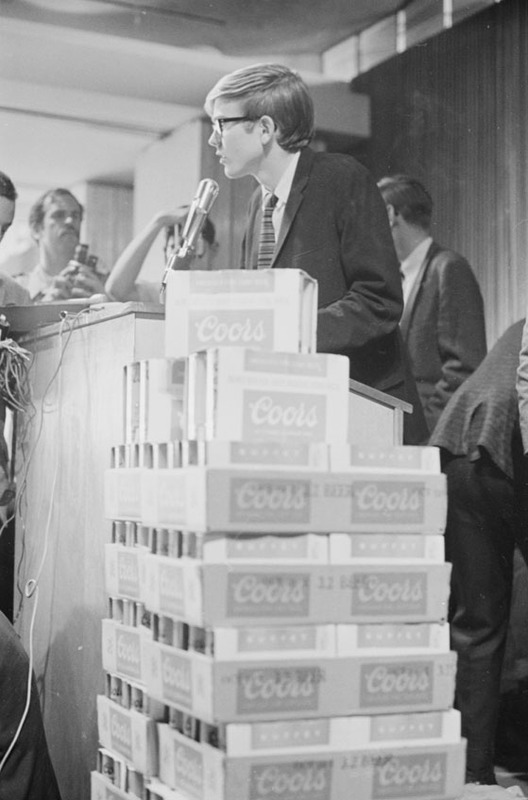
    <title type="html"><![CDATA[CSU Students Protest and Hold a &quot;Beer-in&quot; in 1968]]></title>
    <summary type="html"><![CDATA[<p><strong><em>Drinking culture in Fort Collins may seem pedestrian today, what with nineteen breweries dotting the city’s landscape, but the barbarous beer and bar culture of contemporary Ft. Collins was born of far more conservative roots. How did  After the repeal of the Volstead act and the resulting end of prohibition in 1933, Fort Collins maintained prohibition far longer than the majority of the country. How did the town's brew culture evolve? It all comes down to a single number: 3.2. </p></strong></p><img src="https://www.intermountainhistories.org/files/fullsize/c6befaad17dcba3f15d5ec36f11ec99f.jpg" alt="Beer-In 1968" /><br/><p>After the repeal of Prohibition in 1933, Fort Collins remained somewhat dry.  On March 22, 1933, the town passed the Cullen-Harrison Act, which allowed lawful distribution and consumption of beer that was 3.2% alcohol by weight - a fairly light brew. </p><p>Some thirty-five years later, students of Colorado State University borrowed demonstration tactics employed by civil rights activists to fight for greater student input in what they felt to be an unfair paternal relationship with university administrators—one of the first items on student protestors’ agenda was the accessibility and consumption of 3.2 beer on campus. How better to demonstrate their frustrations than staging a “beer-in” in the student center? Though the student body was far from unanimous on these matters, on Friday, October 18, 1968, the president of the Associated Students of Colorado State University (ASCSU), Doug Phelps, rallied more than 150 students in the Lory Student Center to stage a “beer-in” under the pretense of liberating the student center. </p><p>As early as November of 1965 students had expressed their displeasure with the lack of 3.2 drinking establishments in Fort Collins. A number of students attended the December 7, 1965, meeting that founded the Fort Collins Malt Beverage Association, a group comprised of city officials, existing tavern owners, and other Ft. Collins merchants. Almost exactly two years later, the ASCSU voted to poll the student body to glean student attitudes in support or opposition to the selling of 3.2 beer on campus. By February 1967, the subject had reportedly become a topic of daily discussion and debate. The State Board of Agriculture, the university governing entity, began debating the topic of 3.2 beer sales on campus by the Spring of 1968. In August of the same year, The State Board of Agriculture voted 4-1 against a request to allow the on-campus sale of 3.2 beer by the glass. On October 10, 1968, a helicopter commissioned by student body president Doug Phelps, flew over CSU campus dropping pamphlets urging students to convene for the “liberation” of the Lory Student Center as soon as possible. The resulting crowd discussed issues of student power, and Phelps announced that on October 18 at 3:00 P.M. he intended to drink beer in the student center in an act that was meant to symbolize the potential of student power to dictate Student Center policy. On October 18, 1968, Phelps and more than 150 other students made good on their promise by staging a beer-in in the Student Center Main Ballroom (only approximately 30 actually drank a beer). Students voiced their desire for beer to be sold in the newly constructed Student Center coffee shop which, perhaps not coincidentally, is the current location of the only on-campus drinking establishment, the beloved Ramskeller. </p><p><em><strong><a href="https://www.intermountainhistories.org/items/show/133">For more (including 4 images) view the original article</a></strong></em></p>]]></summary>
    <published>2018-02-01T19:51:26+00:00</published>
    <updated>2026-04-17T19:32:00+00:00</updated>
    <link rel="alternate" type="text/html" href="https://www.intermountainhistories.org/items/show/133"/>
    <id>https://www.intermountainhistories.org/items/show/133</id>
    <author>
      <name>William Bundy and Keegan Martin, Colorado State University</name>
    </author>
  </entry>
  <entry>
    <title type="html"><![CDATA[Early Prohibition and the The Woman&#039;s Christian Temperance Union in Fort Collins]]></title>
    <summary type="html"><![CDATA[<p><strong><em>In the late nineteenth century, women across the United States were fighting for prohibition. The Women’s Christian Temperance Union (WCTU) was one of the most influential nationwide organizations pushing to ban alcohol.  In August of 1880, several local influential local women in Fort Collins, Colorado established a chapter of the WCTU.</em></strong></p><img src="https://www.intermountainhistories.org/files/fullsize/16c89b2946eab17c4c00259ab95e768a.jpg" alt="137 Matthew Street, McIntyre Home" /><br/><p>Prohibition began in Fort Collins in 1896, over twenty years before the 21st Amendment was passed. According to first-hand accounts gathered by Fort Collins historian Ansel Watrous, Fort Collins was a wide open town “full of idle and vicious men, driftwood from railroad and ditch camps, irresponsible creatures, without home or friends who hung about the saloons and brothels" prior to prohibition. Women founded the WCTU to combat such perceived characteristics of the northern Colorado town.  The passage of women's suffrage in 1893 in Colorado fueled aided the WCTU formation and quest to permanently end the sale of liquor in the state. This movement provided women in Fort Collins (and elsewhere) an early chance to influence their community and participate in public politics.</p><p>The meetings of the WCTU, according to an issue of the Fort Collins Courier published on August 9, 1894, were held at a variety of locations including churches and the Fort Collins Opera House on College Avenue; however, the majority of the meetings were held in the intimate confines of important members’ homes and parlors. One such home was the residence of Mrs. Lucy McIntyre. Lucy McIntyre was one of the founders of the WCTU of Fort Collins and Watrous described her as “devoted to the work of uplifting humanity.” Mrs. McIntyre and other members of the WCTU felt that the abolition of alcohol would improve the quality of life in Fort Collins. As Emily Abbot, a prominent member of the local WCTU described it, the members feared that “one-third of the men of this community are surely traveling the road that leads to destruction of mind, of body, and of soul...manhood destroyed, intellect in ruins, families made miserable.” At their meetings, the women discussed temperance literature and promoted prohibitionist ideas. For example, at one meeting Mrs. McIntyre provided figures that she claimed plainly proved “how much better it is to govern a city according to the ‘Good Old Book’.”  </p><p>The women had their first success in April 1884, when the town passed an anti-liquor ordinance. This ordinance, however, was repealed a year later and the city returned to a high license fee ordinance. . In 1895, Ordinance No. 8 passed and reads: “it is unlawful for any person or persons…to sell or give away intoxicating malts, vinous, mixed, fermented or spirituous liquors within the corporate limits of the City of Fort Collins.” The city of Fort Collins remained a dry town until 1969.</p><p><em><strong><a href="https://www.intermountainhistories.org/items/show/131">For more (including 3 images) view the original article</a></strong></em></p>]]></summary>
    <published>2018-02-01T19:35:50+00:00</published>
    <updated>2026-04-17T19:32:00+00:00</updated>
    <link rel="alternate" type="text/html" href="https://www.intermountainhistories.org/items/show/131"/>
    <id>https://www.intermountainhistories.org/items/show/131</id>
    <author>
      <name>Owen England, Matt Hood, Jourdyn Russell, and Madi Steine, Colorado State University</name>
    </author>
  </entry>
</feed>