<?xml version="1.0" encoding="UTF-8"?>
<feed xmlns="http://www.w3.org/2005/Atom">
  <title type="text">Intermountain Histories</title>
  <updated>2026-04-17T19:31:58+00:00</updated>
  <generator uri="http://framework.zend.com" version="1.12.20">Zend_Feed_Writer</generator>
  <link rel="alternate" type="text/html" href="https://www.intermountainhistories.org/"/>
  <link rel="self" type="application/atom+xml" href="https://www.intermountainhistories.org/items/browse?output=rss2"/>
  <id>https://www.intermountainhistories.org/</id>
  <author>
    <name>Intermountain Histories</name>
    <uri>https://www.intermountainhistories.org</uri>
  </author>
  <link rel="hub" href="https://pubsubhubbub.appspot.com/"/>
  <entry>
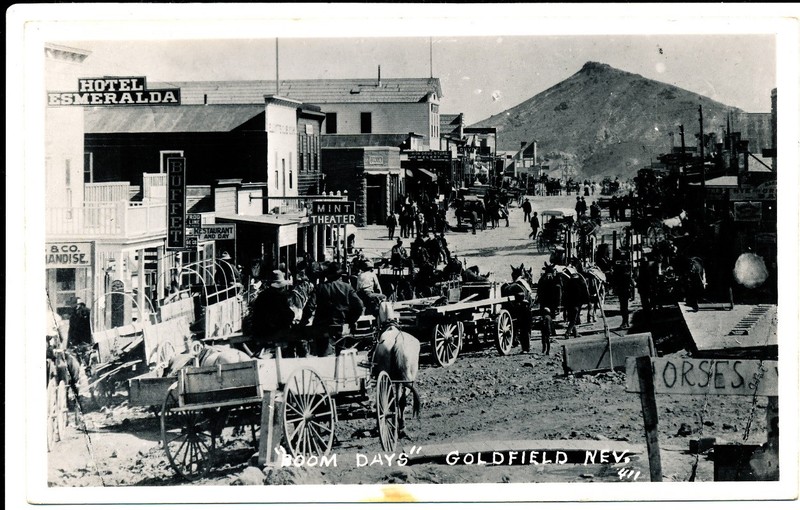
    <title type="html"><![CDATA[The Goldfield Historic District: Boom towns, Boosterism, Labor, and Disaster]]></title>
    <summary type="html"><![CDATA[<p><strong><em>Despite the idea that the frontier closed in 1890, popularized by Fredrick Jackson Turner, the West was not settled. The days of boom towns and quick fortunes continued into the twentieth century. Goldfield saw its fair share of boom and bust, labor strife, and environmental disaster in the early 20th century. </em></strong></p><img src="https://www.intermountainhistories.org/files/fullsize/a3b0b6b1d1c51cc614290496da4574ab.jpg" alt="Street Scenes SS1c" /><br/><p>Tucked away in the Middle of Central Nevada on a narrow two lane highway located between Nevada’s two largest populated areas, 200 miles north of Las Vegas and 250 miles south of Reno is the remains of a city that once dwarfed both.  If you were to travel to Goldfield today you would be greeted by a small town composed of a collection of turn of the century buildings, one restaurant, and an impressive castle inspired courthouse, but if you blinked you might miss the town all together. From a casual observer’s position many would find it hard to believe that Goldfield in first decade of the twentieth century was the largest city in the state of Nevada and once had a population that exceeded over 20,000. </p><p>Prospectors were drawn to the dry, remote Nevada desert in previous decades in search of silver and many mining towns such as Tonopah dotted the landscape. Goldfield alluded their picks because it did not offer silver ore, but gold ore. Prospectors discovered gold at the base of Colombia Mountain (the large mountain seen in the background of the town picture) in 1903 and quickly people began flooding in to the region. This once nondescript piece of desert transformed into Nevada’s largest city in only four years. By 1904 Goldfield had its own post office, telephone and telegraph lines, and newspapers. </p><p>The town began as a gathering of tents and adobe buildings because those materials were either light or readily available in the desert, but as the boom moved on more and more modern buildings were added including access to electricity. Businesses included, saloons, hotels, photography shops, and social clubs. Unlike earlier gold rushes many came to Goldfield by car. Early cars had high clearances, solid rubber tires, and could be repaired in the field making them well suited to the desert. This also led to clashes between horse drawn stage companies and automobiles as they fought over who could go on which roads. Rail lines also arrived in town to carry both passengers and ore. The Railroads connected Goldfield to the rest of the country as lines headed out to the north, south and west.  Goldfield received water through a combination of local springs from surrounding canyons and local wells dug around the town site. For an added fee to the city you could even have indoor plumbing brought to your home or business. Though, being in a desert and constantly growing meant water supply was always a problem. The water shortage contributed to fires in Goldfield, in 1906 alone there were three hotel fires in the city. </p><p>At its peak the city hosted sporting and entertainment events including dances, baseball leagues and the Gans-Nelson world championship fight that lasted a whopping 42 rounds. But by 1907 the boom had begun to slow and labor struggles began to emerge. The struggles between miners (led by the IWW) and mine owners made national news as President Teddy Roosevelt was manipulated into calling troops into the city to put an end to the unrest. Though the growth of the city had ended 1908 proved to be the most productive year in the city’s history, but the city was already in decline. As the ore deposits depleted the city shrunk rapidly by the end of 1909 the population fell to 5,000 from a peak of 20,000 to 30,000 in 1907. The city also began to fall apart physically. In 1913 heavy rains fell in the nearby mountains and a torrent of water came rushing down a nearby canyon and strait through town, destroying the low lying segments of town. The city committed to rebuilding but in 1923 another disaster, this time a fire destroyed much of the city and this time threw was little to no energy to rebuild, by decades end all but one rail line had ceased service and Goldfield had declined to a small town. Today Goldfield still stands and contrary to popular belief it is not a ghost town. It still has a population of 300 and serves and the county seat of Esmerelda County and continues to offer services including a post office, DMV, and the county courthouse. The Goldfield Hotel still stands, as well as prominent buildings, such as the Nixon Building and Santa Fe Saloon, continually operating since 1905. </p><p><em><strong><a href="https://www.intermountainhistories.org/items/show/31">For more (including 6 images) view the original article</a></strong></em></p>]]></summary>
    <published>2017-03-03T16:41:54+00:00</published>
    <updated>2026-04-17T19:31:58+00:00</updated>
    <link rel="alternate" type="text/html" href="https://www.intermountainhistories.org/items/show/31"/>
    <id>https://www.intermountainhistories.org/items/show/31</id>
    <author>
      <name>Anthony Graham, University of Nevada, Las Vegas</name>
    </author>
  </entry>
  <entry>
    <title type="html"><![CDATA[Alamo Airways ]]></title>
    <summary type="html"><![CDATA[<p><strong><em>Transportation influences how people are able to access undiscovered lands. The railroad allowed for the transformation of the West. However, in 1919, the first commercial airplane took off, which shortened distances and contributed to a more integrated world. Las Vegas joined the aviation community in 1920 when the first airplane landed in Clark County, but business was slow and only for mail at this time.  </em></strong></p><img src="https://www.intermountainhistories.org/files/fullsize/7de5a40bee46cd3848514963a00651d1.jpg" alt="Bonanza Airplane " /><br/><p>Commercial Aviation put Las Vegas on the map. George Crockett opened Alamo Airport in 1942 which created a hub for his airline and allowed for further commercial traffic. This site is significant because it was the original location for present day McCarran International Airport. During the 1940s the government needed an airport to further military training and Crockett agree to lease the land. Due to his dedication and sacrifice the county was able to provide necessary pilot training for World War II and contribute to the atomic testing project.  Howard Hughes bought the facility and renamed the airport McCarran International after Senator Pat McCarran. Senator McCarran played a huge role in the development of aviation and encouraged ethical business practices and competition among the airlines. Today McCarran International Airport is the fifth busiest in the United States and tenth throughout the world.</p><p><em><strong><a href="https://www.intermountainhistories.org/items/show/30">For more (including 4 images) view the original article</a></strong></em></p>]]></summary>
    <published>2017-03-03T16:23:18+00:00</published>
    <updated>2026-04-17T19:31:58+00:00</updated>
    <link rel="alternate" type="text/html" href="https://www.intermountainhistories.org/items/show/30"/>
    <id>https://www.intermountainhistories.org/items/show/30</id>
    <author>
      <name>Jesi Colston, University of Nevada, Las Vegas </name>
    </author>
  </entry>
  <entry>
    <title type="html"><![CDATA[Atomic Liquors ]]></title>
    <summary type="html"><![CDATA[<p><strong><em>Walk into this aptly themed bar in 2016 and you will find something unique for the city of Las Vegas: an authentic part of its history. While it has expanded in recent years, Atomic is one of those rare historical specimens that has managed to survive, and even thrive, in a city that continuously reinvents itself for the changing tides of tourism. The bar has kept the same look, and many of the same relics of its past, down to the classic neon sign that has adorned the building since Joe and Stella Sobchik opened it in the early 1950s. </em></strong></p><img src="https://www.intermountainhistories.org/files/fullsize/0cbc06ed75225977ab5afc469a76d5d7.jpg" alt="Atomic Neon at Night " /><br/><p>It started in 1945 as Virginia’s Café, named after Stella’s mother who acquired the property in an inheritance from a local judge she cared for during his final years of life. Stella ran the restaurant for her mother with her husband Joe, while Virginia managed other endeavors on the property. At this time, federal military-industrial spending helped the Las Vegas economy to boom, along with many cities in the American West during the Cold War. The arrival of the Nevada Test Site (NTS) in 1951 was one aspect of this federal military involvement in the Las Vegas community, which continued from the World War II establishments of Basic Magnesium Inc. and Nellis Airforce Base. </p><p>Public opinion of the NTS was initially marked by worry of the possible side effects of radiation and fallout. The quick acceptance and even excitement over being a part of the nation’s defense grew from active efforts by the Atomic Energy Commission, along with the generally increased anti-Communist sentiment in the United States. Fears were easy to quell through created images of the American West as simultaneously an empty wasteland made for testing, and a beautiful sunny oasis. </p><p>The development of the NTS contributed to a prominent nuclear culture, a form of patriotic pride in the city, from which Atomic Liquors directly grew. While the NTS was dropping its first above ground test-bomb, Joe and Stella grew tired of cooking food and looked towards selling alcohol. Initially in the form of a liquor store in 1952, by 1954 the Sobhiks had established Atomic Liquors as a full-service bar, complete with a rooftop to watch mushroom clouds rise 60-70 miles outside of town while sipping popular “atomic cocktails” that marked the era.</p><p>As above-ground testing ended in 1963, the “atomic hairdos,” “Miss Atomic Bomb Contests,” and “atomic cocktails” that marked the era’s culture fell-out of popularity. Atomic Liquors, however, remained. Consistently a hangout for mobsters, celebrities, and other Fremont Street laborers, the bar continued as a popular neighborhood staple for a few decades. As the Fremont Street District hit harder economic times, it lost out to the popularity of the Strip, and Atomic Liquors became a little-known neighborhood watering-hole most locals and tourists alike had not heard of, or did not want to venture into. When the Sobchiks passed in 2010, the bar went to their son, Ron, who then sold it to a group of investors, reopening it in 2012, fully restored. Today locals and tourists alike can enjoy the nostalgia of a bygone classic Las Vegas era, while also embracing the new craft beers and cocktail menu that compliments the larger revitalization of Downtown Las Vegas. </p><p><em><strong><a href="https://www.intermountainhistories.org/items/show/29">For more (including 9 images) view the original article</a></strong></em></p>]]></summary>
    <published>2017-02-27T17:36:37+00:00</published>
    <updated>2026-04-17T19:31:58+00:00</updated>
    <link rel="alternate" type="text/html" href="https://www.intermountainhistories.org/items/show/29"/>
    <id>https://www.intermountainhistories.org/items/show/29</id>
    <author>
      <name>Billy Marino, University of Nevada, Las Vegas </name>
    </author>
  </entry>
  <entry>
    <title type="html"><![CDATA[Forced Relocation and The Owens Valley: Numu (Paiutes) and Japanese-Americans and Forced Relocations to and from the Owens Valley]]></title>
    <summary type="html"><![CDATA[<p><strong><em>The Japanese-American workers pictured in the featured image are standing, stooping, and kneeling in the shadows of the eastern Sierra Nevada mountains in Owens Valley, California - and their presence on the land highlights colonial and capitalist themes that underpin the history of the valley itself. Their forced removal and internment during World War II to this isolated rural area is not a unique history to the Owens Valley. Nor is it the only local story of removal. </em></strong></p><img src="https://www.intermountainhistories.org/files/fullsize/00219c688b8f7ec61b8ac671978dba96.jpg" alt="Farming by Mt. Williamson" /><br/><p>Adjacent to the Manzanar Relocation Center is the site of a colonial military project in the valley called Fort Independence. The creation of the fort in 1862 focused on quelling violent skirmishes between Numu (Owens Valley Paiute) and ranchers and farmers who invaded Numu homelands and devastated their food resources. The destruction of seed bearing plants, the deforestation of pine nuts for timber, and the Anglo settlements on Numu irrigated lands and agricultural fields created the atmosphere of violence that Civil War California Volunteers then exacerbated. The colonial focus on terminating Numu land rights and removing them from the valley only temporarily kept them from their homeland, they returned months after their removal in 1863 to salvage their property and enter wage-work on farms, ranches, and within the growing mining industry.          </p><p>While the Numu had been removed from the valley in 1863, Japanese-American citizens were forcibly relocated to the valley in 1942. The ethnocentric experiences are similar: confined to a block of land away from their homes, a military presence policing their lives, the use of labor to create a self-sufficient federal reservation, and the incorporation of their labor into U.S. capitalist production. These colonial policies, like Native reservation life throughout the U.S., brought diverse families together to build a community through work and non-work activities. The mixed memories of internees toward their lives in the camp highlight the connection to place created within Manzanars two-year lifespan.          </p><p>Jeanne Wakatsuki Houston, a co-author of the memoir "Farewell to Manzanar," documented her families experiences there. She remembered her brother Woody declare, “If we’re gonna live in this place, we better get to work,” and she described in detail her family plugging the holes of their barracks, and community creations of bathroom dividers for privacy, public parks, gardens, farms, schools, and churches for recreational and spiritual socializing. However, she also contested positive memories taking place under guard towers and beside barbed wire, “you could measure your liberty by how far they’d let you go.” The creation of community at Manzanar focused on labor and non-labor activities, which Jeanne Houston’s quotes embody. </p><p>Other residents such as Nob Kamibayashi remembered, “We met new friends from throughout the camp. To this day I have friends who were in the same class as me;” Victor Muraoka added, “My job was washing dishes, sweeping, mopping, and helping the cooks. I worked there the longest and hated to leave,” and Saburo Sasaki and Chiyeko “Chickie” Hiraoka Matoba respectively stated, “[We went to the co-op] for ice cream and soda pop, a haircut, or buy a new pair of shoes,” and “School was sort of [the] center of my activities; and so was sports. There were a lot of sports.” These memories concern work and non-work practices, and the positive memories of life and community under civil and military rule. The differences between reservation, concentration, and internment camps consist of the actual mobility of people confined in each place. However, a similarity of all three focus on aspects of family creation and communal work, which for Japanese-citizens at Manzanar created community outside of their California, Oregon, and Washington homes. </p><p><em><strong><a href="https://www.intermountainhistories.org/items/show/28">For more (including 11 images) view the original article</a></strong></em></p>]]></summary>
    <published>2017-02-17T19:31:19+00:00</published>
    <updated>2026-04-17T19:31:58+00:00</updated>
    <link rel="alternate" type="text/html" href="https://www.intermountainhistories.org/items/show/28"/>
    <id>https://www.intermountainhistories.org/items/show/28</id>
    <author>
      <name>Lee Hanover, University of Nevada, Las Vegas </name>
    </author>
  </entry>
  <entry>
    <title type="html"><![CDATA[The Las Vegas Courthouse and Post Office]]></title>
    <summary type="html"><![CDATA[<img src="https://www.intermountainhistories.org/files/fullsize/9b949b6fdc4d133edc9c750b25e722aa.jpg" alt="External Facade " /><br/><p>Located at 300 Stewart Ave, the Las Vegas Federal Courthouse and Post Office, opened on November 27th 1933 and remained in constant use until 2005. Prior to President Franklin Roosevelt’s appointment of a Federal Judge in Las Vegas the state had only one full time federal court in the state capitol, Carson City. Instead, judges from adjacent states rotated through Las Vegas hearing federal cases in the absence of a full time jurist. Judge Roger Thomas Foley’s Appointment in 1945 signified a greater projection of federal power into the “Battle Born State” and more specifically into Las Vegas. Locally, the Courthouse served both to give locals access to Federal offices but is also noteworthy due to the overwhelming federal oversight of Nevada’s natural resources and often contentious relations between the Federal Government and local residents. </p><p>The courthouse also played host to two events of national importance. On November 15th 1950 the Kefauver Hearings on Organized Crime convened in Las Vegas. Although this installment of Tennessee Senator Estes Kefauver’s investigation lacked the theatre of previous episodes it provided insight into sports wire operations overseen by Organized Crime thereby underscoring the national nature of the Mob.  The Kefauver Hearings, apart from providing “must see television” spurred congress to pass gambling bans thereby solidifying Las Vegas’ role as the capital of American gambling. Authors Ed Reid and Ovid Demaris estimate in their book The Green Felt Jungle that organized crime invested more than $300 million in gambling operations in Las Vegas by 1962. </p><p>Later, on April 13, 1955 Hank Greenspun, publisher of the Las Vegas Sun, faced an “inciting murder” indictment over his editorials criticizing Senator Joe McCarthy at the height of his power. Prosecutors cited headlines reading “Is Senator McCarthy a Secret Communist” as evidence that the author, Greenspun, sought to incite McCarthy’s assassination. The council for the defense countered with the First Amendment to the United States Constitution, the guarantee of Free Speech, while also citing the ruin McCarthy brought to one hundred and eight State Department employees that he accused of Communist ties without any evidence. This contention thereby proposed that rather than inciting McCarthy’s murder their client was a journalist with the courage to speak truth to unchecked power. In a small victory for decency Greenspun was acquitted on the first ballot. </p><p>The Las Vegas Federal Courthouse and Post Office was recognized by the Federal Registry of Historic Places on February 10, 1983 (#83001108). The building served as a courthouse until 1965 and as a  Post Office until it was purchased, re-purposed and refurbished into the National Museum of Organized Crime and Law Enforcement. Museum visitors trace the evolution of Organized Crime and Law Enforcement from localized phenomenons to national movements while simultaneously exploring criminal influence both in illegal activities and in shaping American pop culture.</p><p><em><strong><a href="https://www.intermountainhistories.org/items/show/27">For more (including 3 images) view the original article</a></strong></em></p>]]></summary>
    <published>2017-02-17T18:57:49+00:00</published>
    <updated>2026-04-17T19:31:58+00:00</updated>
    <link rel="alternate" type="text/html" href="https://www.intermountainhistories.org/items/show/27"/>
    <id>https://www.intermountainhistories.org/items/show/27</id>
    <author>
      <name>James Steele, University of Nevada, Las Vegas </name>
    </author>
  </entry>
  <entry>
    <title type="html"><![CDATA[The Moulin Rouge: A Symbol of Las Vegas&#039; Civil Rights Struggle<br />
]]></title>
    <summary type="html"><![CDATA[<p><strong><em>The Moulin Rouge was the first racially-integrated hotel and casino in Las Vegas. It was located three miles from the Las Vegas Strip in the city’s Westside district. Although the casino was open for only six months, to this day it continues to represent the promise of racial integration in Las Vegas.</em></strong></p><img src="https://www.intermountainhistories.org/files/fullsize/e1f09cbbef1338d8bd5213a747141349.jpg" alt="Facade " /><br/><p>The Moulin Rouge was opened in 1955 amidst a civil rights battle in Las Vegas. The city’s black residents insisted that Las Vegas officials pass a civil rights ordinance which would allow African Americans to dine, gamble, and stay at Strip hotels. The city’s practice of segregation, which began in the 1930s, had earned it the moniker “The Mississippi of the West.”  While Las Vegas hotels and casinos employed black employees in behind-the-scenes jobs, the workers who dealt with the public, like dealers and servers, were all white. The most visible African Americans employed by the hotels were entertainers like Sammy Davis Jr., Nat King Cole, and Ella Fitzgerald. Even though their names appeared on hotel marquees, black performers were not permitted in the front door and were required to stay in boarding houses in city’s Westside, the neighborhood where Las Vegas’s black population was restricted. A group of white investors led by Will Max Schwartz saw the business potential of an integrated hotel and casino in Las Vegas. Former heavyweight boxing champion Joe Louis was recruited to serve as the Moulin Rouge’s spokesman and purported co-owner.</p><p>From its opening night on May 24, 1955, the Moulin Rouge attracted a mixed clientele of black and white patrons. Celebrities such as Ella Fitzgerald, Frank Sinatra, Harry Belafonte, Bob Hope, Dean Martin, Milton Berle, Dorothy Lamour, Judy Garland, and Marlene Dietrich all made their way to the Moulin Rouge during its short period of operation. The reason why the Moulin Rouge was such a magnet for performers was because it was the only hotel where black and white entertainers could socialize with one another in Las Vegas. Strip hotels attempted to ban its headliners from visiting the Moulin Rouge. White performers such as Tallulah Bankhead were issued ultimatums, but most refused to comply.  Black entertainers who graced the Moulin Rouge’s showroom include Lionel Hampton, Dinah Washington, Gregory Hines, and the Platters. The Moulin Rouge also offered employment opportunities for residents of the Westside. Black Las Vegans found employment as dealers, cocktail waitresses, bartenders, security guards, and managers.</p><p>The Moulin Rouge, named after the famed Parisian cabaret, had 110 rooms, a swimming pool, a 60-foot-high neon Eiffel Tower and a neon sign designed by Betty Willis in the googie style emblematic of the 1950s. The most popular attraction at the Moulin Rouge was its marquee number, a colorful African-themed late night show called The Tropi Can Can which featured Las Vegas’s only all-black chorus line. In June 1955, showgirls from the Moulin Rouge even made the cover of Life magazine.</p><p>In November 1955, financial mismanagement forced the Moulin Rouge’s closure.  By December, the hotel had filed for bankruptcy. Although it was only open for six months, the Moulin Rouge offered its guests a brief glimpse of what a racially-integrated Las Vegas resort looked like.</p><p>In 1960, black Las Vegans, inspired by the wave of civil rights activism sweeping across the country, threatened to march on the Las Vegas Strip unless the city took action to end segregation. A march would not only block access to the Strip, but also embarrass the city and damage its tourism industry.  In March 1960, days before the planned march, the still-shuttered Moulin Rouge served as the venue for a meeting which included NAACP branch president Dr. James McMillan, Nevada Governor Grant Sawyer, and the city’s powerful gaming executives. At the meeting, mediated by Las Vegas Sun editor Hank Greenspun, casino bosses agreed to end their discriminatory policies and allow African Americans to patronize their establishments. </p><p>In the decades since the Moulin Rouge’s initial closure, a number of different owners have attempted to re-open it and restore the hotel to its former glory. The building fell victim to an arsonist in 2003. In 2010 city officials declared the hotel’s decorative tower a risk to public safety and had it torn down. Despite its long period of dormancy, the Moulin Rouge remains an enduring symbol of racial integration and Las Vegas’s civil rights struggle. </p><p><em><strong><a href="https://www.intermountainhistories.org/items/show/26">For more (including 6 images) view the original article</a></strong></em></p>]]></summary>
    <published>2017-02-17T18:29:57+00:00</published>
    <updated>2026-04-17T19:31:58+00:00</updated>
    <link rel="alternate" type="text/html" href="https://www.intermountainhistories.org/items/show/26"/>
    <id>https://www.intermountainhistories.org/items/show/26</id>
    <author>
      <name>Alan Mattay, University of Nevada, Las Vegas </name>
    </author>
  </entry>
</feed>
